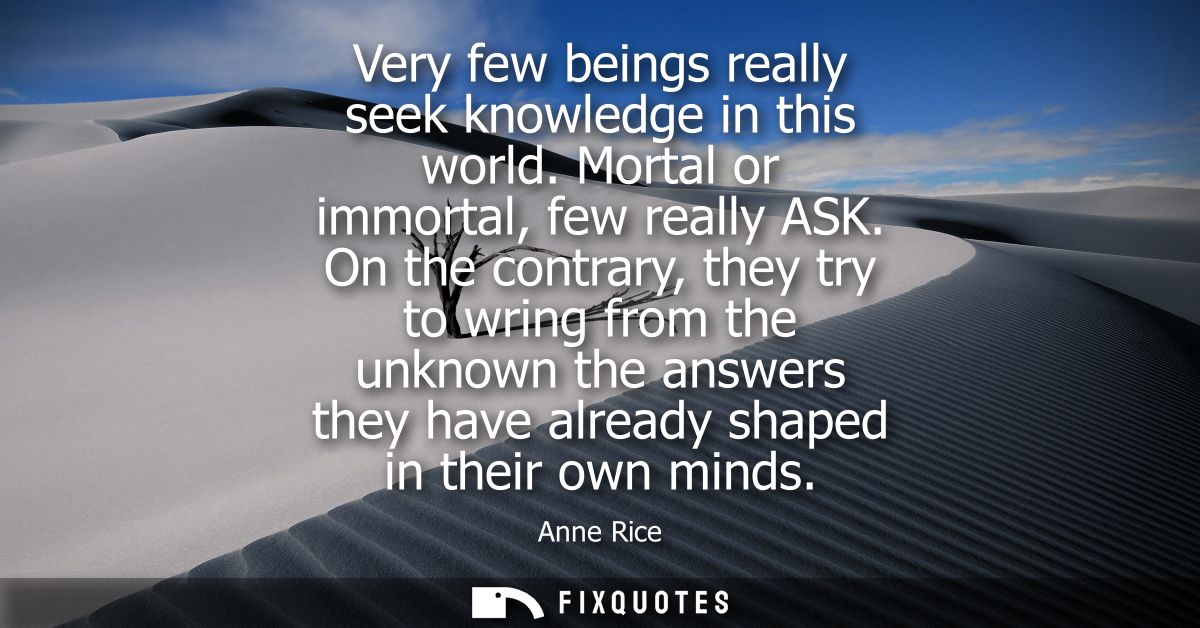
"Very few beings really seek knowledge in this world. Mortal or immortal, few really ASK. On the contrary, they try to wring from the unknown the answers they have already shaped in their own minds"
About this Quote
Rice also splits the audience into “mortal or immortal,” a wink to her vampire cosmology and a sly way of widening the charge sheet. Immortality, in her work, doesn’t automatically produce wisdom; it can just calcify appetite, ego, and narrative. The undead get centuries to ask bigger questions, yet often spend them perfecting a single story about themselves. That’s the subtext: the self is the real tyrant, and time doesn’t loosen its grip.
“Few really ASK” is staged like a spiritual test, not an academic one. Asking requires vulnerability; it means risking an answer that rearranges your identity. Rice’s characters, from Louis to Lestat, are forever bargaining with the unknown, demanding metaphysical clarity while protecting the conclusions they’ve “already shaped.” The line lands because it frames certainty as a kind of premeditation: you don’t discover meaning, you prosecute the universe until it agrees with you.
In the broader cultural context, it reads like a pre-social-media diagnosis of our feed-driven era, where curiosity is performative and questions are often just costumes for opinions. Rice’s intent isn’t to romanticize skepticism; it’s to shame the counterfeit version of it.
Quote Details
| Topic | Knowledge |
|---|---|
| Source | Help us find the source |
| Cite |
Citation Formats
APA Style (7th ed.)
Rice, Anne. (2026, January 15). Very few beings really seek knowledge in this world. Mortal or immortal, few really ASK. On the contrary, they try to wring from the unknown the answers they have already shaped in their own minds. FixQuotes. https://fixquotes.com/quotes/very-few-beings-really-seek-knowledge-in-this-110834/
Chicago Style
Rice, Anne. "Very few beings really seek knowledge in this world. Mortal or immortal, few really ASK. On the contrary, they try to wring from the unknown the answers they have already shaped in their own minds." FixQuotes. January 15, 2026. https://fixquotes.com/quotes/very-few-beings-really-seek-knowledge-in-this-110834/.
MLA Style (9th ed.)
"Very few beings really seek knowledge in this world. Mortal or immortal, few really ASK. On the contrary, they try to wring from the unknown the answers they have already shaped in their own minds." FixQuotes, 15 Jan. 2026, https://fixquotes.com/quotes/very-few-beings-really-seek-knowledge-in-this-110834/. Accessed 12 Feb. 2026.