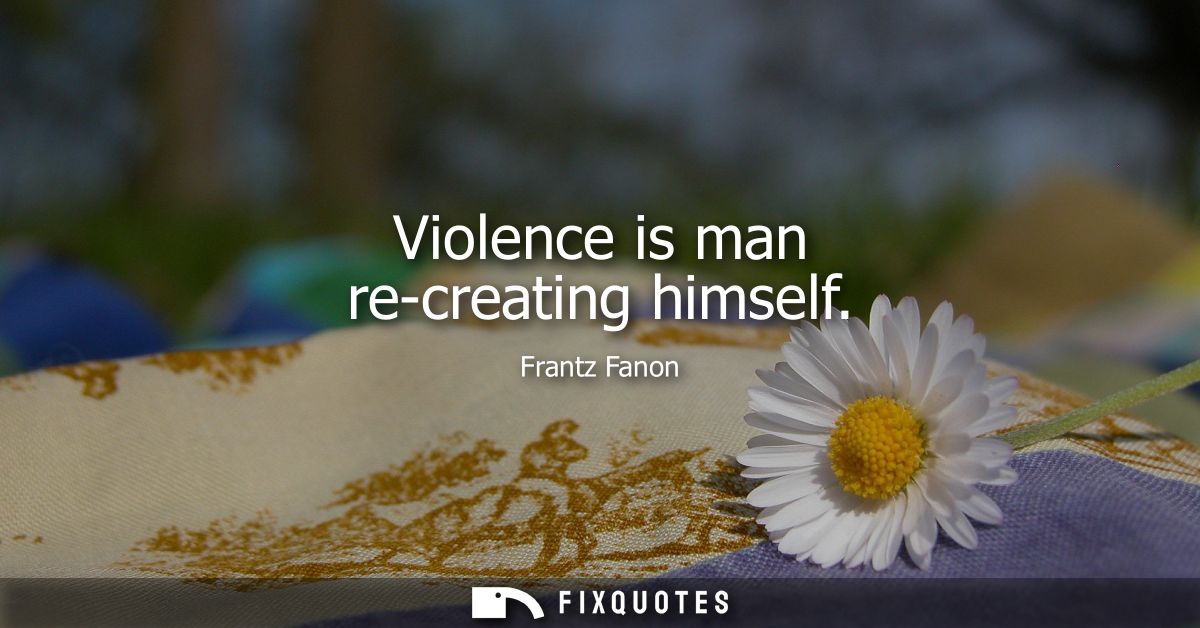
"Violence is man re-creating himself"
About this Quote
Fanon’s line lands like a punch because it refuses the comforting fiction that violence is only a breakdown of order. In the colonial world he dissected as a psychiatrist and revolutionary theorist, violence is also a grim kind of authorship: the dominated subject, reduced to a body to be managed, uses force to carve out a self that colonialism has systematically denied.
The phrase “re-creating himself” is doing heavy lifting. Fanon isn’t romanticizing bloodshed as “authentic.” He’s naming a psychological and social mechanism: when every peaceful avenue of recognition is blocked - political voice, economic dignity, even the right to be complex - violence can become the only available language that registers. It’s less a moral argument than a diagnostic one, written by someone who treated the psychic injuries of racism and occupation. His clinical background matters; he’s tracking how humiliation, fear, and enforced dependency don’t just harm individuals, they warp the entire emotional climate of a society. Violence, then, is not simply destructive. It can feel like a sudden restoration of agency, a brutal shortcut to selfhood.
The subtext is accusatory: if violence “re-creates” the colonized, it’s because colonial power first unmade them. Fanon’s context - French Algeria, torture, counterinsurgency, the daily theater of domination - makes the sentence both explanation and indictment. It also carries an implicit warning to liberal humanists: condemning violence in the abstract is easy; confronting the conditions that make it psychologically “creative” is the harder, more political task.
The phrase “re-creating himself” is doing heavy lifting. Fanon isn’t romanticizing bloodshed as “authentic.” He’s naming a psychological and social mechanism: when every peaceful avenue of recognition is blocked - political voice, economic dignity, even the right to be complex - violence can become the only available language that registers. It’s less a moral argument than a diagnostic one, written by someone who treated the psychic injuries of racism and occupation. His clinical background matters; he’s tracking how humiliation, fear, and enforced dependency don’t just harm individuals, they warp the entire emotional climate of a society. Violence, then, is not simply destructive. It can feel like a sudden restoration of agency, a brutal shortcut to selfhood.
The subtext is accusatory: if violence “re-creates” the colonized, it’s because colonial power first unmade them. Fanon’s context - French Algeria, torture, counterinsurgency, the daily theater of domination - makes the sentence both explanation and indictment. It also carries an implicit warning to liberal humanists: condemning violence in the abstract is easy; confronting the conditions that make it psychologically “creative” is the harder, more political task.
Quote Details
| Topic | Reinvention |
|---|---|
| Source | Later attribution: Encyclopedia of African American Politics (Robert C. Smith, 2003) modern compilationISBN: 9781438130194 · ID: Kb0sFxQ6yHoC
Evidence: ... Fanon published four books in his short life , including A Dying Colonialism , an account of the resistance of ... violence ” is man re - creating himself : “ The native cures himself through the force of arms . ” Fanon implies ... Other candidates (1) Preface to The Wretched of the Earth (Frantz Fanon, 1961)50.0% They would do well to read Fanon; for he shows clearly that this irrepressible violence is neither sound and fury, no... |
| Cite |
Citation Formats
APA Style (7th ed.)
Fanon, Frantz. (2026, February 9). Violence is man re-creating himself. FixQuotes. https://fixquotes.com/quotes/violence-is-man-re-creating-himself-154318/
Chicago Style
Fanon, Frantz. "Violence is man re-creating himself." FixQuotes. February 9, 2026. https://fixquotes.com/quotes/violence-is-man-re-creating-himself-154318/.
MLA Style (9th ed.)
"Violence is man re-creating himself." FixQuotes, 9 Feb. 2026, https://fixquotes.com/quotes/violence-is-man-re-creating-himself-154318/. Accessed 27 Mar. 2026.
More Quotes by Frantz
Add to List