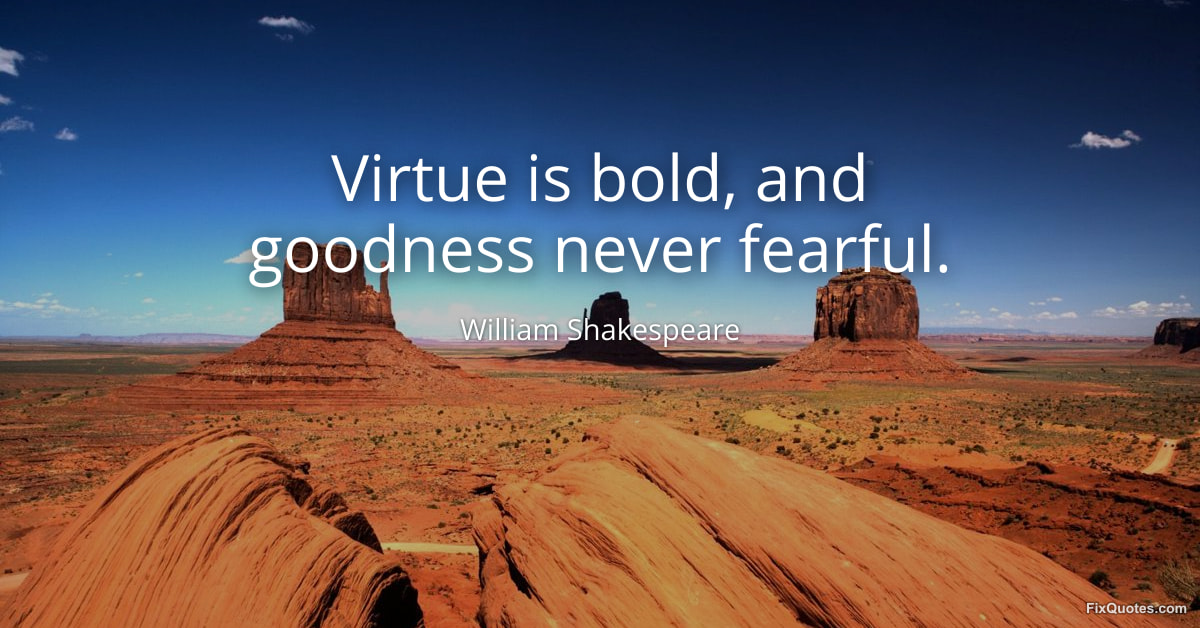
"Virtue is bold, and goodness never fearful"
About this Quote
“Virtue is bold, and goodness never fearful” lands like a stage direction for the conscience: stop flinching. Shakespeare isn’t praising swagger for its own sake; he’s dramatizing a moral psychology he returns to again and again. The innocent may tremble, but they don’t have to cower. Real virtue, in his world, carries itself with a kind of plain nerve because it isn’t busy managing lies.
The line works because it weaponizes a familiar human tell: guilt is jumpy. Shakespeare’s villains are perpetually improvising alibis, hyper-alert to the consequences of their own schemes. Their fear isn’t sensitivity; it’s exposure. By contrast, “goodness” here is less about sanctimony than coherence. When your inner story matches your outer behavior, you can afford steadiness. Boldness becomes a moral byproduct, not a personality brand.
There’s also a shrewd social subtext. Early modern life ran on hierarchy, rumor, and public judgment; reputations were fragile and authority could be arbitrary. In that climate, being “good” is not a soft posture. It’s a risky public stance, a refusal to be bullied into silence by the threat of suspicion. Shakespeare, ever the dramatist of appearances, suggests that fearlessness isn’t the absence of danger but the refusal to let danger dictate your character.
Read onstage, it’s a provocation: if you’re afraid, ask what you’re protecting. If you’re good, stand where everyone can see you.
The line works because it weaponizes a familiar human tell: guilt is jumpy. Shakespeare’s villains are perpetually improvising alibis, hyper-alert to the consequences of their own schemes. Their fear isn’t sensitivity; it’s exposure. By contrast, “goodness” here is less about sanctimony than coherence. When your inner story matches your outer behavior, you can afford steadiness. Boldness becomes a moral byproduct, not a personality brand.
There’s also a shrewd social subtext. Early modern life ran on hierarchy, rumor, and public judgment; reputations were fragile and authority could be arbitrary. In that climate, being “good” is not a soft posture. It’s a risky public stance, a refusal to be bullied into silence by the threat of suspicion. Shakespeare, ever the dramatist of appearances, suggests that fearlessness isn’t the absence of danger but the refusal to let danger dictate your character.
Read onstage, it’s a provocation: if you’re afraid, ask what you’re protecting. If you’re good, stand where everyone can see you.
Quote Details
| Topic | Ethics & Morality |
|---|---|
| Source | Verified source: Mr. William Shakespeares Comedies, Histories, & Tragedies (William Shakespeare, 1623)
Evidence: Vertue is bold, and goodnes neuer fearefull: (Measure for Measure, Actus Tertius (Act 3), Scaena Prima (Scene 1)). This line is spoken by Duke Vincentio (disguised as a friar) in Measure for Measure, Act 3, Scene 1. The earliest *printed* primary source for the play text is the 1623 First Folio (often treated as the first publication of many Shakespeare plays in a collected, authorized form). Modernized spelling yields: “Virtue is bold, and goodness never fearful.” Note: Shakespeare’s plays were frequently performed years before they were printed; Measure for Measure is commonly dated to the early 1600s (often 1603–1604), but the first *publication* of this wording in a primary Shakespeare source is the First Folio printing. Other candidates (1) The Works of William Shakespeare (William Shakespeare, 1883) compilation95.0% William Shakespeare. judgment with the disposition of natures : she , having the truth of honour in her , hath made .... |
| Cite |
Citation Formats
APA Style (7th ed.)
Shakespeare, William. (2026, February 27). Virtue is bold, and goodness never fearful. FixQuotes. https://fixquotes.com/quotes/virtue-is-bold-and-goodness-never-fearful-27604/
Chicago Style
Shakespeare, William. "Virtue is bold, and goodness never fearful." FixQuotes. February 27, 2026. https://fixquotes.com/quotes/virtue-is-bold-and-goodness-never-fearful-27604/.
MLA Style (9th ed.)
"Virtue is bold, and goodness never fearful." FixQuotes, 27 Feb. 2026, https://fixquotes.com/quotes/virtue-is-bold-and-goodness-never-fearful-27604/. Accessed 24 Mar. 2026.
More Quotes by William
Add to List