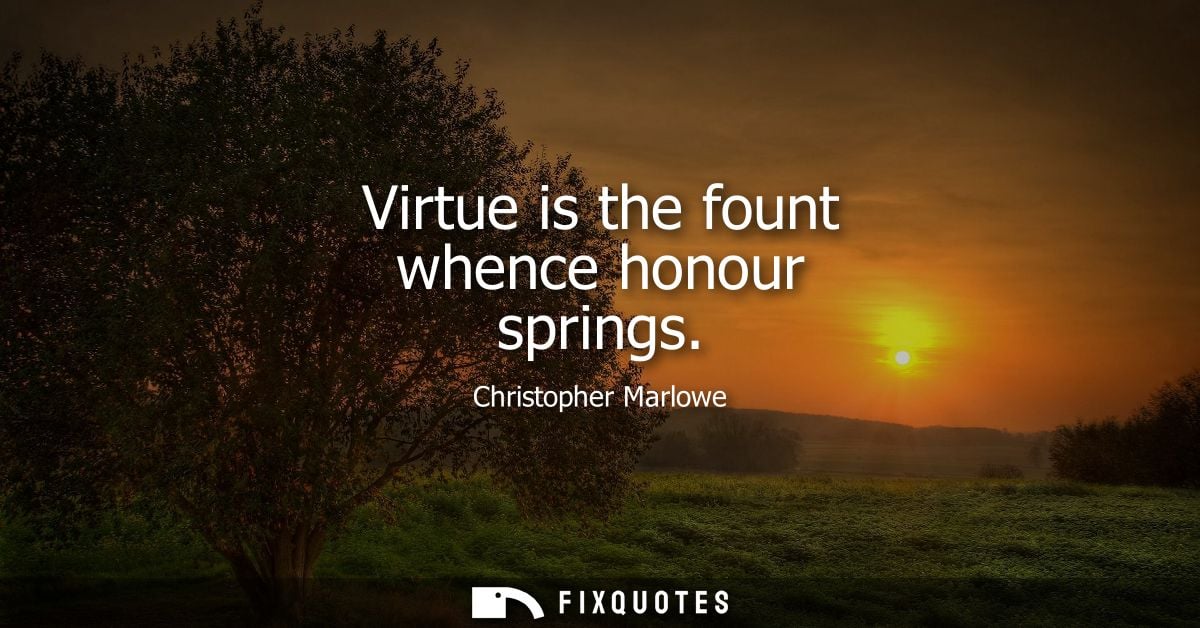
"Virtue is the fount whence honour springs"
About this Quote
A tidy moral equation like this is exactly the sort of line that can sound like a sermon while smuggling in a provocation. Marlowe’s “Virtue is the fount whence honour springs” carries the sheen of Renaissance civics: behave well, and reputation will follow. But in a Marlowe world, “honour” is rarely a clean reward. It’s a currency, a costume, a public performance that can be bought, staged, or stolen. Calling virtue the “fount” doesn’t just praise goodness; it stakes a claim about legitimacy. True honour, the line insists, isn’t inherited, announced, or enforced by rank. It has to be generated.
That’s the subtextual knife: in an era obsessed with bloodlines, patronage, and courtly appearances, linking honour to virtue quietly de-centers aristocratic entitlement. It’s a flattering premise for audiences who want to believe in merit, and a threatening one for institutions that trade on status. Marlowe, a dramatist who loved ambition and transgression, understands how often honour is invoked to launder violence or ambition. By rooting it in virtue, he sets a standard that exposes hypocrisy: if your honour doesn’t “spring” from ethical conduct, it’s just noise.
The metaphor does extra work. A “fount” suggests a continuous source, not a one-time act. Virtue isn’t a dramatic gesture; it’s a sustaining discipline. In the theater, that’s dynamite. It invites the audience to measure characters not by their claims of honour but by the moral engine underneath - and to notice, uncomfortably, how often the springs run dry.
That’s the subtextual knife: in an era obsessed with bloodlines, patronage, and courtly appearances, linking honour to virtue quietly de-centers aristocratic entitlement. It’s a flattering premise for audiences who want to believe in merit, and a threatening one for institutions that trade on status. Marlowe, a dramatist who loved ambition and transgression, understands how often honour is invoked to launder violence or ambition. By rooting it in virtue, he sets a standard that exposes hypocrisy: if your honour doesn’t “spring” from ethical conduct, it’s just noise.
The metaphor does extra work. A “fount” suggests a continuous source, not a one-time act. Virtue isn’t a dramatic gesture; it’s a sustaining discipline. In the theater, that’s dynamite. It invites the audience to measure characters not by their claims of honour but by the moral engine underneath - and to notice, uncomfortably, how often the springs run dry.
Quote Details
| Topic | Ethics & Morality |
|---|---|
| Source | Help us find the source |
| Cite |
Citation Formats
APA Style (7th ed.)
Marlowe, Christopher. (2026, January 15). Virtue is the fount whence honour springs. FixQuotes. https://fixquotes.com/quotes/virtue-is-the-fount-whence-honour-springs-27635/
Chicago Style
Marlowe, Christopher. "Virtue is the fount whence honour springs." FixQuotes. January 15, 2026. https://fixquotes.com/quotes/virtue-is-the-fount-whence-honour-springs-27635/.
MLA Style (9th ed.)
"Virtue is the fount whence honour springs." FixQuotes, 15 Jan. 2026, https://fixquotes.com/quotes/virtue-is-the-fount-whence-honour-springs-27635/. Accessed 10 Feb. 2026.
More Quotes by Christopher
Add to List