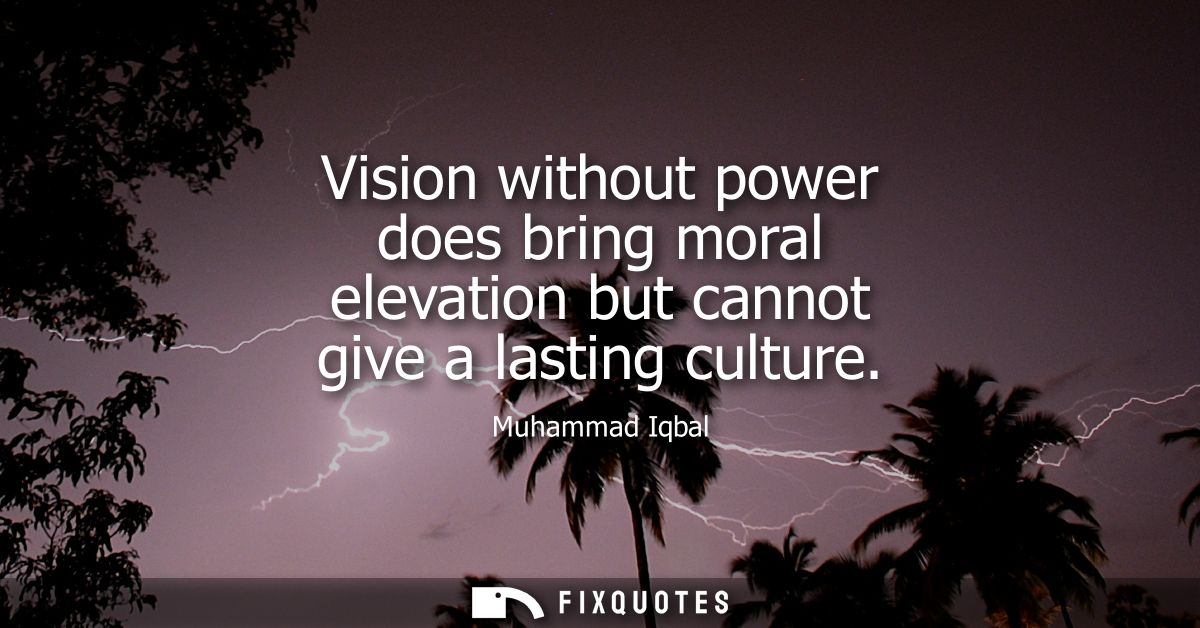
"Vision without power does bring moral elevation, but cannot give a lasting culture"
About this Quote
The subtext is pointed toward colonized and politically disempowered Muslims in British India: a community rich in spiritual and intellectual tradition, yet structurally outmaneuvered. Iqbal is skeptical of a purely aesthetic or pietistic renaissance that remains dependent on the goodwill of others. Without some form of collective agency, “vision” risks becoming a consolation prize - beautiful poetry, elevated ethics, and inspiring sermons that never translate into durable public life.
The phrasing does quiet rhetorical work. “Does bring” concedes real value; he isn’t mocking idealism. Then “cannot give” draws a hard boundary: moral improvement is portable, culture is territorial. Lasting culture requires continuity, and continuity requires power - not just coercion, but organizing capacity, economic strength, political leverage, and self-confidence at scale.
Coming from a poet, the claim is also a self-indictment: art can awaken, but it cannot, by itself, build the conditions that keep awakening from fading. Iqbal’s intent is to push his audience from reverence to responsibility, from inward uplift to outward force.
Quote Details
| Topic | Vision & Strategy |
|---|---|
| Source | Verified source: The Reconstruction of Religious Thought in Islam (Muhammad Iqbal, 1930)
Evidence: Vision without power does bring moral elevation but cannot give a lasting culture. Power without vision tends to become destructive and inhuman. Both must combine for the spiritual expansion of humanity. (Lecture 3 / Chapter 3: "The Conception of God and the Meaning of Prayer" (page varies by edition)). This sentence appears in Iqbal’s own English prose in Lecture/Chapter 3 of The Reconstruction of Religious Thought in Islam. The work is commonly described as a compilation of lectures published in 1930; later editions exist (e.g., an Oxford edition in 1934) with differing pagination, so an exact page number depends on which printing you are verifying against. The web text above reproduces the passage in the middle of Lecture 3. Other candidates (1) Muhammad ﷺ Encyclopædia of Seerah (Afzalur Rahman, 1989) compilation95.0% ... Muhammad Iqbal seems to make the same point in these words: "Vision without power does bring moral elevation but ... |
| Cite |
Citation Formats
APA Style (7th ed.)
Iqbal, Muhammad. (2026, February 16). Vision without power does bring moral elevation, but cannot give a lasting culture. FixQuotes. https://fixquotes.com/quotes/vision-without-power-does-bring-moral-elevation-169052/
Chicago Style
Iqbal, Muhammad. "Vision without power does bring moral elevation, but cannot give a lasting culture." FixQuotes. February 16, 2026. https://fixquotes.com/quotes/vision-without-power-does-bring-moral-elevation-169052/.
MLA Style (9th ed.)
"Vision without power does bring moral elevation, but cannot give a lasting culture." FixQuotes, 16 Feb. 2026, https://fixquotes.com/quotes/vision-without-power-does-bring-moral-elevation-169052/. Accessed 25 Mar. 2026.