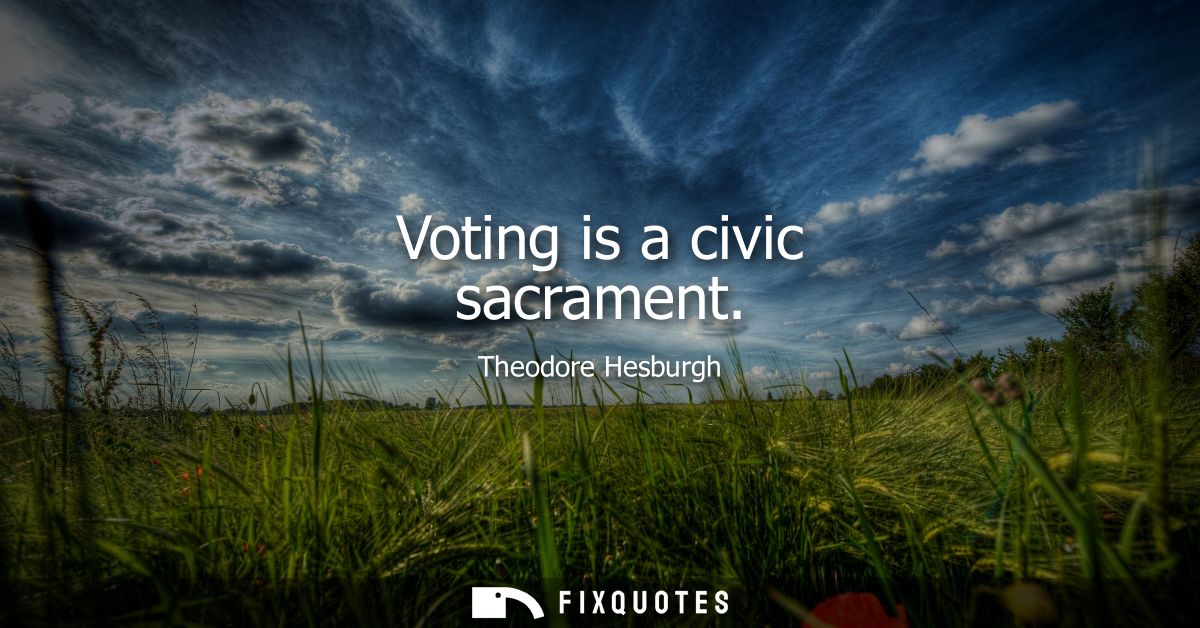
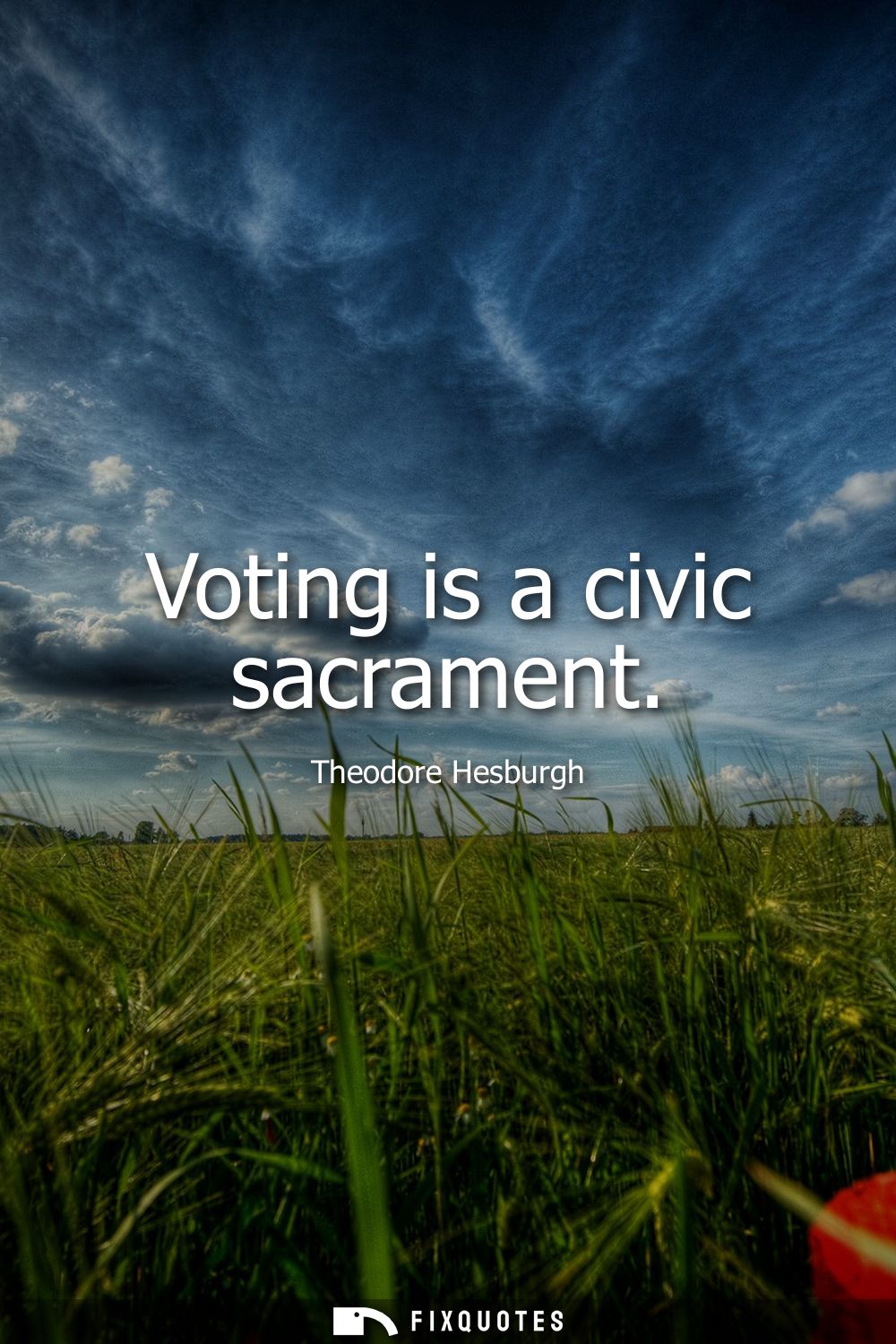
"Voting is a civic sacrament"
About this Quote
Calling voting a "civic sacrament" is a deliberate act of translation: Hesburgh pulls a practice from the sanctuary and plants it in the voting booth, insisting that democracy isn’t just procedure but moral obligation. A sacrament is outward ritual with inward consequence, something you do with your body to mark what you believe with your soul. By borrowing that word, he elevates the mundane mechanics of casting a ballot into a form of public witnessing.
The intent is both exhortation and rebuke. Exhortation, because sacramental language dignifies participation: voting becomes a shared rite that binds strangers into a community with duties, not just preferences. Rebuke, because sacramental language also implies sin and neglect. If voting is sacred, then apathy isn’t merely laziness; it’s a kind of civic refusal, a failure to show up for the common good.
The subtext carries a sharp edge about legitimacy and inclusion. Sacraments presume access; you don’t build them around barriers. Hesburgh, a prominent Catholic priest and longtime public intellectual who served on the U.S. Civil Rights Commission, was steeped in the mid-20th-century fight over whose citizenship counted in practice. In that context, the phrase quietly condemns voter suppression and disenfranchisement as profanations of a shared ritual.
It also works rhetorically because it bridges two American vocabularies that often compete: faith and democracy. Hesburgh doesn’t ask the religious to retreat from politics or the secular to accept theology. He offers a civic religion without dogma, a reverence for participation that treats the ballot as a moral instrument, not a consumer choice.
The intent is both exhortation and rebuke. Exhortation, because sacramental language dignifies participation: voting becomes a shared rite that binds strangers into a community with duties, not just preferences. Rebuke, because sacramental language also implies sin and neglect. If voting is sacred, then apathy isn’t merely laziness; it’s a kind of civic refusal, a failure to show up for the common good.
The subtext carries a sharp edge about legitimacy and inclusion. Sacraments presume access; you don’t build them around barriers. Hesburgh, a prominent Catholic priest and longtime public intellectual who served on the U.S. Civil Rights Commission, was steeped in the mid-20th-century fight over whose citizenship counted in practice. In that context, the phrase quietly condemns voter suppression and disenfranchisement as profanations of a shared ritual.
It also works rhetorically because it bridges two American vocabularies that often compete: faith and democracy. Hesburgh doesn’t ask the religious to retreat from politics or the secular to accept theology. He offers a civic religion without dogma, a reverence for participation that treats the ballot as a moral instrument, not a consumer choice.
Quote Details
| Topic | Freedom |
|---|---|
| Source | Help us find the source |
| Cite |
Citation Formats
APA Style (7th ed.)
Hesburgh, Theodore. (2026, January 15). Voting is a civic sacrament. FixQuotes. https://fixquotes.com/quotes/voting-is-a-civic-sacrament-152604/
Chicago Style
Hesburgh, Theodore. "Voting is a civic sacrament." FixQuotes. January 15, 2026. https://fixquotes.com/quotes/voting-is-a-civic-sacrament-152604/.
MLA Style (9th ed.)
"Voting is a civic sacrament." FixQuotes, 15 Jan. 2026, https://fixquotes.com/quotes/voting-is-a-civic-sacrament-152604/. Accessed 5 Mar. 2026.
More Quotes by Theodore
Add to List