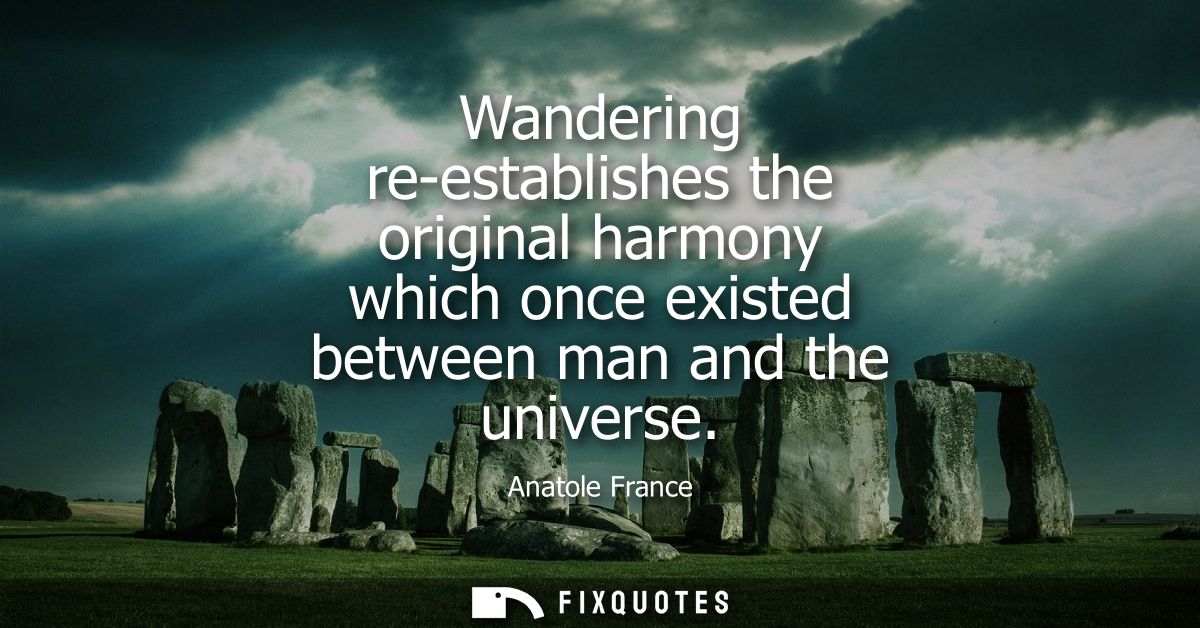
"Wandering re-establishes the original harmony which once existed between man and the universe"
About this Quote
Wandering is not escape but an art of attention. Leaving the straight lines of schedules and objectives lets the world re-enter through unguarded senses. By moving without an agenda, a person begins to recover an older accord with the living world. Before clocks and timetables, orientation came from sun and wind, from the slope of a path and the smell of rain. The body once knew how to read that text. Wandering restores that literacy.
Anatole France, a skeptical humanist of the fin-de-siecle, loved the free play of mind and the gentle irony of stepping aside from grand systems. His era brimmed with industrial confidence and tight social roles; he answered with the flaneur’s drift, the humble perambulation that listens rather than conquers. The harmony he invokes is not a mystical erasure of the self but a tuning of rhythms: breath with breeze, stride with terrain, attention with the unplanned appearance of a bird or a doorway or a drifting cloud. It is a way of being that asks less what the world can yield and more how to meet it without grasping.
Travel with plans consumes; wandering receives. One collects fewer destinations and more moments of alignment. A bend in the road becomes a teacher. Silence becomes speech. The world ceases to be background and becomes partner, not a thing to be solved but a presence to join. Such harmony depends on humility. When nothing is demanded, everything can arrive.
There is also a moral undercurrent. To wander is to loosen the grip of mastery and utility, to dwell lightly in places and accept their terms. It is a tiny revolt against the habit of turning life into a ledger. Step by step, the noise inside quiets until the outer world is heard again, and with it the sense that belonging is not granted by ownership or control, but by moving through the universe as if it were home.
Anatole France, a skeptical humanist of the fin-de-siecle, loved the free play of mind and the gentle irony of stepping aside from grand systems. His era brimmed with industrial confidence and tight social roles; he answered with the flaneur’s drift, the humble perambulation that listens rather than conquers. The harmony he invokes is not a mystical erasure of the self but a tuning of rhythms: breath with breeze, stride with terrain, attention with the unplanned appearance of a bird or a doorway or a drifting cloud. It is a way of being that asks less what the world can yield and more how to meet it without grasping.
Travel with plans consumes; wandering receives. One collects fewer destinations and more moments of alignment. A bend in the road becomes a teacher. Silence becomes speech. The world ceases to be background and becomes partner, not a thing to be solved but a presence to join. Such harmony depends on humility. When nothing is demanded, everything can arrive.
There is also a moral undercurrent. To wander is to loosen the grip of mastery and utility, to dwell lightly in places and accept their terms. It is a tiny revolt against the habit of turning life into a ledger. Step by step, the noise inside quiets until the outer world is heard again, and with it the sense that belonging is not granted by ownership or control, but by moving through the universe as if it were home.
Quote Details
| Topic | Wanderlust |
|---|
More Quotes by Anatole
Add to List