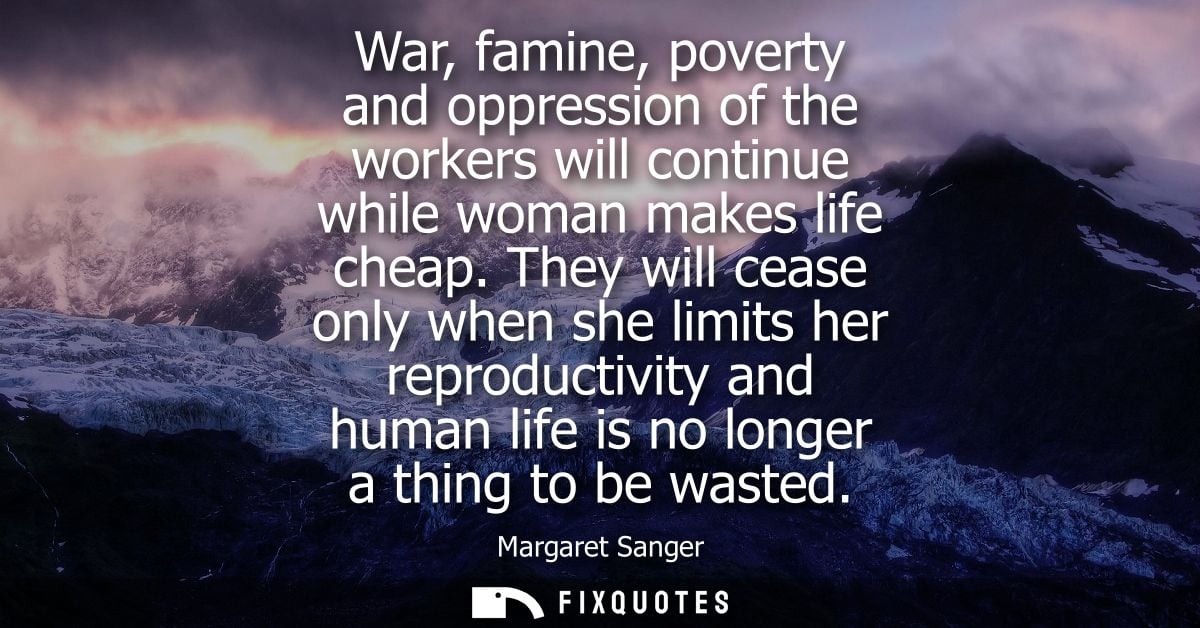
"War, famine, poverty and oppression of the workers will continue while woman makes life cheap. They will cease only when she limits her reproductivity and human life is no longer a thing to be wasted"
About this Quote
Sanger isn’t pleading for compassion here; she’s issuing an indictment. The provocation is in the phrase “woman makes life cheap,” which lands like blame until you register her target: a social order that treats women’s bodies as an unpaid factory for replacing labor and supplying cannon fodder. By yoking “war” to “reproductivity,” she frames mass suffering not as a tragic accident but as an economic and political business model sustained by compulsory motherhood.
The line works because it weaponizes moral language. “Cheap” and “wasted” are market terms masquerading as ethics, a deliberate inversion that exposes how easily human beings become inputs when births are abundant and women are denied control. The subtext isn’t anti-life; it’s anti-expendability. If life is endlessly reproducible, institutions can spend it casually: armies can draft, factories can grind, landlords can squeeze. Limiting birth, in Sanger’s calculus, raises the “price” of life by making every person harder to replace and therefore harder to sacrifice.
Context matters, because Sanger wrote in an era when contraception was criminalized, childbirth was dangerous, and working-class women bore the brunt of both. Her rhetoric is also a time capsule of early 20th-century reform’s sharp edges: it courts scandal, and it sits uncomfortably close to the period’s coercive currents, including eugenic thinking that often piggybacked on the language of “improvement.” Still, the intent is clear: reproductive autonomy as leverage against systems that thrive on surplus people and women with no exit.
The line works because it weaponizes moral language. “Cheap” and “wasted” are market terms masquerading as ethics, a deliberate inversion that exposes how easily human beings become inputs when births are abundant and women are denied control. The subtext isn’t anti-life; it’s anti-expendability. If life is endlessly reproducible, institutions can spend it casually: armies can draft, factories can grind, landlords can squeeze. Limiting birth, in Sanger’s calculus, raises the “price” of life by making every person harder to replace and therefore harder to sacrifice.
Context matters, because Sanger wrote in an era when contraception was criminalized, childbirth was dangerous, and working-class women bore the brunt of both. Her rhetoric is also a time capsule of early 20th-century reform’s sharp edges: it courts scandal, and it sits uncomfortably close to the period’s coercive currents, including eugenic thinking that often piggybacked on the language of “improvement.” Still, the intent is clear: reproductive autonomy as leverage against systems that thrive on surplus people and women with no exit.
Quote Details
| Topic | Human Rights |
|---|
More Quotes by Margaret
Add to List