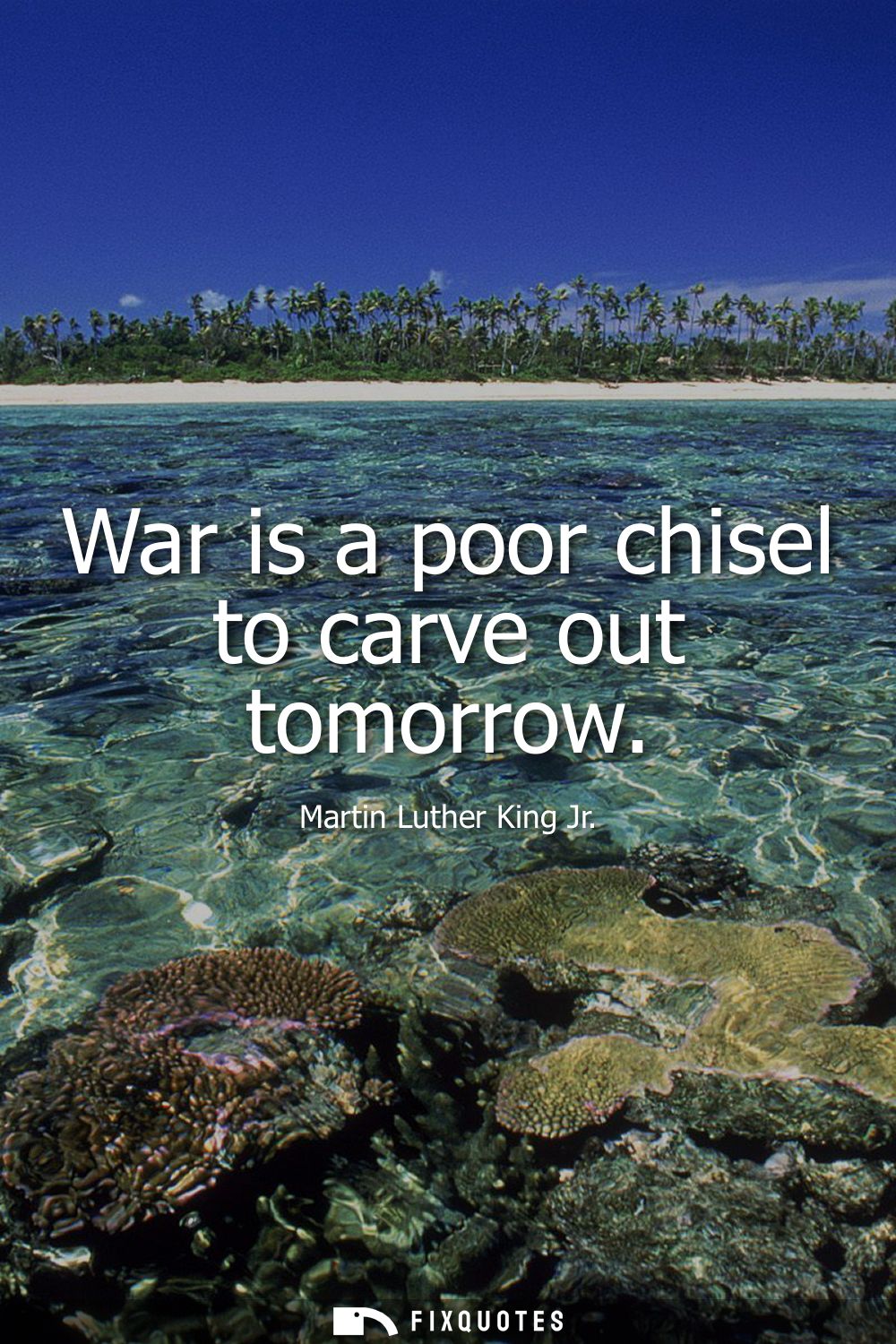
"War is a poor chisel to carve out tomorrow"
About this Quote
War, King implies, is not just immoral; it is inept. The line lands because it rejects the usual wartime sales pitch that violence is “necessary” or “productive,” then replaces it with a metaphor that makes that claim look embarrassingly crude. A chisel is supposed to shape with control and intention. Call war a “poor chisel” and you’ve already conceded what hawks often dodge: even when it “works,” it works by smashing, not by building. The future you get is jagged, accidental, and soaked in collateral damage.
The verb choice does more than moralize. “Carve” suggests artistry, patience, and long planning - the opposite of war’s blunt time horizon. King is arguing about means and ends as a single ethical system: the tool you choose determines the shape of the outcome. If you reach for violence to create “tomorrow,” tomorrow will inherit violence’s logic: domination, fear, and the habit of treating people as material.
Context sharpens the intent. By the mid-1960s, King had moved from a narrowly framed civil-rights campaign into a critique of American militarism, especially Vietnam, where promises of security and freedom translated into body counts and broken communities. As a minister, King’s authority isn’t technocratic; it’s prophetic. He’s calling out a nation that wants redemption without repentance - trying to hammer a moral future out of the same metal that made the present unbearable. The line’s quiet power is that it doesn’t need to shout. It just makes war sound like what it is: a tool no serious builder would trust.
The verb choice does more than moralize. “Carve” suggests artistry, patience, and long planning - the opposite of war’s blunt time horizon. King is arguing about means and ends as a single ethical system: the tool you choose determines the shape of the outcome. If you reach for violence to create “tomorrow,” tomorrow will inherit violence’s logic: domination, fear, and the habit of treating people as material.
Context sharpens the intent. By the mid-1960s, King had moved from a narrowly framed civil-rights campaign into a critique of American militarism, especially Vietnam, where promises of security and freedom translated into body counts and broken communities. As a minister, King’s authority isn’t technocratic; it’s prophetic. He’s calling out a nation that wants redemption without repentance - trying to hammer a moral future out of the same metal that made the present unbearable. The line’s quiet power is that it doesn’t need to shout. It just makes war sound like what it is: a tool no serious builder would trust.
Quote Details
| Topic | War |
|---|---|
| Source | Martin Luther King Jr., "Beyond Vietnam — A Time to Break Silence" (Riverside Church, New York, April 4, 1967). Transcript contains the line often rendered as "Wars are poor chisels for carving out peaceful tomorrows." |
| Cite |
Citation Formats
APA Style (7th ed.)
Jr., Martin Luther King. (2026, January 17). War is a poor chisel to carve out tomorrow. FixQuotes. https://fixquotes.com/quotes/war-is-a-poor-chisel-to-carve-out-tomorrow-32888/
Chicago Style
Jr., Martin Luther King. "War is a poor chisel to carve out tomorrow." FixQuotes. January 17, 2026. https://fixquotes.com/quotes/war-is-a-poor-chisel-to-carve-out-tomorrow-32888/.
MLA Style (9th ed.)
"War is a poor chisel to carve out tomorrow." FixQuotes, 17 Jan. 2026, https://fixquotes.com/quotes/war-is-a-poor-chisel-to-carve-out-tomorrow-32888/. Accessed 5 Apr. 2026.
More Quotes by Martin
Add to List