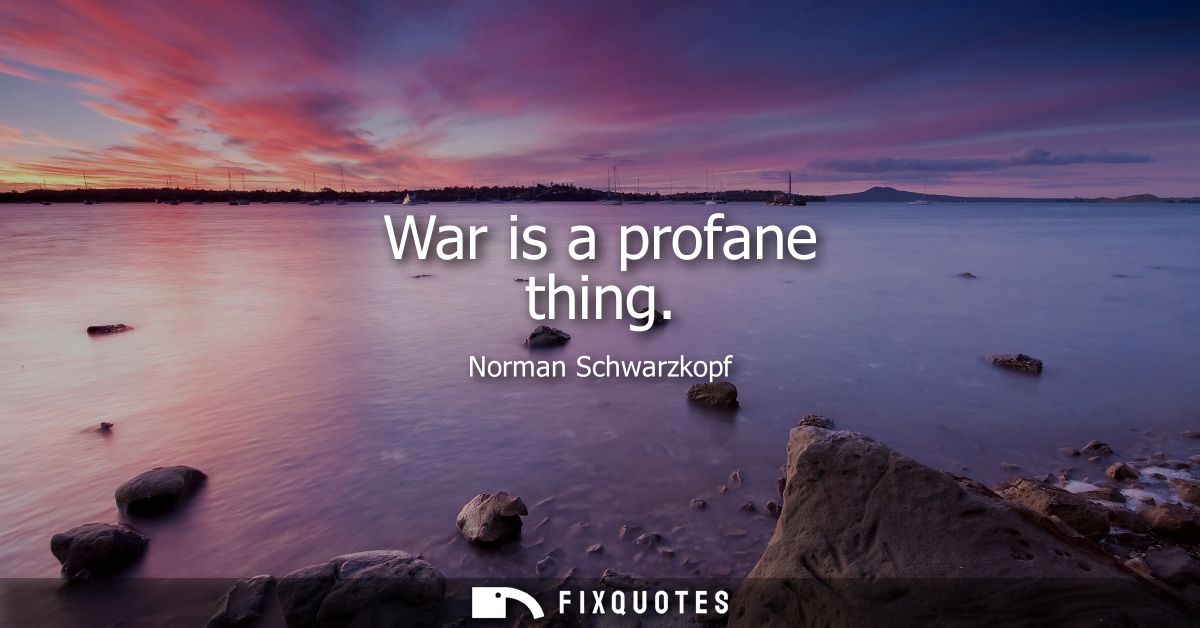
"War is a profane thing"
About this Quote
Calling war "profane" is a calculated choice from a career soldier: it refuses the comforting euphemisms that usually wrap conflict in nobility. Norman Schwarzkopf isn’t saying war is merely tragic or costly; he’s invoking a moral category that sits adjacent to the sacred. Profanity defiles. It dirties what people want kept clean: national ideals, religious language, the notion that violence can be sterilized into a “mission” or a “campaign.” Coming from the commander most identified with the Gulf War’s televised precision, the line punctures the very aesthetic that made that conflict feel orderly to the public.
The intent is double-edged. It functions as a warning against romanticizing the battlefield, but it also protects the profession of soldiering by separating the fighter from the thing fought. If war is profane, then the soldier can be framed as someone enduring contamination on behalf of others, not someone celebrating it. That’s a powerful subtext for a military leader speaking to civilians: don’t turn this into entertainment, don’t ask for myth, don’t confuse competence with purity.
Context matters because Schwarzkopf’s era sat between Vietnam’s corrosive distrust and post-9/11 militarized sentimentality. His bluntness reads like an attempt to keep moral accounting intact amid spectacle and slogans. The phrase is short enough to be quotable, severe enough to land, and vague enough to travel across political camps: anti-war critics hear condemnation; hawks hear realism. That ambiguity is the point. It leaves no room for the fantasy that war can be anything other than a sanctioned violation.
The intent is double-edged. It functions as a warning against romanticizing the battlefield, but it also protects the profession of soldiering by separating the fighter from the thing fought. If war is profane, then the soldier can be framed as someone enduring contamination on behalf of others, not someone celebrating it. That’s a powerful subtext for a military leader speaking to civilians: don’t turn this into entertainment, don’t ask for myth, don’t confuse competence with purity.
Context matters because Schwarzkopf’s era sat between Vietnam’s corrosive distrust and post-9/11 militarized sentimentality. His bluntness reads like an attempt to keep moral accounting intact amid spectacle and slogans. The phrase is short enough to be quotable, severe enough to land, and vague enough to travel across political camps: anti-war critics hear condemnation; hawks hear realism. That ambiguity is the point. It leaves no room for the fantasy that war can be anything other than a sanctioned violation.
Quote Details
| Topic | War |
|---|---|
| Source | Help us find the source |
| Cite |
Citation Formats
APA Style (7th ed.)
Schwarzkopf, Norman. (2026, January 16). War is a profane thing. FixQuotes. https://fixquotes.com/quotes/war-is-a-profane-thing-116542/
Chicago Style
Schwarzkopf, Norman. "War is a profane thing." FixQuotes. January 16, 2026. https://fixquotes.com/quotes/war-is-a-profane-thing-116542/.
MLA Style (9th ed.)
"War is a profane thing." FixQuotes, 16 Jan. 2026, https://fixquotes.com/quotes/war-is-a-profane-thing-116542/. Accessed 28 Mar. 2026.
More Quotes by Norman
Add to List