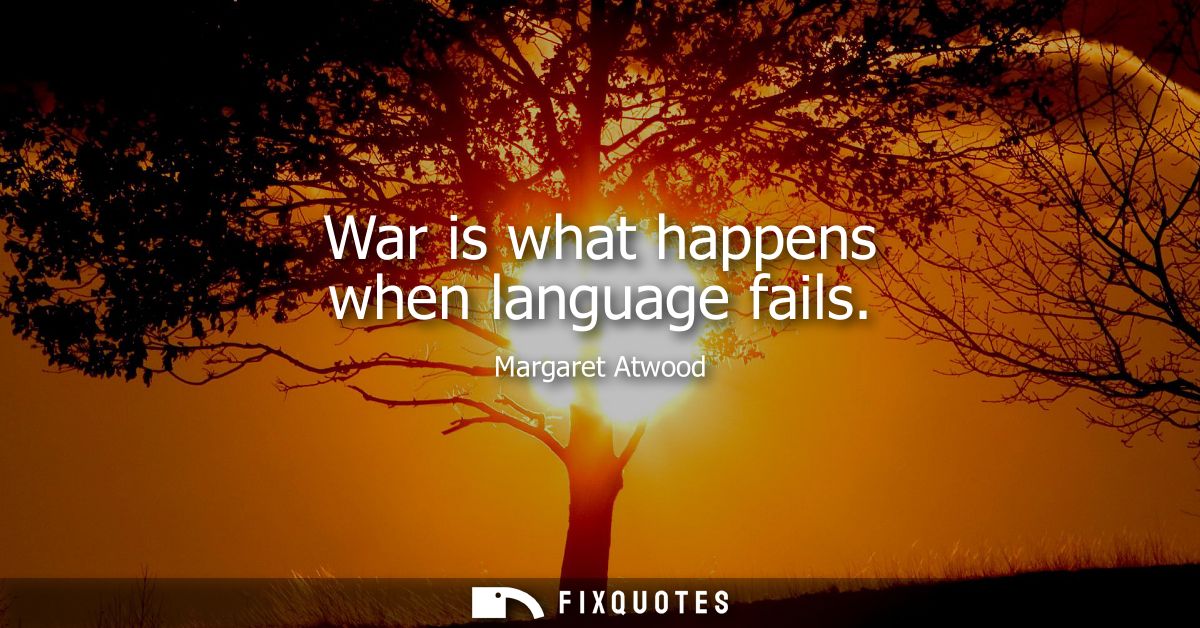
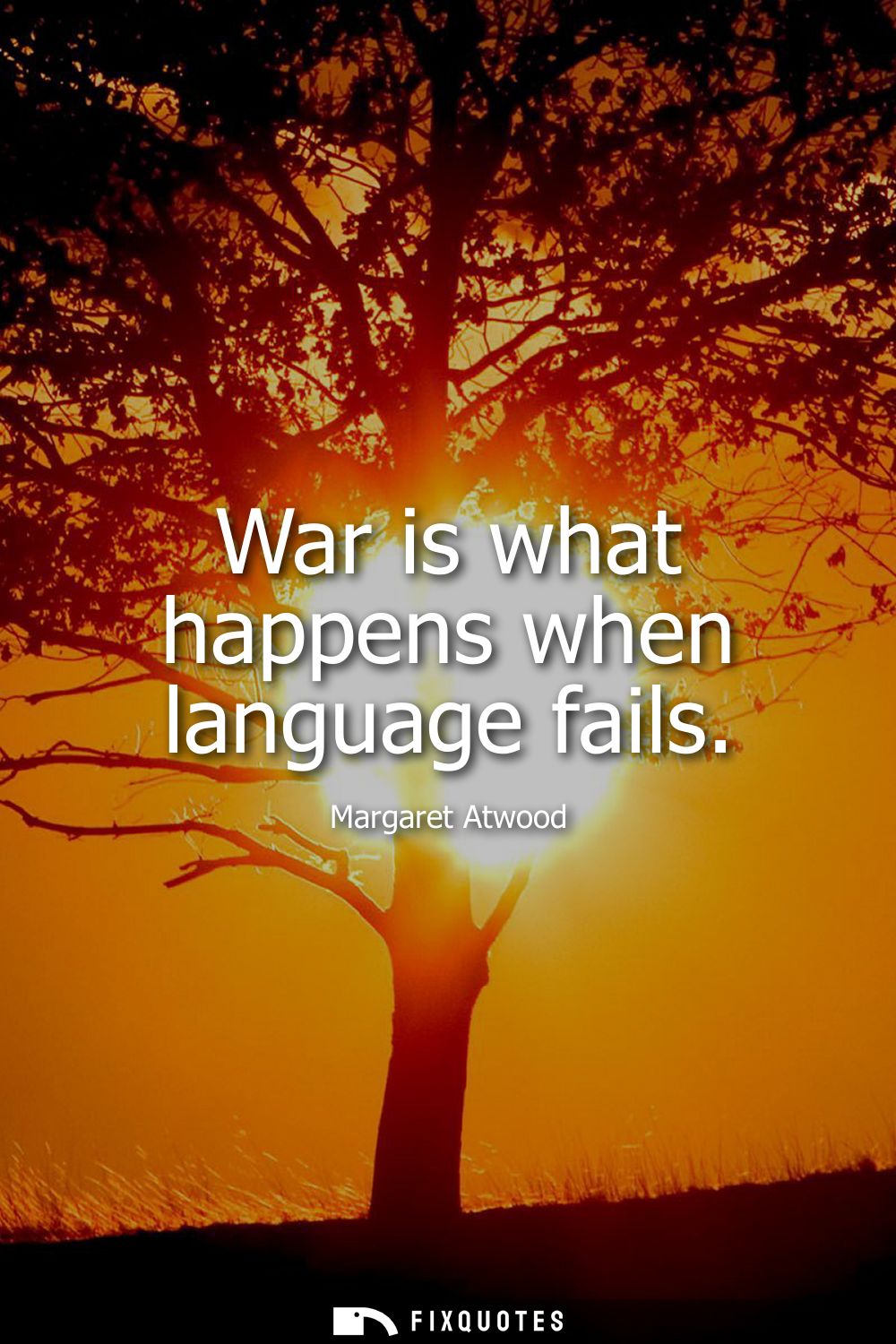
"War is what happens when language fails"
About this Quote
Atwood’s line is a deceptively tidy indictment: war isn’t framed as destiny or “human nature,” but as a bureaucratic outcome of botched communication. The phrase “what happens” makes it sound almost procedural, like a system defaulting to violence when its primary interface breaks. That’s the bite. She’s not romanticizing conflict; she’s demoting it to a failure mode.
The key move is her choice of “language,” not “diplomacy” or “negotiation.” Language is bigger and messier: it includes propaganda, euphemism, official lies, and the private vocabulary people use to justify harm. In Atwood’s world, words don’t just describe reality; they manufacture consent, launder brutality, and teach us which lives count. So “language fails” doesn’t only mean leaders can’t reach an agreement. It also means language is deliberately sabotaged: truth flattened into slogans, complexity reduced to tribal shibboleths, adversaries turned into vermin. Once you can’t name the other side as fully human, bullets become grammatically easy.
As a novelist, Atwood is also quietly defending her craft. Fiction is a laboratory for empathy, perspective, and moral imagination; it keeps language elastic enough to hold contradiction. The subtext is almost accusatory: if war is the endpoint, then the breakdown began earlier, in classrooms, newsrooms, parliaments, and living rooms where people stopped listening and started rehearsing.
It lands because it refuses heroics. War is not a grand narrative. It’s what you get when the story collapses.
The key move is her choice of “language,” not “diplomacy” or “negotiation.” Language is bigger and messier: it includes propaganda, euphemism, official lies, and the private vocabulary people use to justify harm. In Atwood’s world, words don’t just describe reality; they manufacture consent, launder brutality, and teach us which lives count. So “language fails” doesn’t only mean leaders can’t reach an agreement. It also means language is deliberately sabotaged: truth flattened into slogans, complexity reduced to tribal shibboleths, adversaries turned into vermin. Once you can’t name the other side as fully human, bullets become grammatically easy.
As a novelist, Atwood is also quietly defending her craft. Fiction is a laboratory for empathy, perspective, and moral imagination; it keeps language elastic enough to hold contradiction. The subtext is almost accusatory: if war is the endpoint, then the breakdown began earlier, in classrooms, newsrooms, parliaments, and living rooms where people stopped listening and started rehearsing.
It lands because it refuses heroics. War is not a grand narrative. It’s what you get when the story collapses.
Quote Details
| Topic | War |
|---|---|
| Source | Later attribution: New York Magazine (1993) modern compilation
Evidence: ... Margaret Atwood. Doubleday; 466 pages; $23.50. A GLAMOROUS, DOUBLE-DEALING HUSSY turns up on the doorstep of a ... War is what happens when language fails," thinks Tony, trying to put her problems in a historical perspective. Oh ... Other candidates (2) Margaret Atwood (Margaret Atwood) compilation95.0% roughing it wilderness tips 1991 war is what happens when language fails the ro Atlantic Narratives: Modern Short Stories; Second Series (Donnell, Annie Hamilton, 1943) primary42.9% had almost forgotten you must try this on this is what youre going to wear when |
| Cite |
Citation Formats
APA Style (7th ed.)
Atwood, Margaret. (2026, February 7). War is what happens when language fails. FixQuotes. https://fixquotes.com/quotes/war-is-what-happens-when-language-fails-166240/
Chicago Style
Atwood, Margaret. "War is what happens when language fails." FixQuotes. February 7, 2026. https://fixquotes.com/quotes/war-is-what-happens-when-language-fails-166240/.
MLA Style (9th ed.)
"War is what happens when language fails." FixQuotes, 7 Feb. 2026, https://fixquotes.com/quotes/war-is-what-happens-when-language-fails-166240/. Accessed 5 Mar. 2026.
More Quotes by Margaret
Add to List