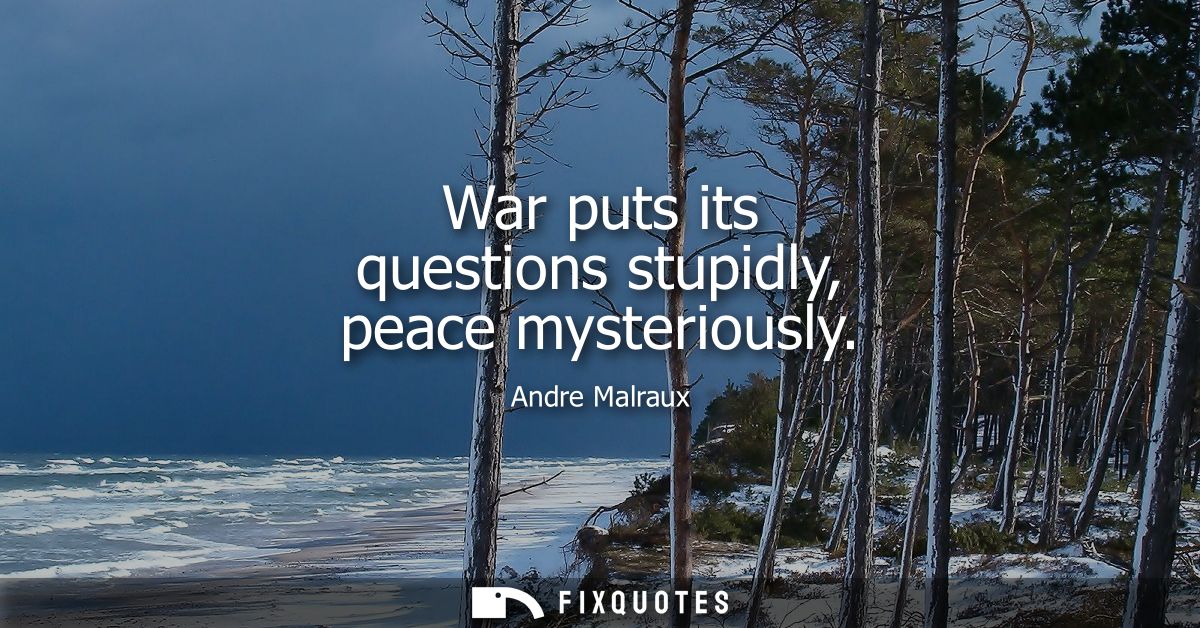
"War puts its questions stupidly, peace mysteriously"
About this Quote
War is the blunt instrument that forces a multiple-choice test: kill or be killed, win or lose, friend or enemy. Malraux’s line skewers that coercive clarity as a kind of stupidity - not because the stakes are small, but because the frame is. War “puts its questions” the way an interrogator does: fast, binary, designed to strip nuance and hurry you into obedience. The stupidity isn’t intellectual; it’s structural. War reduces human life to logistics and slogans, then calls the reduction “realism.”
Peace, by contrast, doesn’t interrogate you at gunpoint. It destabilizes you. “Mysteriously” is doing the heavy lifting here: peace reopens moral complexity, memory, and desire. When the shooting stops, the hard questions return in soft forms - how to live with what you did, how to rebuild trust, what justice looks like when you can’t cleanly separate victim and perpetrator, what to do with freedom when it’s no longer a wartime prop. Peace isn’t comforting; it’s ambiguous, slow, and psychologically expensive.
The context matters. Malraux was not a salon pacifist; he was shaped by the 20th century’s ideological trench warfare - the Spanish Civil War, anti-fascist commitment, the machinery of total war, the postwar problem of meaning. His fiction and politics both orbit a central dilemma: humans hunger for purpose, and war offers a brutal counterfeit purpose on demand. Peace offers no such script, only the unnerving task of writing one.
Peace, by contrast, doesn’t interrogate you at gunpoint. It destabilizes you. “Mysteriously” is doing the heavy lifting here: peace reopens moral complexity, memory, and desire. When the shooting stops, the hard questions return in soft forms - how to live with what you did, how to rebuild trust, what justice looks like when you can’t cleanly separate victim and perpetrator, what to do with freedom when it’s no longer a wartime prop. Peace isn’t comforting; it’s ambiguous, slow, and psychologically expensive.
The context matters. Malraux was not a salon pacifist; he was shaped by the 20th century’s ideological trench warfare - the Spanish Civil War, anti-fascist commitment, the machinery of total war, the postwar problem of meaning. His fiction and politics both orbit a central dilemma: humans hunger for purpose, and war offers a brutal counterfeit purpose on demand. Peace offers no such script, only the unnerving task of writing one.
Quote Details
| Topic | Peace |
|---|---|
| Source | Help us find the source |
| Cite |
Citation Formats
APA Style (7th ed.)
Malraux, Andre. (2026, January 18). War puts its questions stupidly, peace mysteriously. FixQuotes. https://fixquotes.com/quotes/war-puts-its-questions-stupidly-peace-mysteriously-20207/
Chicago Style
Malraux, Andre. "War puts its questions stupidly, peace mysteriously." FixQuotes. January 18, 2026. https://fixquotes.com/quotes/war-puts-its-questions-stupidly-peace-mysteriously-20207/.
MLA Style (9th ed.)
"War puts its questions stupidly, peace mysteriously." FixQuotes, 18 Jan. 2026, https://fixquotes.com/quotes/war-puts-its-questions-stupidly-peace-mysteriously-20207/. Accessed 12 Feb. 2026.
More Quotes by Andre
Add to List