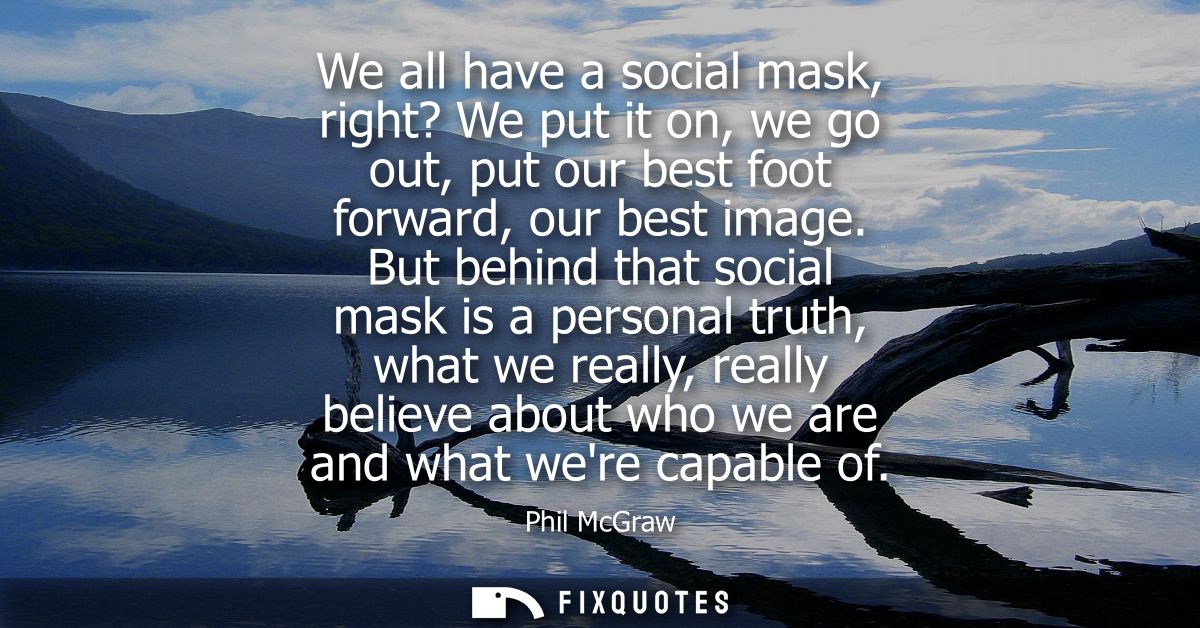
"We all have a social mask, right? We put it on, we go out, put our best foot forward, our best image. But behind that social mask is a personal truth, what we really, really believe about who we are and what we're capable of"
About this Quote
The subtext is more pointed than it first appears. The “mask” isn’t just social etiquette; it’s a suggestion that your daily competence may be a kind of fraud, and that the real you is hiding underneath. That move creates urgency: if there’s a buried “truth” about what you’re capable of, then your life can be re-edited, not merely improved. The repetition in “really, really believe” is classic McGraw cadence, a rhetorical shoulder shake that pushes past polite agreement into emotional assent. He’s not asking what you think; he’s insisting on what you believe, where rationalization has less room to maneuver.
Culturally, it fits the therapeutic turn of American media: private interiority repackaged as public narrative. On daytime television, “personal truth” becomes both diagnosis and plot engine. The line offers agency (“capable of”) while also planting suspicion about the self you’ve been presenting. It works because it flatters the viewer as deep, wounded, and salvageable in the same breath.
Quote Details
| Topic | Confidence |
|---|---|
| Source | Help us find the source |
| Cite |
Citation Formats
APA Style (7th ed.)
McGraw, Phil. (2026, January 17). We all have a social mask, right? We put it on, we go out, put our best foot forward, our best image. But behind that social mask is a personal truth, what we really, really believe about who we are and what we're capable of. FixQuotes. https://fixquotes.com/quotes/we-all-have-a-social-mask-right-we-put-it-on-we-70938/
Chicago Style
McGraw, Phil. "We all have a social mask, right? We put it on, we go out, put our best foot forward, our best image. But behind that social mask is a personal truth, what we really, really believe about who we are and what we're capable of." FixQuotes. January 17, 2026. https://fixquotes.com/quotes/we-all-have-a-social-mask-right-we-put-it-on-we-70938/.
MLA Style (9th ed.)
"We all have a social mask, right? We put it on, we go out, put our best foot forward, our best image. But behind that social mask is a personal truth, what we really, really believe about who we are and what we're capable of." FixQuotes, 17 Jan. 2026, https://fixquotes.com/quotes/we-all-have-a-social-mask-right-we-put-it-on-we-70938/. Accessed 16 Mar. 2026.