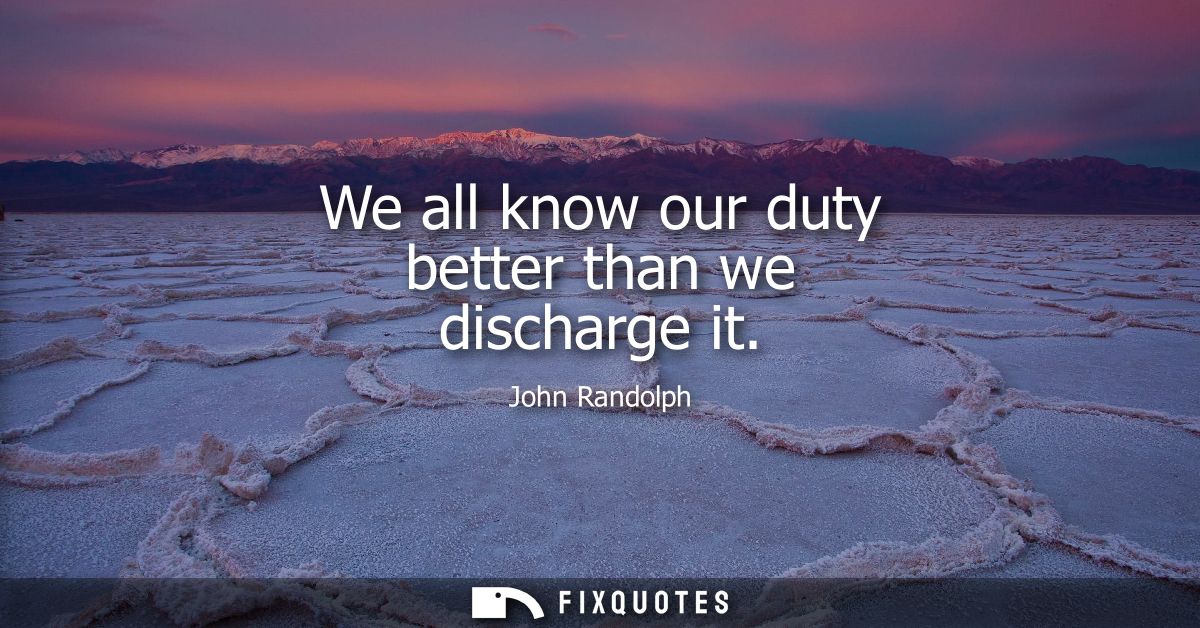
"We all know our duty better than we discharge it"
About this Quote
A reprimand disguised as a confession, John Randolph's line lands because it refuses the comforting fiction that morality is mainly a knowledge problem. "We all know" flattens status differences and denies alibis: ignorance, confusion, bad information. Randolph isn't scolding a single opponent so much as indicting an entire political class (and, by extension, the citizenry that tolerates it) for treating duty as a slogan rather than a discipline.
The sentence works rhetorically by pairing intimacy with severity. "Our duty" sounds like the language of civic religion, the kind leaders invoke at podiums. Then Randolph twists the knife with "better than we discharge it", a verb that yokes ethics to paperwork and obligations. Duty becomes a debt, and "discharge" suggests both release and disposal: we don't fulfill responsibilities so much as try to get rid of them, to file them away, to feel done with them. It's a remarkably modern critique of performative virtue, where public declarations of principle substitute for the harder work of acting on them.
Context matters. Randolph, a combustible early American statesman known for his independence and moralistic streak, spoke in an era when the young republic was still defining what public service meant beyond revolutionary rhetoric. The line reads like a warning to a nation founding itself on lofty ideals while rapidly discovering the temptations of office, faction, and convenience. It's blunt, but not nihilistic: the premise is that conscience is already speaking. The failure is will.
The sentence works rhetorically by pairing intimacy with severity. "Our duty" sounds like the language of civic religion, the kind leaders invoke at podiums. Then Randolph twists the knife with "better than we discharge it", a verb that yokes ethics to paperwork and obligations. Duty becomes a debt, and "discharge" suggests both release and disposal: we don't fulfill responsibilities so much as try to get rid of them, to file them away, to feel done with them. It's a remarkably modern critique of performative virtue, where public declarations of principle substitute for the harder work of acting on them.
Context matters. Randolph, a combustible early American statesman known for his independence and moralistic streak, spoke in an era when the young republic was still defining what public service meant beyond revolutionary rhetoric. The line reads like a warning to a nation founding itself on lofty ideals while rapidly discovering the temptations of office, faction, and convenience. It's blunt, but not nihilistic: the premise is that conscience is already speaking. The failure is will.
Quote Details
| Topic | Ethics & Morality |
|---|---|
| Source | Help us find the source |
| Cite |
Citation Formats
APA Style (7th ed.)
Randolph, John. (2026, January 16). We all know our duty better than we discharge it. FixQuotes. https://fixquotes.com/quotes/we-all-know-our-duty-better-than-we-discharge-it-118771/
Chicago Style
Randolph, John. "We all know our duty better than we discharge it." FixQuotes. January 16, 2026. https://fixquotes.com/quotes/we-all-know-our-duty-better-than-we-discharge-it-118771/.
MLA Style (9th ed.)
"We all know our duty better than we discharge it." FixQuotes, 16 Jan. 2026, https://fixquotes.com/quotes/we-all-know-our-duty-better-than-we-discharge-it-118771/. Accessed 12 Feb. 2026.
More Quotes by John
Add to List