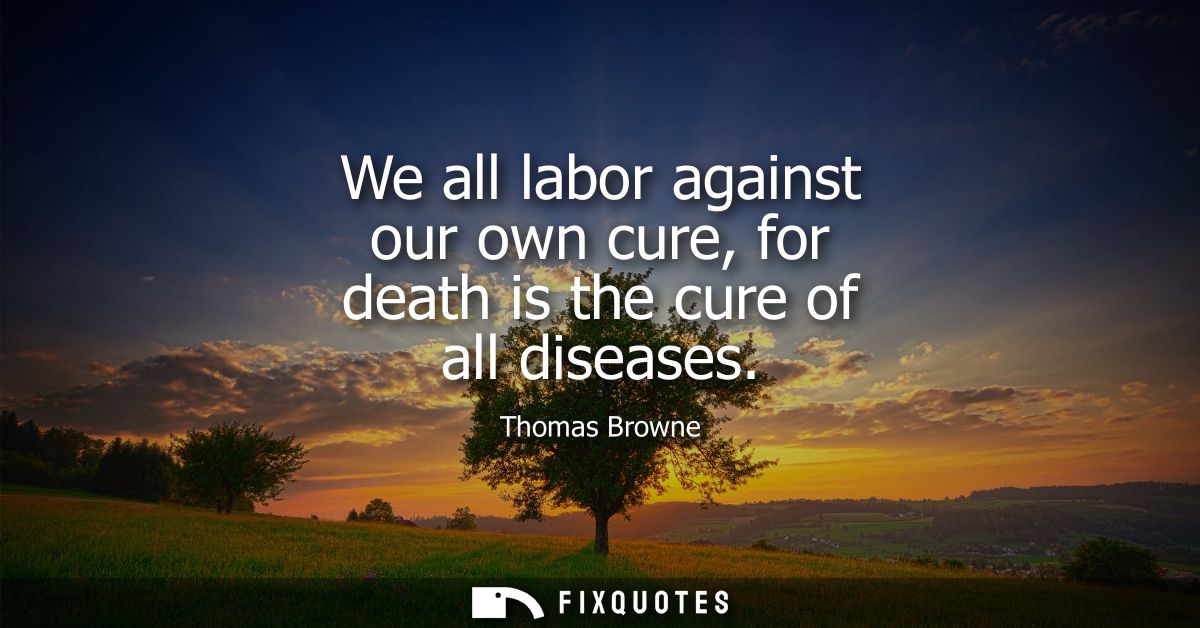
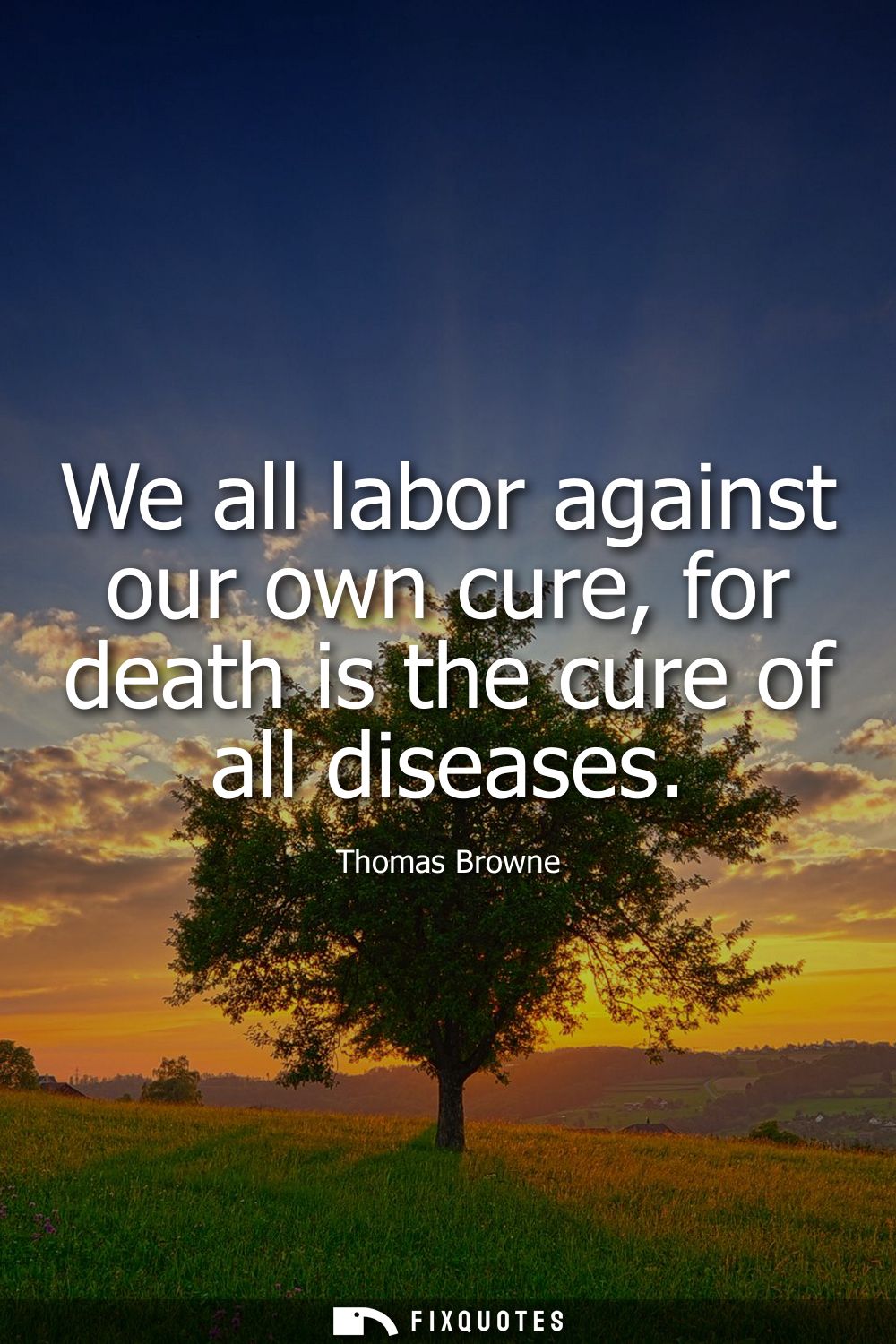
"We all labor against our own cure, for death is the cure of all diseases"
About this Quote
The subtext is less nihilism than perspective. Seventeenth-century medicine, even at its most learned, could not promise what modern readers assume as baseline: reliable recovery. Plague, consumption, childbirth fever, and infections made "health" feel provisional. Browne, trained in the new empiricism yet steeped in Christian metaphysics, writes from a world where science and salvation are not rival brands but adjacent languages for talking about limits. His sentence has the cadence of a moral aphorism and the logic of a case note.
The intent is to puncture the fantasy of mastery. We hustle, medicate, diet, pray, and discipline our bodies as if permanence were negotiable. Browne’s twist is that the ultimate "cure" is also the end of the subject who wanted curing. It’s a reminder that medicine’s triumphs are real, but bounded: every victory is temporary, every remission a loan.
Quote Details
| Topic | Mortality |
|---|---|
| Source | Thomas Browne, Religio Medici — the line is attributed to Browne's Religio Medici (concise bibliographic attribution; edition/page varies). |
| Cite |
Citation Formats
APA Style (7th ed.)
Browne, Thomas. (2026, January 16). We all labor against our own cure, for death is the cure of all diseases. FixQuotes. https://fixquotes.com/quotes/we-all-labor-against-our-own-cure-for-death-is-82566/
Chicago Style
Browne, Thomas. "We all labor against our own cure, for death is the cure of all diseases." FixQuotes. January 16, 2026. https://fixquotes.com/quotes/we-all-labor-against-our-own-cure-for-death-is-82566/.
MLA Style (9th ed.)
"We all labor against our own cure, for death is the cure of all diseases." FixQuotes, 16 Jan. 2026, https://fixquotes.com/quotes/we-all-labor-against-our-own-cure-for-death-is-82566/. Accessed 3 Apr. 2026.