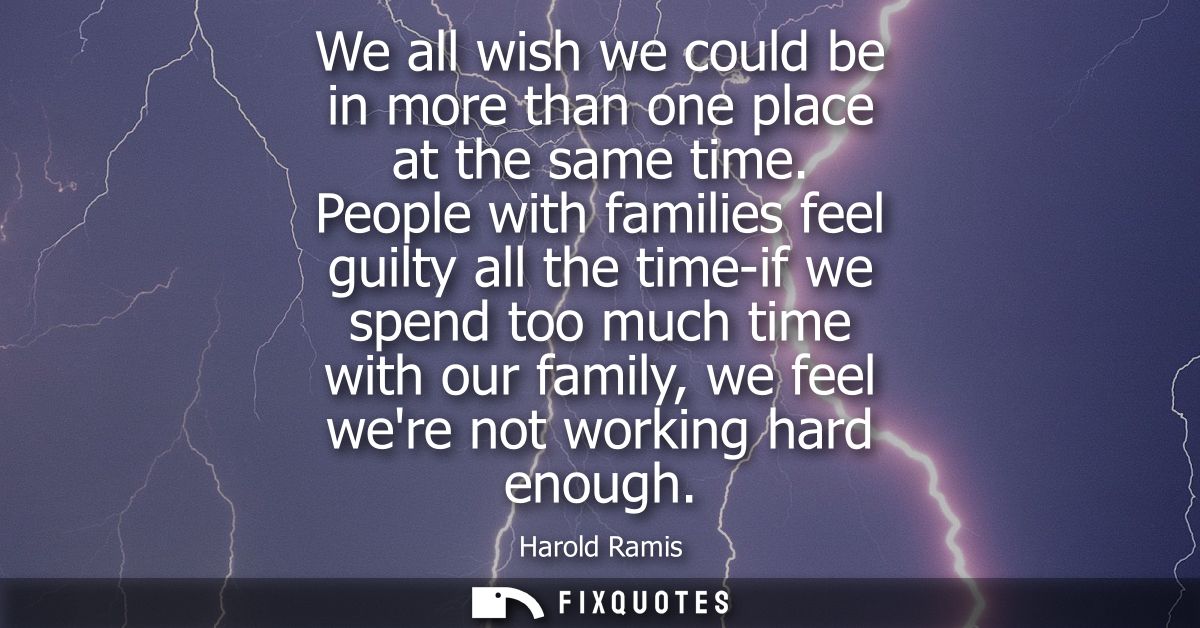
"We all wish we could be in more than one place at the same time. People with families feel guilty all the time-if we spend too much time with our family, we feel we're not working hard enough"
About this Quote
The sly move is how he frames guilt as a constant, not a signal. “People with families feel guilty all the time” isn’t advice; it’s an indictment of a system that keeps moving the goalposts. The subtext is that the problem isn’t individual weakness or poor time management, it’s the expectation that devotion must be proven in mutually exclusive ways. Ramis also smuggles in a status observation: “working hard enough” is treated like a moral category, as if labor is the only credible alibi for not being available.
In context, Ramis belonged to a generation that watched work intensify and family life get idealized at the same time, creating a perfect trap: you’re supposed to be a hands-on parent and a relentlessly productive professional, and any imbalance gets recast as personal failure. The line works because it refuses inspiration. It offers recognition - a comedian’s version of solidarity - and exposes how guilt has become the background music of adulthood.
Quote Details
| Topic | Work-Life Balance |
|---|---|
| Source | Help us find the source |
| Cite |
Citation Formats
APA Style (7th ed.)
Ramis, Harold. (2026, January 17). We all wish we could be in more than one place at the same time. People with families feel guilty all the time-if we spend too much time with our family, we feel we're not working hard enough. FixQuotes. https://fixquotes.com/quotes/we-all-wish-we-could-be-in-more-than-one-place-at-54341/
Chicago Style
Ramis, Harold. "We all wish we could be in more than one place at the same time. People with families feel guilty all the time-if we spend too much time with our family, we feel we're not working hard enough." FixQuotes. January 17, 2026. https://fixquotes.com/quotes/we-all-wish-we-could-be-in-more-than-one-place-at-54341/.
MLA Style (9th ed.)
"We all wish we could be in more than one place at the same time. People with families feel guilty all the time-if we spend too much time with our family, we feel we're not working hard enough." FixQuotes, 17 Jan. 2026, https://fixquotes.com/quotes/we-all-wish-we-could-be-in-more-than-one-place-at-54341/. Accessed 31 Mar. 2026.