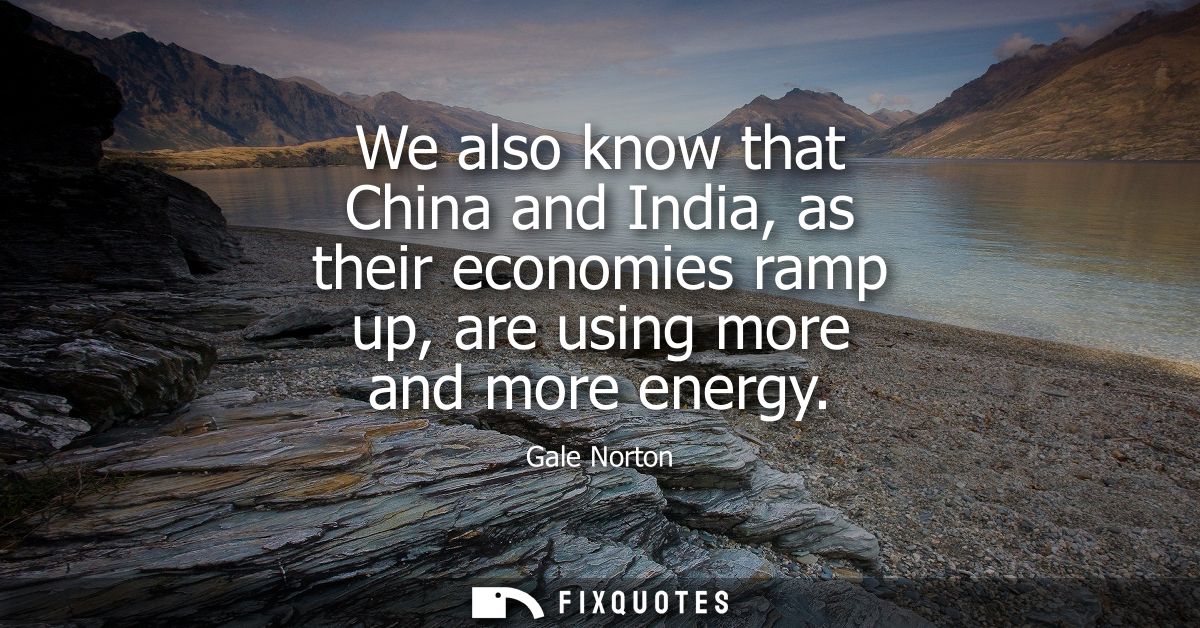
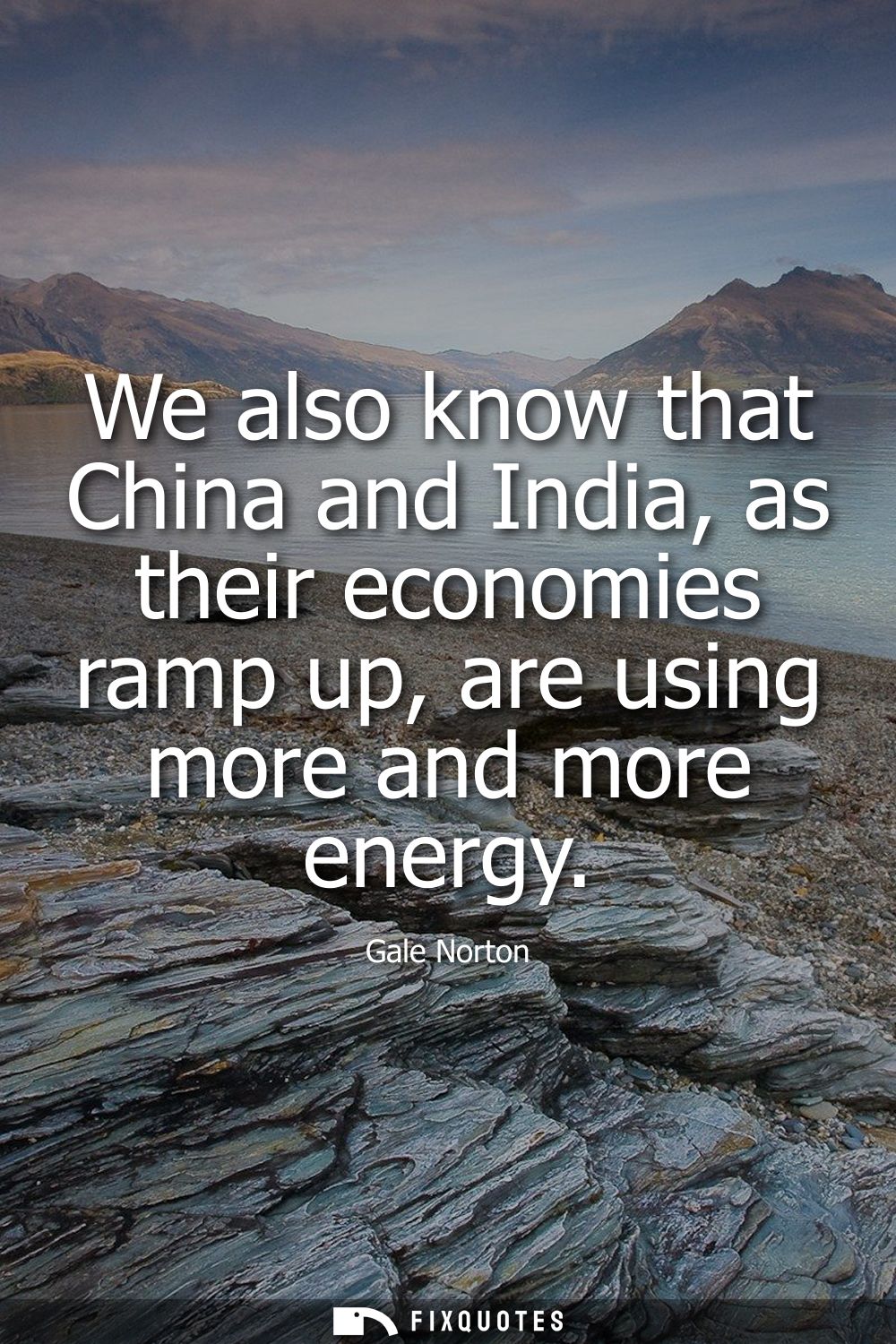
"We also know that China and India, as their economies ramp up, are using more and more energy"
About this Quote
There is a quiet sleight of hand in Norton’s line: it presents a global trend as settled fact, then uses that “we also know” to smuggle in an argument about what should happen next. The sentence is built like a briefing, not a plea. “Know” signals authority and inevitability; “ramp up” sounds like a machine coming online. The effect is to naturalize rising energy consumption as the price of economic ascent, not as a policy choice shaped by technology, regulation, or international pressure.
The subtext sits in the pairing of China and India. In American political rhetoric of the 2000s, those names functioned as shorthand for two anxieties at once: competition and accountability. If developing giants are “using more and more energy,” then domestic restraint can be framed as futile, even naïve. Climate obligations become a fairness argument: why should the U.S. tighten its belt if others are still growing into theirs? It’s a familiar move in environmental debates, shifting the emotional center from stewardship to grievance.
Context matters because Norton, as a U.S. public servant associated with energy and environmental policy, wasn’t describing a neutral spreadsheet; she was shaping the audience’s sense of the problem’s scale and who counts as responsible. The line narrows the policy horizon to supply and security (more energy demand), while soft-pedaling the harder question of trajectory (what kind of energy, and at whose cost). It’s less a forecast than a permission structure: a way to justify incrementalism at home by pointing to acceleration abroad.
The subtext sits in the pairing of China and India. In American political rhetoric of the 2000s, those names functioned as shorthand for two anxieties at once: competition and accountability. If developing giants are “using more and more energy,” then domestic restraint can be framed as futile, even naïve. Climate obligations become a fairness argument: why should the U.S. tighten its belt if others are still growing into theirs? It’s a familiar move in environmental debates, shifting the emotional center from stewardship to grievance.
Context matters because Norton, as a U.S. public servant associated with energy and environmental policy, wasn’t describing a neutral spreadsheet; she was shaping the audience’s sense of the problem’s scale and who counts as responsible. The line narrows the policy horizon to supply and security (more energy demand), while soft-pedaling the harder question of trajectory (what kind of energy, and at whose cost). It’s less a forecast than a permission structure: a way to justify incrementalism at home by pointing to acceleration abroad.
Quote Details
| Topic | Science |
|---|
More Quotes by Gale
Add to List