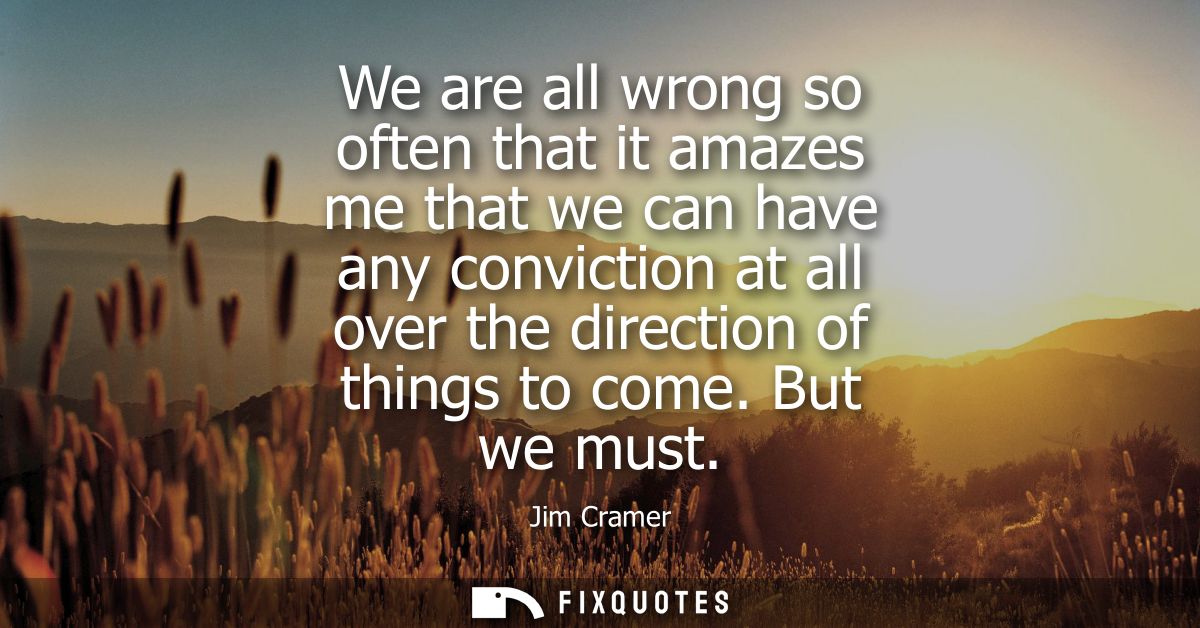
"We are all wrong so often that it amazes me that we can have any conviction at all over the direction of things to come. But we must"
About this Quote
Then comes the hard pivot: “But we must.” It’s abrupt, almost parental, and it smuggles in the real message: action is non-optional. Markets reward decisiveness, not metaphysical accuracy. If you wait for certainty, you don’t invest; you spectate. Cramer’s career sits squarely inside that contradiction. As a televised stock-picker, he’s paid to project confidence in an environment that routinely punishes it. The subtext is both defensive and directive: yes, we’re wrong constantly, but the job (and the audience’s need) is to keep making calls anyway.
Context matters here: post-2000s financial culture turned prediction into entertainment and conviction into content. Cramer’s rhetorical move acknowledges fallibility while re-legitimizing the performance. You can be wrong; just don’t be paralyzed. In a world built on probabilistic guesses, “must” is how you keep the lights on.
Quote Details
| Topic | Decision-Making |
|---|---|
| Source | Help us find the source |
| Cite |
Citation Formats
APA Style (7th ed.)
Cramer, Jim. (2026, January 15). We are all wrong so often that it amazes me that we can have any conviction at all over the direction of things to come. But we must. FixQuotes. https://fixquotes.com/quotes/we-are-all-wrong-so-often-that-it-amazes-me-that-142940/
Chicago Style
Cramer, Jim. "We are all wrong so often that it amazes me that we can have any conviction at all over the direction of things to come. But we must." FixQuotes. January 15, 2026. https://fixquotes.com/quotes/we-are-all-wrong-so-often-that-it-amazes-me-that-142940/.
MLA Style (9th ed.)
"We are all wrong so often that it amazes me that we can have any conviction at all over the direction of things to come. But we must." FixQuotes, 15 Jan. 2026, https://fixquotes.com/quotes/we-are-all-wrong-so-often-that-it-amazes-me-that-142940/. Accessed 25 Mar. 2026.