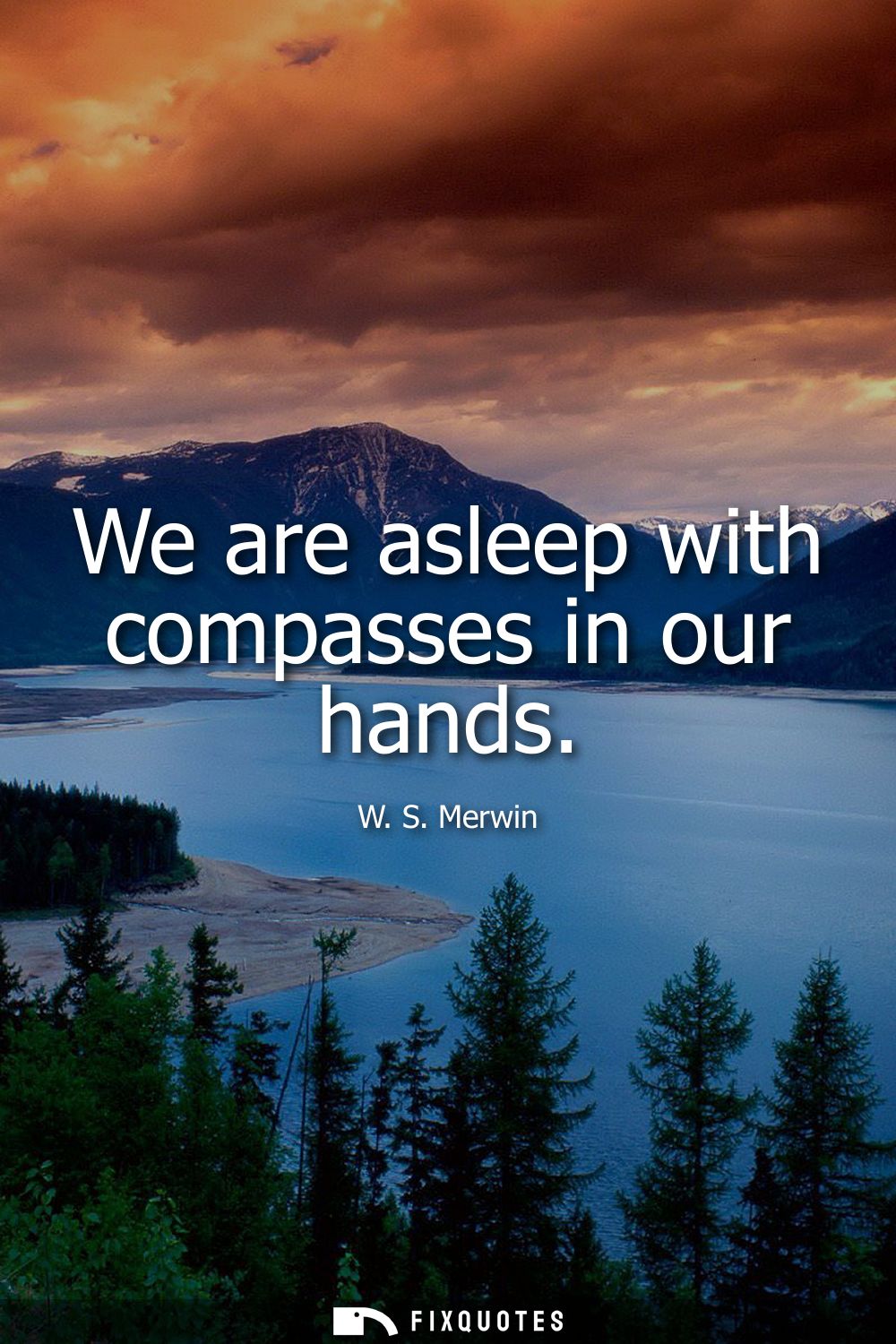
"We are asleep with compasses in our hands"
About this Quote
A compass is a tool for the awake: it assumes attention, direction, a chosen north. Merwin’s line turns that tidy promise into a quietly damning image of modern life, where we keep the instruments of purpose clutched in our hands while drifting through the day half-conscious. The bite is in the mismatch. We’re not lost because we lack guidance; we’re lost because we’re anesthetized in the middle of having it.
Merwin, writing out of a late-20th-century American unease (environmental collapse, political noise, spiritual dislocation), often sounds like someone listening for the world’s last clear signals under layers of habit. Here the subtext is less “find your way” than “notice how thoroughly you’ve surrendered your noticing.” The compass becomes a stand-in for every system that promises orientation: ideology, career ladders, self-help mantras, even the soft tyranny of productivity. Possession replaces presence. We hoard maps and metrics while sleepwalking through the terrain they’re meant to help us navigate.
The line also works because it’s physically intimate: “in our hands” suggests responsibility, even culpability. This isn’t fate; it’s negligence. Yet “asleep” carries tenderness, too, a recognition that numbness can be a survival strategy in a culture that overwhelms the senses. Merwin’s genius is the restraint: no sermon, no villain, just one haunting snapshot that makes the reader feel the weight of a direction held but not lived.
Merwin, writing out of a late-20th-century American unease (environmental collapse, political noise, spiritual dislocation), often sounds like someone listening for the world’s last clear signals under layers of habit. Here the subtext is less “find your way” than “notice how thoroughly you’ve surrendered your noticing.” The compass becomes a stand-in for every system that promises orientation: ideology, career ladders, self-help mantras, even the soft tyranny of productivity. Possession replaces presence. We hoard maps and metrics while sleepwalking through the terrain they’re meant to help us navigate.
The line also works because it’s physically intimate: “in our hands” suggests responsibility, even culpability. This isn’t fate; it’s negligence. Yet “asleep” carries tenderness, too, a recognition that numbness can be a survival strategy in a culture that overwhelms the senses. Merwin’s genius is the restraint: no sermon, no villain, just one haunting snapshot that makes the reader feel the weight of a direction held but not lived.
Quote Details
| Topic | Deep |
|---|---|
| Source | Help us find the source |
| Cite |
Citation Formats
APA Style (7th ed.)
Merwin, W. S. (2026, January 14). We are asleep with compasses in our hands. FixQuotes. https://fixquotes.com/quotes/we-are-asleep-with-compasses-in-our-hands-145508/
Chicago Style
Merwin, W. S. "We are asleep with compasses in our hands." FixQuotes. January 14, 2026. https://fixquotes.com/quotes/we-are-asleep-with-compasses-in-our-hands-145508/.
MLA Style (9th ed.)
"We are asleep with compasses in our hands." FixQuotes, 14 Jan. 2026, https://fixquotes.com/quotes/we-are-asleep-with-compasses-in-our-hands-145508/. Accessed 12 Feb. 2026.
More Quotes by S. Merwin
Add to List