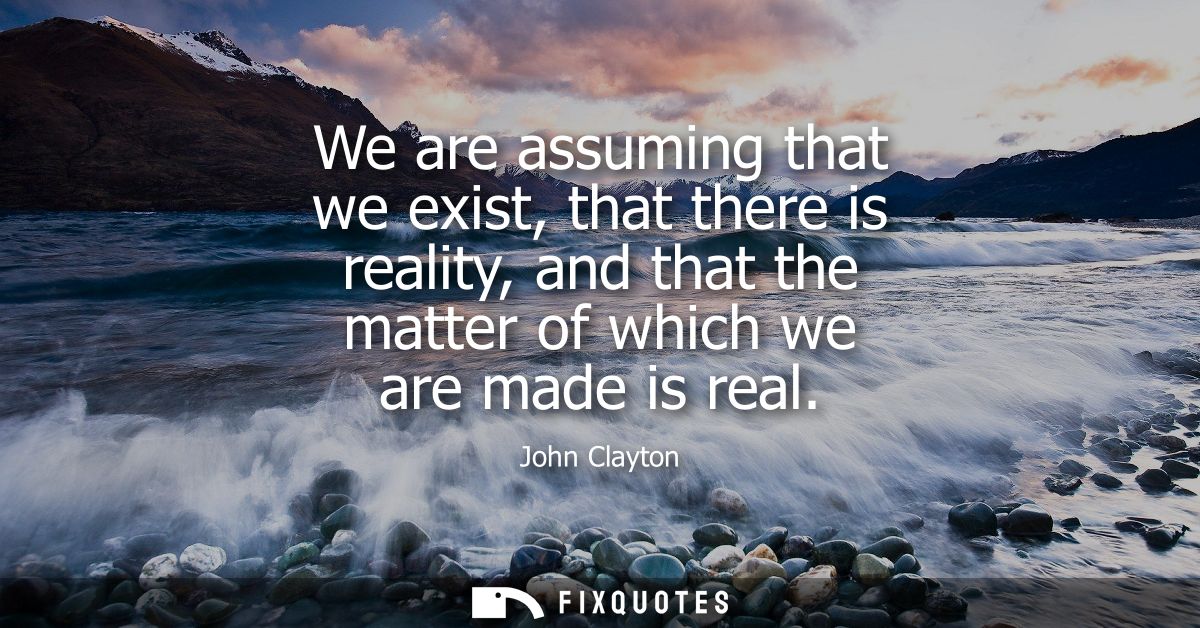
"We are assuming that we exist, that there is reality, and that the matter of which we are made is real"
About this Quote
Clayton’s line reads like a trapdoor under everyday confidence. Most people move through the world with a silent stack of assumptions: I’m here, the room is here, the body is solid, the rules are stable. He drags those assumptions into the light and makes them look suddenly negotiable. The phrasing matters. “We are assuming” frames existence not as a fact but as a habit of mind, a collective choice to treat perception as reliable. It’s less mystical than it sounds; it’s closer to the low-grade uncertainty that sits beneath modern life, where deepfakes, simulations, and curated selves have trained us to doubt what “real” even buys us.
The quote’s power is its triple-stacking: existence, reality, matter. Each clause widens the blast radius. Start with the self (do I exist?), then the world (is there reality?), then the substrate (is the matter real?). That final move is the sneakiest. It gestures toward both philosophy and physics: the old skepticism of Descartes, but also the contemporary sense that what we call “matter” is mostly empty space, probabilities, and models we use because they work. Clayton isn’t offering an answer; he’s isolating the hidden cost of certainty.
As a writer, his intent feels diagnostic rather than doctrinal: to show how storytelling, identity, and even sanity depend on agreed-upon premises. The subtext is unsettling but pragmatic: if reality is partly a shared assumption, then power belongs to whoever gets to define what counts as real.
The quote’s power is its triple-stacking: existence, reality, matter. Each clause widens the blast radius. Start with the self (do I exist?), then the world (is there reality?), then the substrate (is the matter real?). That final move is the sneakiest. It gestures toward both philosophy and physics: the old skepticism of Descartes, but also the contemporary sense that what we call “matter” is mostly empty space, probabilities, and models we use because they work. Clayton isn’t offering an answer; he’s isolating the hidden cost of certainty.
As a writer, his intent feels diagnostic rather than doctrinal: to show how storytelling, identity, and even sanity depend on agreed-upon premises. The subtext is unsettling but pragmatic: if reality is partly a shared assumption, then power belongs to whoever gets to define what counts as real.
Quote Details
| Topic | Truth |
|---|
More Quotes by John
Add to List