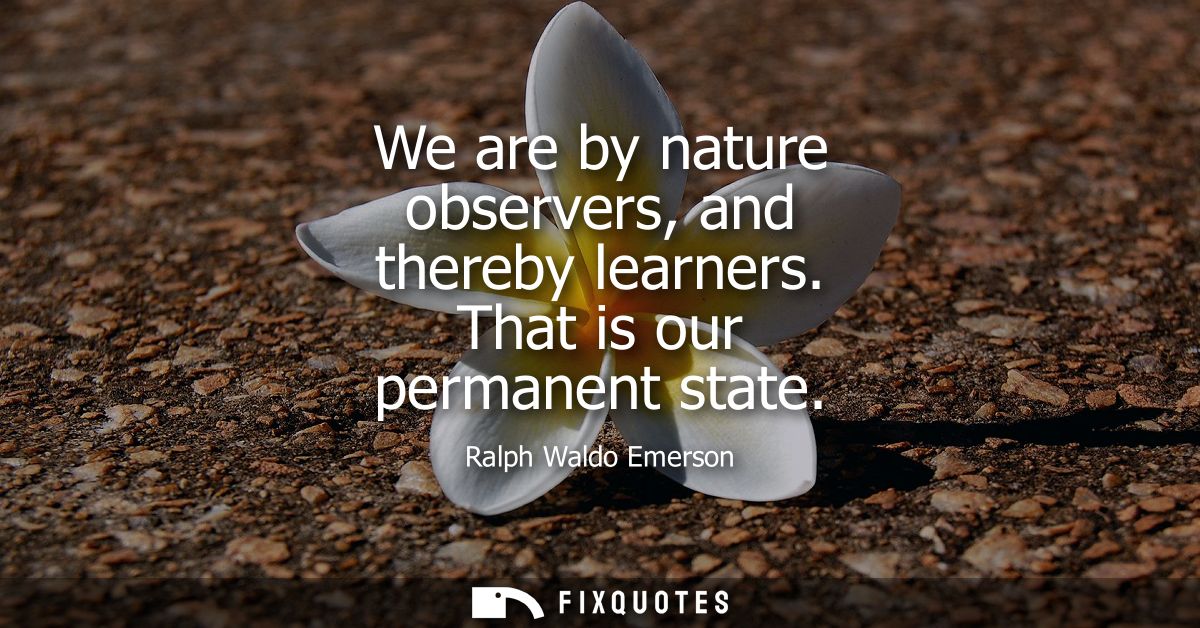
"We are by nature observers, and thereby learners. That is our permanent state"
About this Quote
The subtext is a defense of self-reliance that doesn’t harden into solipsism. Emerson is often caricatured as the patron saint of rugged individualism, but here the individual is porous: the world keeps writing on you. “Observers” also implies distance, even restraint. He’s suspicious of inherited doctrine and secondhand belief; he prefers the mind that witnesses directly, gathers evidence, and revises itself. That stance is philosophical, but it’s also political in antebellum America, where religion, reform movements, and abolition debates were contests over who gets to define reality.
“Permanent state” is the sting. It refuses the comforting idea that wisdom is a stable possession. Emerson is describing adulthood not as mastery but as a sustained attentiveness, a kind of ethical vigilance. The sentence has the posture of serenity, yet it’s a challenge: if learning is permanent, complacency is the only real failure.
Quote Details
| Topic | Learning |
|---|---|
| Source | Help us find the source |
| Cite |
Citation Formats
APA Style (7th ed.)
Emerson, Ralph Waldo. (2026, January 14). We are by nature observers, and thereby learners. That is our permanent state. FixQuotes. https://fixquotes.com/quotes/we-are-by-nature-observers-and-thereby-learners-28884/
Chicago Style
Emerson, Ralph Waldo. "We are by nature observers, and thereby learners. That is our permanent state." FixQuotes. January 14, 2026. https://fixquotes.com/quotes/we-are-by-nature-observers-and-thereby-learners-28884/.
MLA Style (9th ed.)
"We are by nature observers, and thereby learners. That is our permanent state." FixQuotes, 14 Jan. 2026, https://fixquotes.com/quotes/we-are-by-nature-observers-and-thereby-learners-28884/. Accessed 25 Mar. 2026.