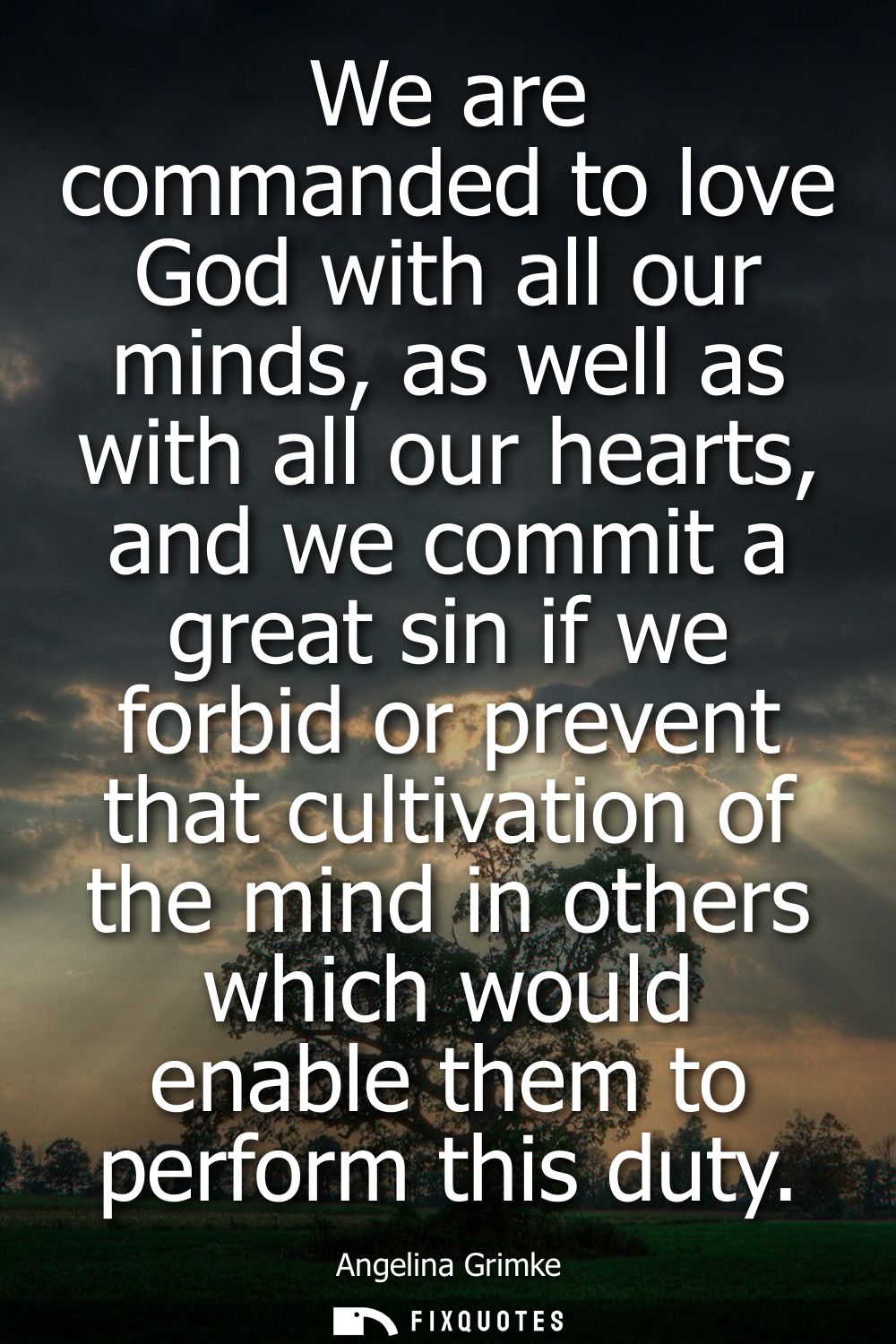
"We are commanded to love God with all our minds, as well as with all our hearts, and we commit a great sin if we forbid or prevent that cultivation of the mind in others which would enable them to perform this duty"
About this Quote
The intent is surgical. Grimke is not merely praising education; she is morally indicting the systems that ration it. "We are commanded" invokes shared scripture to deny her audience an escape hatch. The phrase "great sin" is not decorative thunder. It converts the denial of learning (especially to women and enslaved people) from a social custom into a spiritual offense. If someone blocks another person's cultivation of the mind, they're not preserving order - they're interfering with someone else's capacity to fulfill God's will.
The subtext is a direct challenge to clerical and patriarchal gatekeeping. In Grimke's era, opponents of abolition and women's rights often argued that certain groups were unfit for education or public reasoning, casting submission as holiness. Grimke replies: you can't claim God while fearing minds. Her syntax makes the leap feel inevitable: if duty requires mind, then equality in education becomes a religious requirement, not a radical luxury.
Context matters: as a Quaker-leaning abolitionist and early feminist, Grimke writes from inside Christianity, not outside it. That's the power. She doesn't ask permission from the culture's moral language; she commandeers it.
Quote Details
| Topic | God |
|---|---|
| Source | Help us find the source |
| Cite |
Citation Formats
APA Style (7th ed.)
Grimke, Angelina. (2026, January 16). We are commanded to love God with all our minds, as well as with all our hearts, and we commit a great sin if we forbid or prevent that cultivation of the mind in others which would enable them to perform this duty. FixQuotes. https://fixquotes.com/quotes/we-are-commanded-to-love-god-with-all-our-minds-97755/
Chicago Style
Grimke, Angelina. "We are commanded to love God with all our minds, as well as with all our hearts, and we commit a great sin if we forbid or prevent that cultivation of the mind in others which would enable them to perform this duty." FixQuotes. January 16, 2026. https://fixquotes.com/quotes/we-are-commanded-to-love-god-with-all-our-minds-97755/.
MLA Style (9th ed.)
"We are commanded to love God with all our minds, as well as with all our hearts, and we commit a great sin if we forbid or prevent that cultivation of the mind in others which would enable them to perform this duty." FixQuotes, 16 Jan. 2026, https://fixquotes.com/quotes/we-are-commanded-to-love-god-with-all-our-minds-97755/. Accessed 3 Apr. 2026.