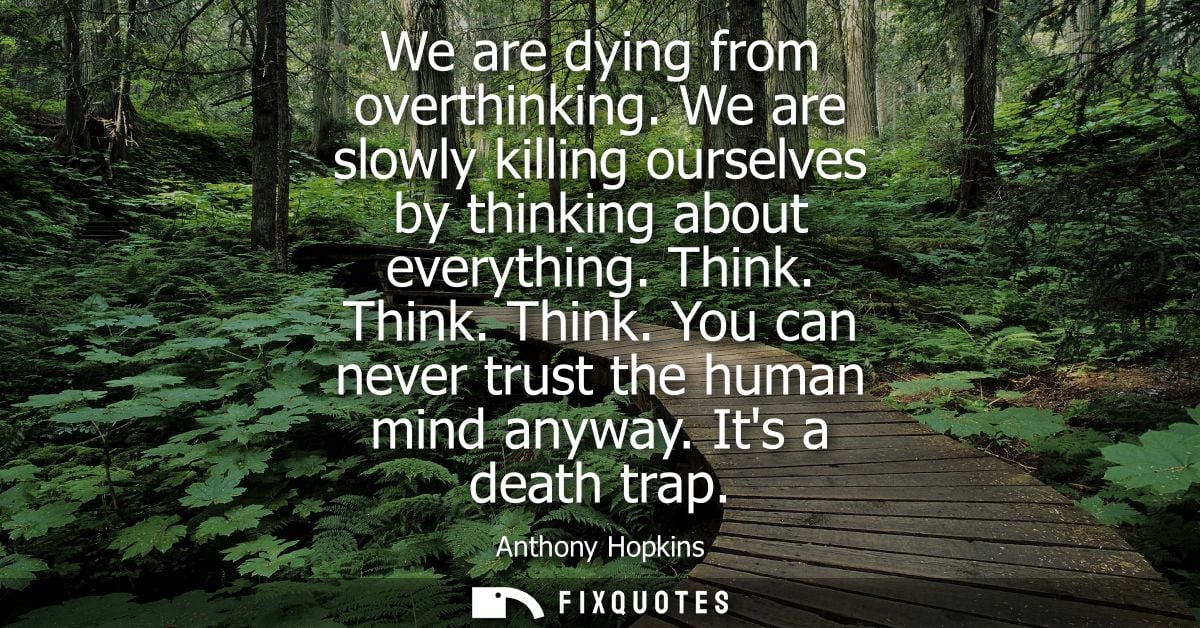
"We are dying from overthinking. We are slowly killing ourselves by thinking about everything. Think. Think. Think. You can never trust the human mind anyway. It's a death trap"
About this Quote
The specific intent feels less philosophical than survivalist. Hopkins isn’t arguing that thought is bad; he’s naming the modern pathology of thought without traction: rumination, catastrophizing, obsessive self-auditing. "Overthinking" becomes a slow-motion violence, not because ideas harm us, but because the mind is excellent at manufacturing urgency from nothing. Calling it a "death trap" dramatizes how convincing mental stories can feel, especially when anxiety dresses itself up as insight.
Context matters: Hopkins has spoken publicly about sobriety, discipline, and the daily maintenance required to stay steady. Read through that lens, this is the voice of someone who’s learned that the brain will offer you persuasive scripts - shame, fear, obsession - and call them truth. The subtext is permission: step out of the courtroom in your head. Stop treating every feeling like evidence. The performance isn’t always reality.
Quote Details
| Topic | Anxiety |
|---|---|
| Source | Help us find the source |
| Cite |
Citation Formats
APA Style (7th ed.)
Hopkins, Anthony. (2026, January 15). We are dying from overthinking. We are slowly killing ourselves by thinking about everything. Think. Think. Think. You can never trust the human mind anyway. It's a death trap. FixQuotes. https://fixquotes.com/quotes/we-are-dying-from-overthinking-we-are-slowly-138362/
Chicago Style
Hopkins, Anthony. "We are dying from overthinking. We are slowly killing ourselves by thinking about everything. Think. Think. Think. You can never trust the human mind anyway. It's a death trap." FixQuotes. January 15, 2026. https://fixquotes.com/quotes/we-are-dying-from-overthinking-we-are-slowly-138362/.
MLA Style (9th ed.)
"We are dying from overthinking. We are slowly killing ourselves by thinking about everything. Think. Think. Think. You can never trust the human mind anyway. It's a death trap." FixQuotes, 15 Jan. 2026, https://fixquotes.com/quotes/we-are-dying-from-overthinking-we-are-slowly-138362/. Accessed 5 Mar. 2026.