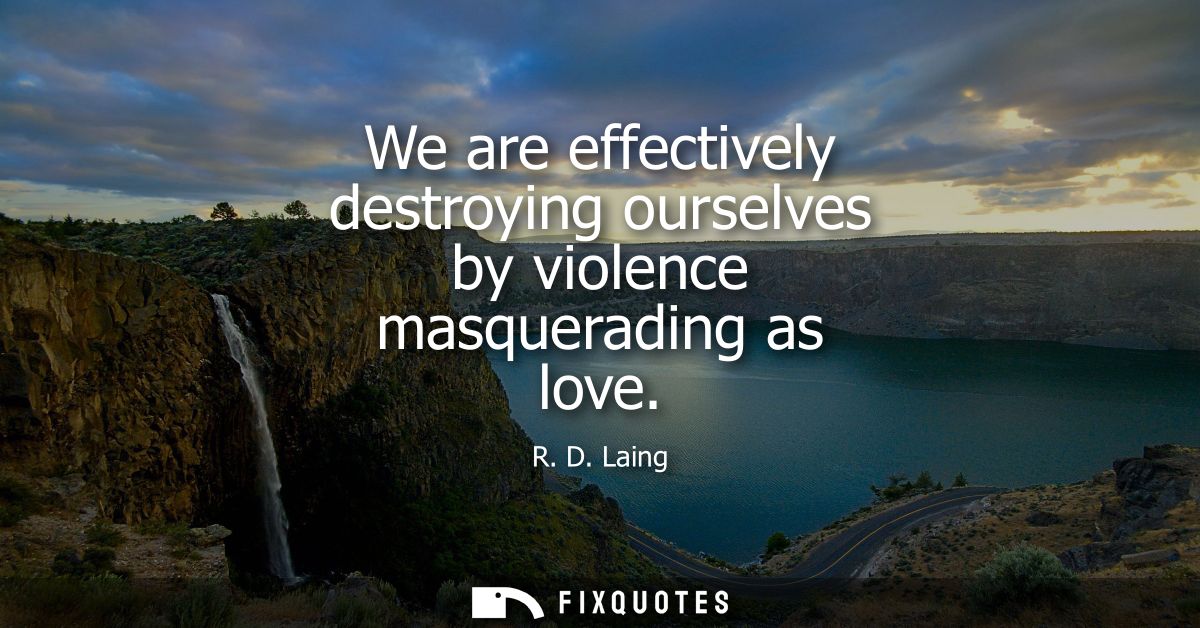
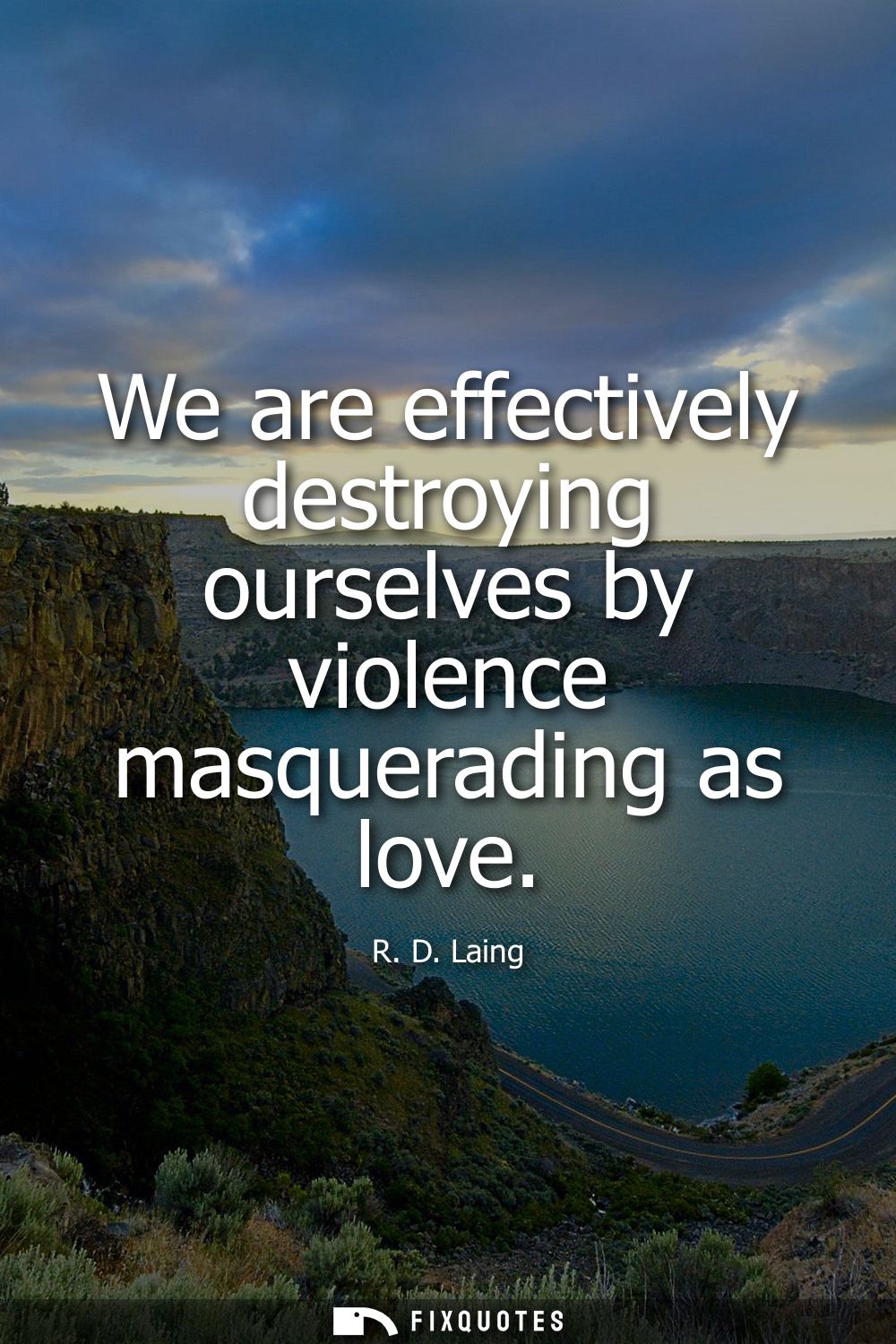
"We are effectively destroying ourselves by violence masquerading as love"
About this Quote
Laing’s line lands like a diagnosis delivered without anesthesia: the most lethal damage often arrives wearing the face of care. “Violence masquerading as love” isn’t just about obvious abuse; it’s about the everyday coercions that get culturally baptized as concern - the controlling partner who “just worries,” the family that calls surveillance “support,” the institution that labels compliance “treatment.” The phrase “masquerading” matters. It implies performance, costume, complicity: everyone involved is invited to play along because the disguise is socially rewarded.
The intent is surgical. Laing, a central figure in anti-psychiatry, spent his career questioning how psychiatric authority could pathologize distress while ignoring the social and familial conditions producing it. In that context, “love” can be a soft badge pinned onto domination: medicating nonconformity, forcing “normality,” calling restraint “protection.” He’s not romanticizing chaos; he’s warning that the rhetoric of care can become a moral alibi for harm.
“Effectively destroying ourselves” widens the target beyond individual cruelty to a collective self-sabotage. When a culture treats possession as devotion and obedience as wellness, it trains people to misrecognize danger as intimacy. The subtext is bleak: the most difficult violence to resist is the kind you’re taught to be grateful for. Laing’s sting is that our tragedy isn’t ignorance of violence; it’s our talent for dressing it up as virtue, then calling the bruises evidence that we were loved.
The intent is surgical. Laing, a central figure in anti-psychiatry, spent his career questioning how psychiatric authority could pathologize distress while ignoring the social and familial conditions producing it. In that context, “love” can be a soft badge pinned onto domination: medicating nonconformity, forcing “normality,” calling restraint “protection.” He’s not romanticizing chaos; he’s warning that the rhetoric of care can become a moral alibi for harm.
“Effectively destroying ourselves” widens the target beyond individual cruelty to a collective self-sabotage. When a culture treats possession as devotion and obedience as wellness, it trains people to misrecognize danger as intimacy. The subtext is bleak: the most difficult violence to resist is the kind you’re taught to be grateful for. Laing’s sting is that our tragedy isn’t ignorance of violence; it’s our talent for dressing it up as virtue, then calling the bruises evidence that we were loved.
Quote Details
| Topic | Love |
|---|---|
| Source | Help us find the source |
| Cite |
Citation Formats
APA Style (7th ed.)
Laing, R. D. (2026, January 16). We are effectively destroying ourselves by violence masquerading as love. FixQuotes. https://fixquotes.com/quotes/we-are-effectively-destroying-ourselves-by-130421/
Chicago Style
Laing, R. D. "We are effectively destroying ourselves by violence masquerading as love." FixQuotes. January 16, 2026. https://fixquotes.com/quotes/we-are-effectively-destroying-ourselves-by-130421/.
MLA Style (9th ed.)
"We are effectively destroying ourselves by violence masquerading as love." FixQuotes, 16 Jan. 2026, https://fixquotes.com/quotes/we-are-effectively-destroying-ourselves-by-130421/. Accessed 25 Mar. 2026.
More Quotes by D. Laing
Add to List