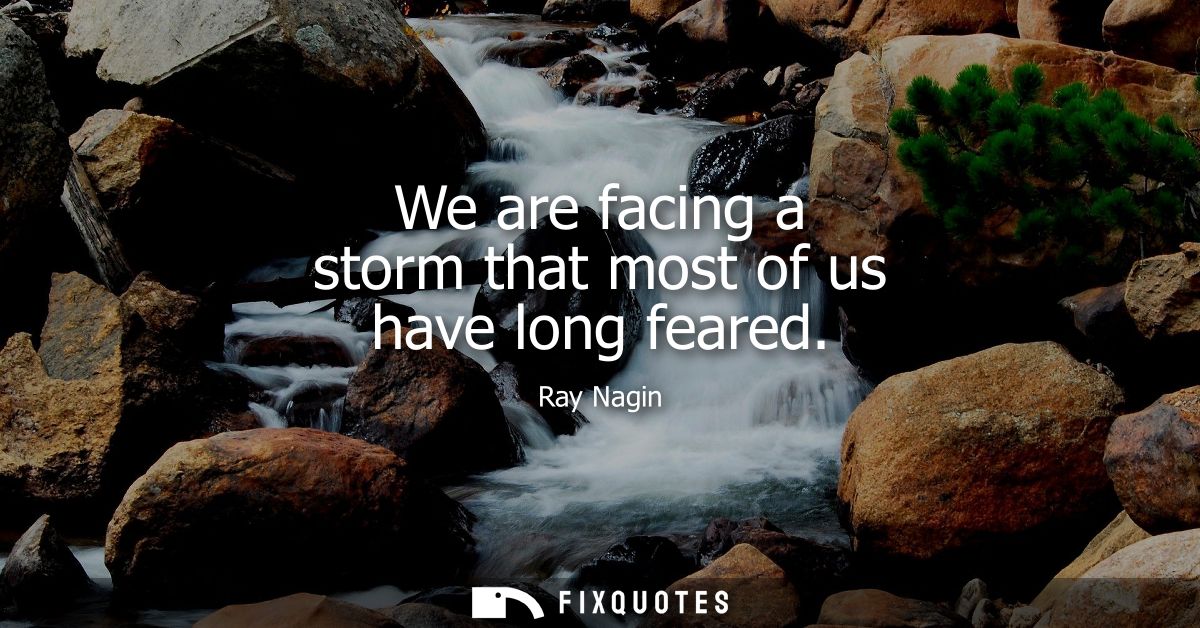
"We are facing a storm that most of us have long feared"
About this Quote
A storm is never just weather in a politician's mouth; it's a moral weather report. When Ray Nagin warns, "We are facing a storm that most of us have long feared", he compresses dread, inevitability, and collective vulnerability into a single forecast. The line works because it refuses specificity while still sounding precise. "A storm" is concrete enough to picture, but vague enough to hold multiple anxieties at once: catastrophe, failure of institutions, even the unease that comes from knowing you saw something coming and still weren't ready.
The pronouns do the heavy lifting. "We" performs solidarity, trying to flatten the gulf between the governed and the governing at the exact moment that gulf becomes deadly. "Most of us" quietly admits exclusion: some people feared this longer, louder, and with better reason. In a city like New Orleans, where risk maps often mirror race and poverty, fear isn't evenly distributed. That small qualifier signals a politics of unequal preparedness without naming it.
"Long feared" also functions as an alibi and an indictment. It's an alibi because it suggests the danger wasn't a surprise, shifting blame toward an abstract fate. It's an indictment because if the fear was longstanding, the obvious follow-up question is why the preparations weren't. The sentence is calibrated for crisis leadership: steadying in tone, communal in posture, and just ambiguous enough to cushion accountability while invoking urgency.
The pronouns do the heavy lifting. "We" performs solidarity, trying to flatten the gulf between the governed and the governing at the exact moment that gulf becomes deadly. "Most of us" quietly admits exclusion: some people feared this longer, louder, and with better reason. In a city like New Orleans, where risk maps often mirror race and poverty, fear isn't evenly distributed. That small qualifier signals a politics of unequal preparedness without naming it.
"Long feared" also functions as an alibi and an indictment. It's an alibi because it suggests the danger wasn't a surprise, shifting blame toward an abstract fate. It's an indictment because if the fear was longstanding, the obvious follow-up question is why the preparations weren't. The sentence is calibrated for crisis leadership: steadying in tone, communal in posture, and just ambiguous enough to cushion accountability while invoking urgency.
Quote Details
| Topic | Fear |
|---|---|
| Source | Verified source: Associated Press: Katrina evacuation report (Ray Nagin, 2005)
Evidence: We are facing a storm that most of us have long feared,. The earliest primary-source evidence I could verify is Ray Nagin speaking on August 28, 2005 during the New Orleans mandatory-evacuation period before Hurricane Katrina's landfall. A same-day/next-day Associated Press report quotes him verbatim: "We are facing a storm that most of us have long feared," said New Orleans Mayor C. Ray Nagin. A CNN transcript from August 28, 2005 appears to capture the same event/interview context, but in that transcript Nagin’s wording is slightly different: "This storm is enormous. It's coming up in a direction that most people have dreaded..." That suggests the famous wording may have come from a press conference or remarks carried by AP rather than the CNN phone interview, or AP may have quoted from a separate statement the same day. I could not verify an earlier book, interview, or published source before August 28, 2005. Other candidates (1) The Unthinkable (Amanda Ripley, 2009) compilation95.0% ... Ray Nagin was advising residents to evacuate . " Ladies and gentlemen , this is not a test . This is the real dea... |
| Cite |
Citation Formats
APA Style (7th ed.)
Nagin, Ray. (2026, March 12). We are facing a storm that most of us have long feared. FixQuotes. https://fixquotes.com/quotes/we-are-facing-a-storm-that-most-of-us-have-long-135848/
Chicago Style
Nagin, Ray. "We are facing a storm that most of us have long feared." FixQuotes. March 12, 2026. https://fixquotes.com/quotes/we-are-facing-a-storm-that-most-of-us-have-long-135848/.
MLA Style (9th ed.)
"We are facing a storm that most of us have long feared." FixQuotes, 12 Mar. 2026, https://fixquotes.com/quotes/we-are-facing-a-storm-that-most-of-us-have-long-135848/. Accessed 3 Apr. 2026.
More Quotes by Ray
Add to List