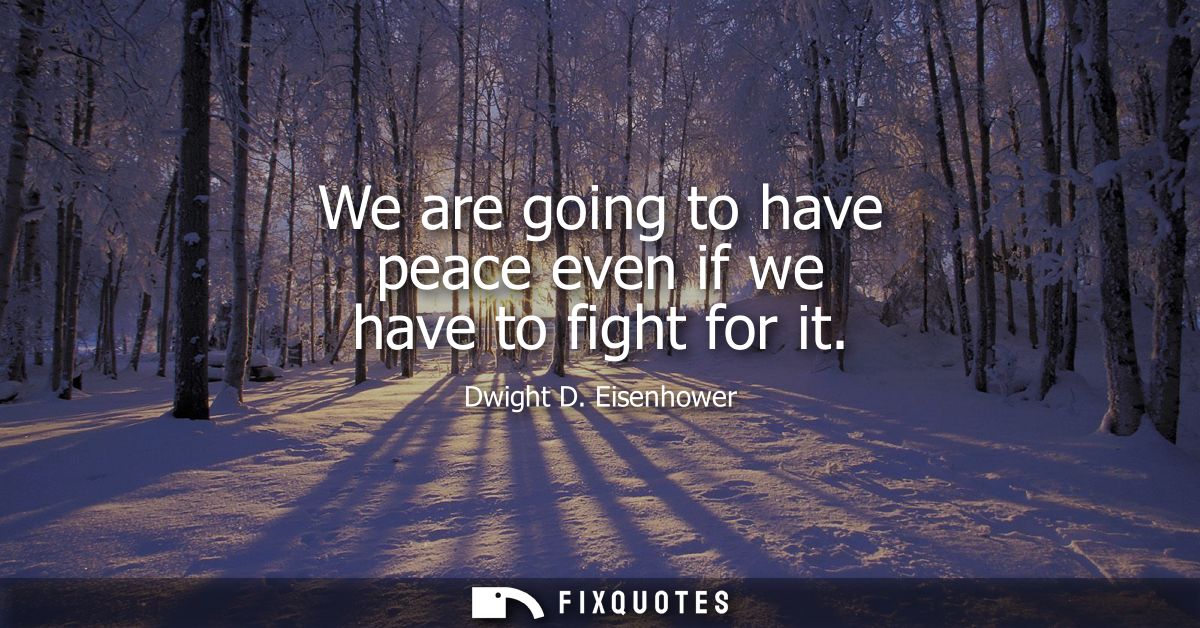
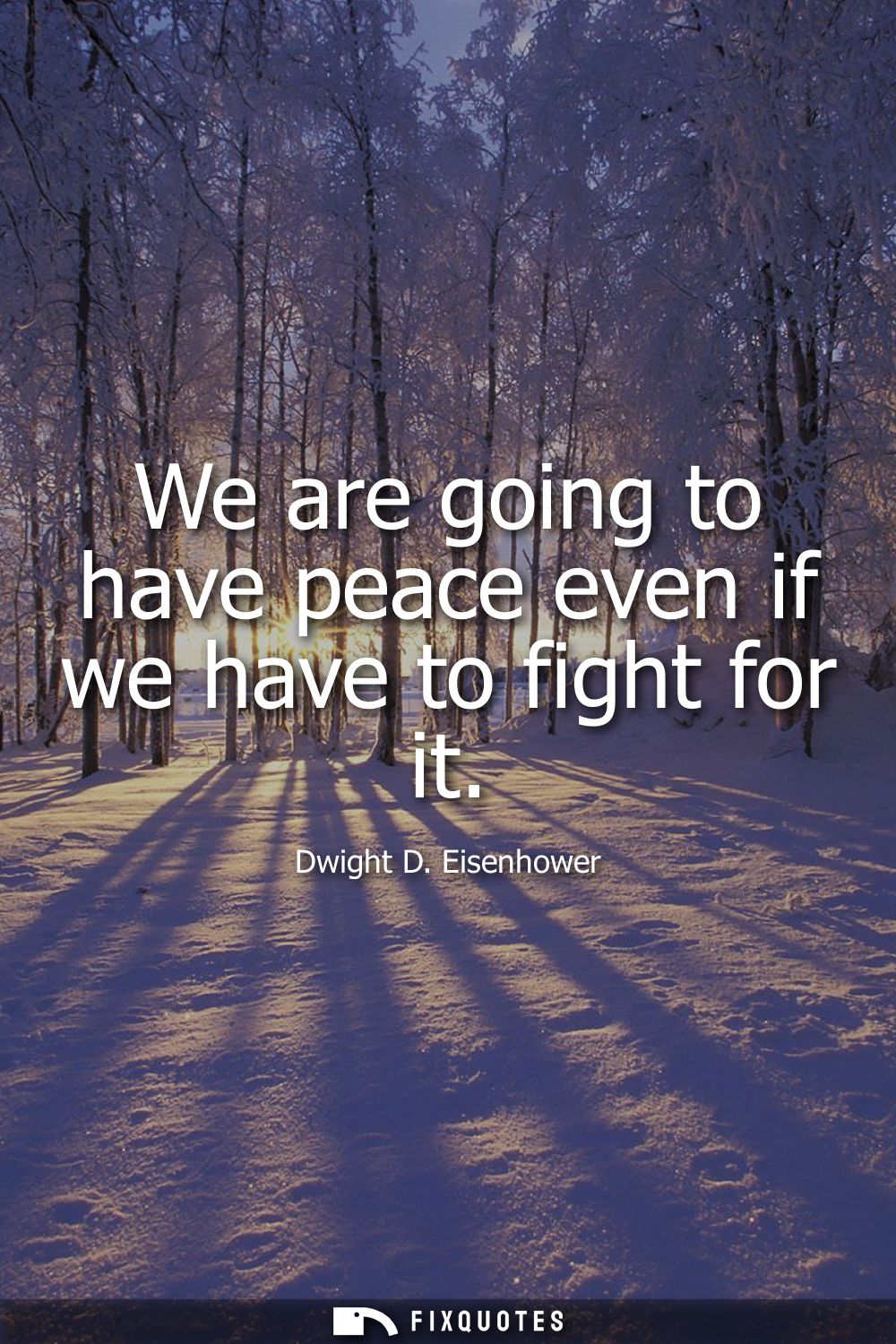
"We are going to have peace even if we have to fight for it"
About this Quote
“Peace” is doing double duty here: a moral ideal and a strategic outcome, not a mood. Eisenhower’s line works because it treats peace less like a dove on a poster and more like an engineering problem with a defense budget attached. The apparent contradiction - fighting for peace - is the point. It reframes violence as a tool of restraint, the unpleasant mechanism required to prevent something worse. In Cold War terms, it’s deterrence distilled into a sentence: credible force as the price of stability.
As a career general turned president, Eisenhower had unique authority to sell that paradox. He wasn’t an armchair hawk romanticizing conflict; he’d seen war at industrial scale. That biography gives the phrase its ballast, while also sharpening its edge. He’s not promising pacifism. He’s promising control: America will decide the terms under which peace is produced, maintained, and policed.
The subtext is a warning to adversaries and a reassurance to voters. To the Soviets, it signals resolve: any attempt to expand or intimidate will meet resistance. To Americans exhausted by World War II and anxious about Korea and nuclear escalation, it offers a tough-minded comfort - you can want peace without being naive about power.
It also hints at the era’s defining bargain: permanent military readiness justified as the guardian of normal life. Coming from the same president who later warned about the military-industrial complex, the quote reads as both doctrine and omen. Peace, in this framing, isn’t the absence of war; it’s the management of it.
As a career general turned president, Eisenhower had unique authority to sell that paradox. He wasn’t an armchair hawk romanticizing conflict; he’d seen war at industrial scale. That biography gives the phrase its ballast, while also sharpening its edge. He’s not promising pacifism. He’s promising control: America will decide the terms under which peace is produced, maintained, and policed.
The subtext is a warning to adversaries and a reassurance to voters. To the Soviets, it signals resolve: any attempt to expand or intimidate will meet resistance. To Americans exhausted by World War II and anxious about Korea and nuclear escalation, it offers a tough-minded comfort - you can want peace without being naive about power.
It also hints at the era’s defining bargain: permanent military readiness justified as the guardian of normal life. Coming from the same president who later warned about the military-industrial complex, the quote reads as both doctrine and omen. Peace, in this framing, isn’t the absence of war; it’s the management of it.
Quote Details
| Topic | Peace |
|---|---|
| Source | Later attribution: Quotes: The Famous and Not so Famous (Terence M. Dorn Ph.D., 2021) modern compilationISBN: 9781662447952 · ID: ptZSEAAAQBAJ
Evidence:
... Dwight D. Eisenhower A sense of humor is part of the art of leadership , of getting along with people , of getting things done . - Dwight D. Eisenhower We are going to have peace even if we have to fight for it.- Dwight D. Eisenhower ... |
| Cite |
Citation Formats
APA Style (7th ed.)
Eisenhower, Dwight D. (2026, February 16). We are going to have peace even if we have to fight for it. FixQuotes. https://fixquotes.com/quotes/we-are-going-to-have-peace-even-if-we-have-to-19031/
Chicago Style
Eisenhower, Dwight D. "We are going to have peace even if we have to fight for it." FixQuotes. February 16, 2026. https://fixquotes.com/quotes/we-are-going-to-have-peace-even-if-we-have-to-19031/.
MLA Style (9th ed.)
"We are going to have peace even if we have to fight for it." FixQuotes, 16 Feb. 2026, https://fixquotes.com/quotes/we-are-going-to-have-peace-even-if-we-have-to-19031/. Accessed 29 Mar. 2026.
More Quotes by Dwight
Add to List