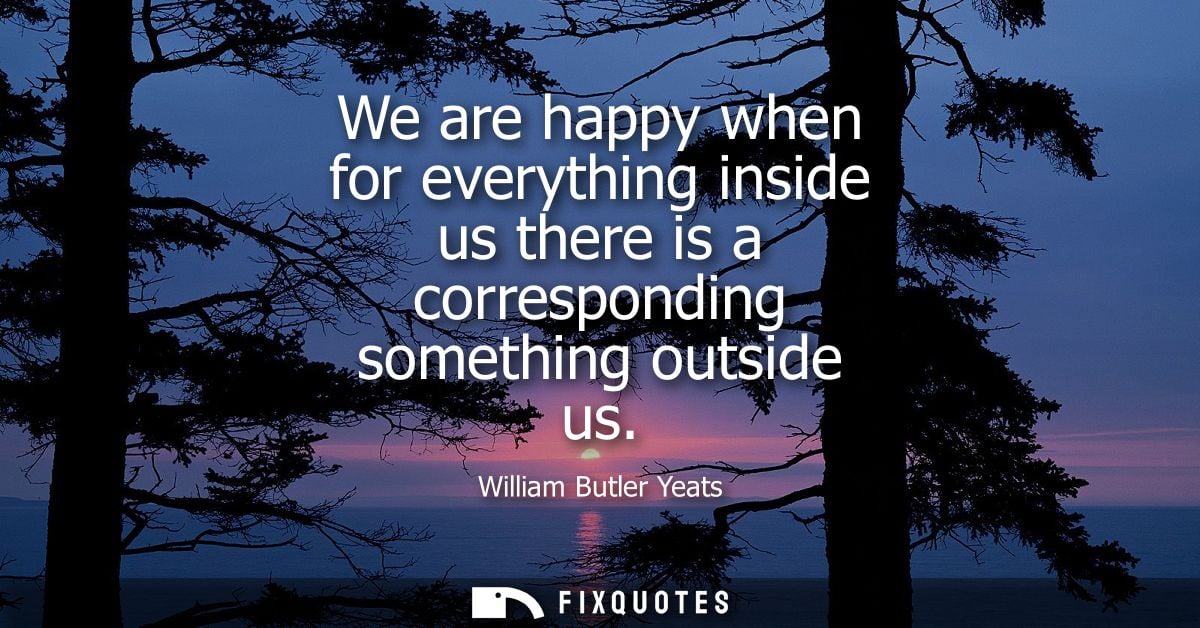
"We are happy when for everything inside us there is a corresponding something outside us"
About this Quote
The subtext is both romantic and faintly ominous. Romantic, because it insists the self is not self-sufficient; it wants recognition, embodiment, reply. Ominous, because it makes happiness contingent: if the world refuses to mirror you, you don’t just feel disappointed, you feel unreal. Yeats is describing a psyche hungry for objective correlative before Eliot made the term famous: emotions need images, events, and other people to land on, or they curdle into abstraction.
Context matters: Yeats wrote under the long shadow of Irish cultural nationalism, spiritualism, and modernity’s disenchanted grind. He built elaborate symbolic systems - masks, gyres, mythic cycles - precisely to make “inside” and “outside” rhyme. The intent here is a quiet defense of art and love as alignment technologies: poetry as the craft that finds, or forges, that “corresponding something.” It’s also a warning: when the outer world doesn’t answer, the inner world can turn feverish, and Yeats knew how quickly that mismatch becomes politics, obsession, or prophecy.
Quote Details
| Topic | Happiness |
|---|---|
| Source | Help us find the source |
| Cite |
Citation Formats
APA Style (7th ed.)
Yeats, William Butler. (2026, January 18). We are happy when for everything inside us there is a corresponding something outside us. FixQuotes. https://fixquotes.com/quotes/we-are-happy-when-for-everything-inside-us-there-11062/
Chicago Style
Yeats, William Butler. "We are happy when for everything inside us there is a corresponding something outside us." FixQuotes. January 18, 2026. https://fixquotes.com/quotes/we-are-happy-when-for-everything-inside-us-there-11062/.
MLA Style (9th ed.)
"We are happy when for everything inside us there is a corresponding something outside us." FixQuotes, 18 Jan. 2026, https://fixquotes.com/quotes/we-are-happy-when-for-everything-inside-us-there-11062/. Accessed 25 Mar. 2026.