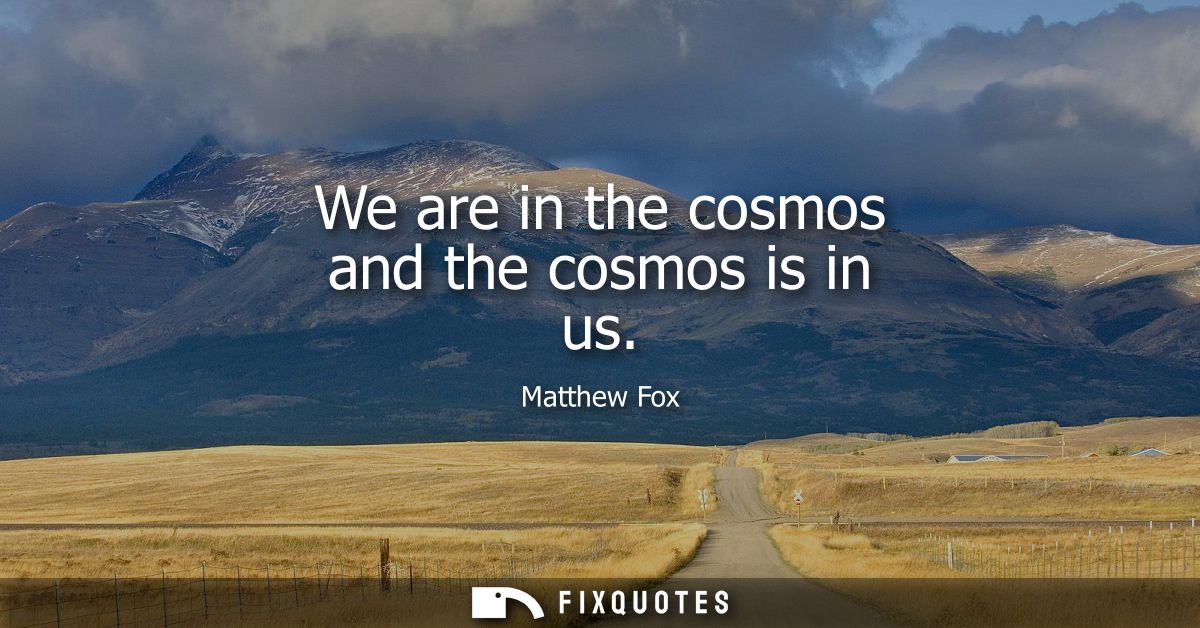
"We are in the cosmos and the cosmos is in us"
About this Quote
Fox’s line collapses the distance we’re trained to feel between “out there” and “in here.” It’s a spiritual jailbreak disguised as a simple mirror phrase: not only do we inhabit the universe, but the universe inhabits us. The symmetry is doing the persuasion. By repeating “cosmos” on both sides of the sentence, Fox smuggles in a claim about belonging that bypasses debate and lands as recognition.
The intent is less scientific than ethical. Fox, known for creation spirituality and a sometimes-combustible relationship with institutional Christianity, is pushing against a theology that treats Earth as a temporary stage and the body as suspect. “Cosmos” signals something larger than “nature”: a charged, almost sacred order. If the cosmos is in us, then alienation becomes a kind of false consciousness, and exploitation starts to look like self-harm. Environmental politics turns intimate. Wonder becomes obligation.
The subtext also runs against the modern habit of splitting meaning into two competing camps: cold materialism or private faith. Fox tries to fuse them. You can read the phrase as poetic mysticism, but it also echoes the plain facts of physics and biology: stardust chemistry, borrowed atoms, breathable air cycling through lungs and forests. That double readability is why it works culturally. It offers a bridge between spiritual longing and ecological reality without making either side feel patronized.
Contextually, it belongs to a late-20th-century turn toward eco-theology and holistic thinking, a rebuttal to both religious austerity and consumer modernity’s lonely individual. The sentence is a tiny manifesto: you are not a visitor here. You are a participant.
The intent is less scientific than ethical. Fox, known for creation spirituality and a sometimes-combustible relationship with institutional Christianity, is pushing against a theology that treats Earth as a temporary stage and the body as suspect. “Cosmos” signals something larger than “nature”: a charged, almost sacred order. If the cosmos is in us, then alienation becomes a kind of false consciousness, and exploitation starts to look like self-harm. Environmental politics turns intimate. Wonder becomes obligation.
The subtext also runs against the modern habit of splitting meaning into two competing camps: cold materialism or private faith. Fox tries to fuse them. You can read the phrase as poetic mysticism, but it also echoes the plain facts of physics and biology: stardust chemistry, borrowed atoms, breathable air cycling through lungs and forests. That double readability is why it works culturally. It offers a bridge between spiritual longing and ecological reality without making either side feel patronized.
Contextually, it belongs to a late-20th-century turn toward eco-theology and holistic thinking, a rebuttal to both religious austerity and consumer modernity’s lonely individual. The sentence is a tiny manifesto: you are not a visitor here. You are a participant.
Quote Details
| Topic | Deep |
|---|---|
| Source | Help us find the source |
More Quotes by Matthew
Add to List