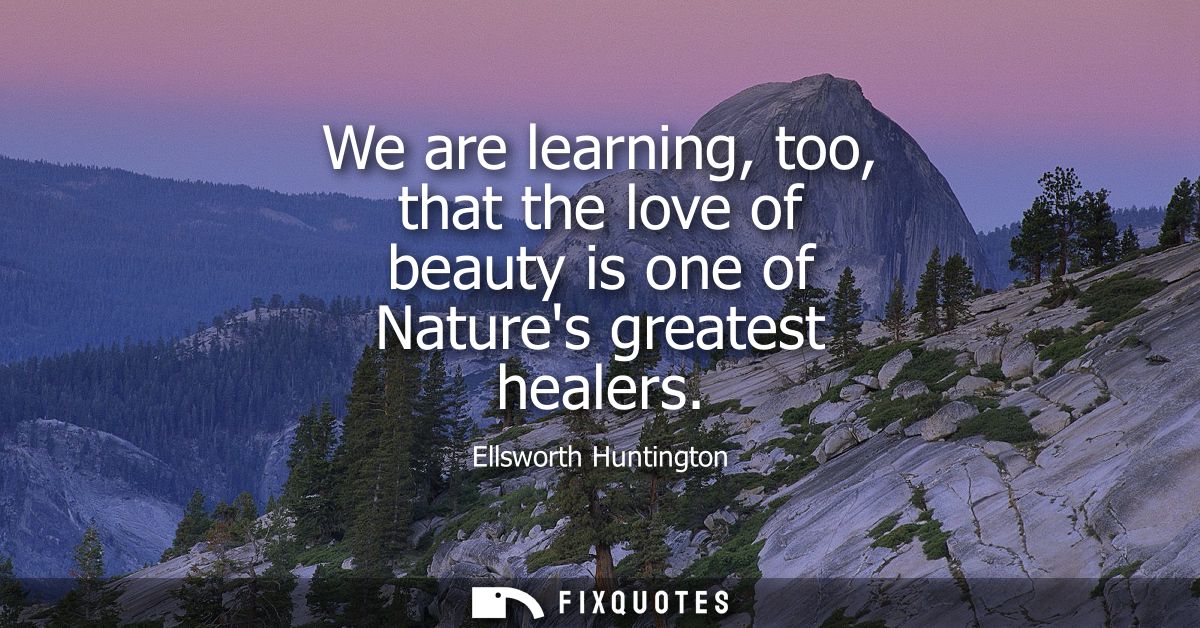
"We are learning, too, that the love of beauty is one of Nature's greatest healers"
About this Quote
The subtext is slightly paternal and distinctly Progressive: if nature supplies “one of… greatest healers,” then modern society has an obligation to give people access to it. Think parks, school art programs, city beautification, the moralized language of “uplift.” The line assumes the industrial world is making people sick in ways doctors can’t fully treat, and that restoration requires more than medicine: it requires re-tuning the senses. “Nature” does double duty here, acting as both environment (trees, landscapes, light) and authority (a legitimizing force that blesses beauty as necessary rather than indulgent).
The intent is persuasive, not poetic. By calling beauty a healer, Huntington turns aesthetics into a tool for resilience: something that steadies the mind, softens stress, rehumanizes people ground down by work and modern pace. It’s also a quiet rebuke to utilitarian thinking. If a society can quantify productivity but can’t make room for beauty, Huntington suggests, it is misunderstanding what keeps people whole.
Quote Details
| Topic | Nature |
|---|---|
| Source | Help us find the source |
| Cite |
Citation Formats
APA Style (7th ed.)
Huntington, Ellsworth. (2026, January 17). We are learning, too, that the love of beauty is one of Nature's greatest healers. FixQuotes. https://fixquotes.com/quotes/we-are-learning-too-that-the-love-of-beauty-is-67301/
Chicago Style
Huntington, Ellsworth. "We are learning, too, that the love of beauty is one of Nature's greatest healers." FixQuotes. January 17, 2026. https://fixquotes.com/quotes/we-are-learning-too-that-the-love-of-beauty-is-67301/.
MLA Style (9th ed.)
"We are learning, too, that the love of beauty is one of Nature's greatest healers." FixQuotes, 17 Jan. 2026, https://fixquotes.com/quotes/we-are-learning-too-that-the-love-of-beauty-is-67301/. Accessed 22 Mar. 2026.