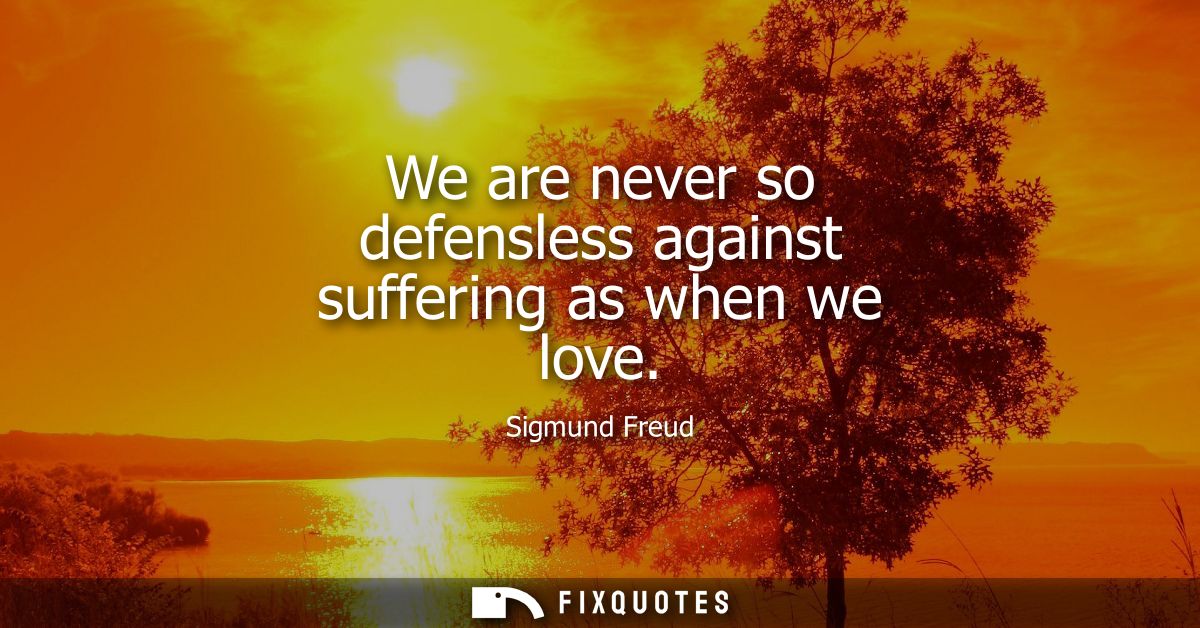
"We are never so defensless against suffering as when we love"
About this Quote
Love, for Freud, is less a refuge than an exposed nerve. The line hits because it reverses the sentimental promise that intimacy will save us: attachment is precisely what makes pain possible, then inevitable. Freud understood suffering not as random misfortune but as a predictable tax on investment. When you love, you hand someone the power to disappoint you, abandon you, die on you, or simply fail to be what your psyche recruited them to be.
The intent is clinical, almost prosecutorial. Freud is naming a structural vulnerability: love concentrates value in a person or object, and the mind responds by raising the stakes. The subtext is that we don’t just love others; we use them. We enlist them to stabilize our anxieties, replay our earliest bonds, soothe old deprivation. That’s why love can feel like destiny and why loss feels like catastrophe: it’s not only the present relationship that’s threatened, but the whole internal architecture built around it.
Context matters. Freud wrote in a Europe where modernity was stripping away traditional consolations, and his project was to show that the psyche has its own brutal logic. In that framework, defenselessness isn’t a moral failing; it’s the cost of attachment itself. The quote also slips in a darkly democratic idea: no amount of intelligence or self-command fully insulates you. To love is to accept an asymmetry you can’t psychoanalyze away in real time. That’s the sting, and the honesty, that keeps the sentence alive.
The intent is clinical, almost prosecutorial. Freud is naming a structural vulnerability: love concentrates value in a person or object, and the mind responds by raising the stakes. The subtext is that we don’t just love others; we use them. We enlist them to stabilize our anxieties, replay our earliest bonds, soothe old deprivation. That’s why love can feel like destiny and why loss feels like catastrophe: it’s not only the present relationship that’s threatened, but the whole internal architecture built around it.
Context matters. Freud wrote in a Europe where modernity was stripping away traditional consolations, and his project was to show that the psyche has its own brutal logic. In that framework, defenselessness isn’t a moral failing; it’s the cost of attachment itself. The quote also slips in a darkly democratic idea: no amount of intelligence or self-command fully insulates you. To love is to accept an asymmetry you can’t psychoanalyze away in real time. That’s the sting, and the honesty, that keeps the sentence alive.
Quote Details
| Topic | Love |
|---|---|
| Source | Help us find the source |
| Cite |
Citation Formats
APA Style (7th ed.)
Freud, Sigmund. (2026, January 18). We are never so defensless against suffering as when we love. FixQuotes. https://fixquotes.com/quotes/we-are-never-so-defensless-against-suffering-as-21173/
Chicago Style
Freud, Sigmund. "We are never so defensless against suffering as when we love." FixQuotes. January 18, 2026. https://fixquotes.com/quotes/we-are-never-so-defensless-against-suffering-as-21173/.
MLA Style (9th ed.)
"We are never so defensless against suffering as when we love." FixQuotes, 18 Jan. 2026, https://fixquotes.com/quotes/we-are-never-so-defensless-against-suffering-as-21173/. Accessed 12 Feb. 2026.
More Quotes by Sigmund
Add to List