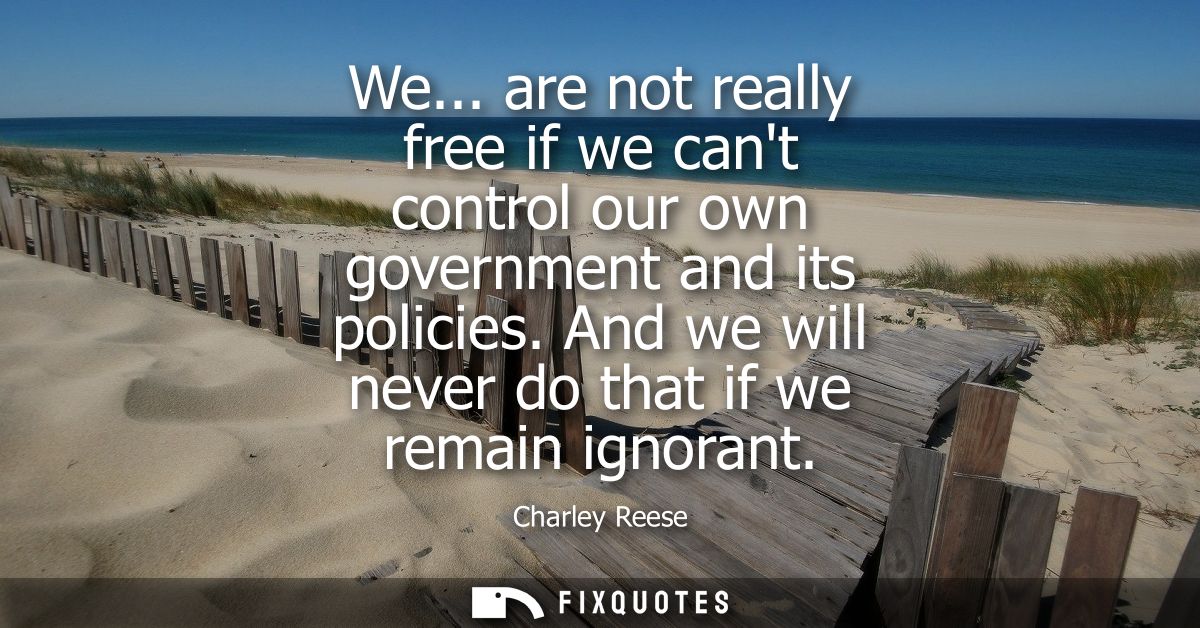
"We... are not really free if we can't control our own government and its policies. And we will never do that if we remain ignorant"
About this Quote
The specific intent is to reframe ignorance as a form of consent. Reese’s "control" isn’t about domination; it’s about accountability: shaping policy, checking institutions, resisting propaganda, voting with comprehension rather than habit. The subtext is that many people treat politics as background noise until it becomes personal, and by then the machinery is already pointed in one direction. Ignorance becomes not just a private failing but a public vulnerability, something that can be managed by those with money, media access, and bureaucratic permanence.
Contextually, Reese wrote as a populist-leaning columnist skeptical of centralized power, surveillance, foreign entanglements, and the cozy ecosystem of Washington incentives. His line lands in the tradition of American civic republicanism: the idea that self-government requires citizens who can recognize when they’re being sold fear, simplicity, or spectacle. It works because it flips the usual hierarchy: freedom isn’t the starting point; it’s the outcome. And the price of admission is attention.
Quote Details
| Topic | Freedom |
|---|---|
| Source | Help us find the source |
| Cite |
Citation Formats
APA Style (7th ed.)
Reese, Charley. (2026, January 17). We... are not really free if we can't control our own government and its policies. And we will never do that if we remain ignorant. FixQuotes. https://fixquotes.com/quotes/we-are-not-really-free-if-we-cant-control-our-own-67160/
Chicago Style
Reese, Charley. "We... are not really free if we can't control our own government and its policies. And we will never do that if we remain ignorant." FixQuotes. January 17, 2026. https://fixquotes.com/quotes/we-are-not-really-free-if-we-cant-control-our-own-67160/.
MLA Style (9th ed.)
"We... are not really free if we can't control our own government and its policies. And we will never do that if we remain ignorant." FixQuotes, 17 Jan. 2026, https://fixquotes.com/quotes/we-are-not-really-free-if-we-cant-control-our-own-67160/. Accessed 3 Apr. 2026.