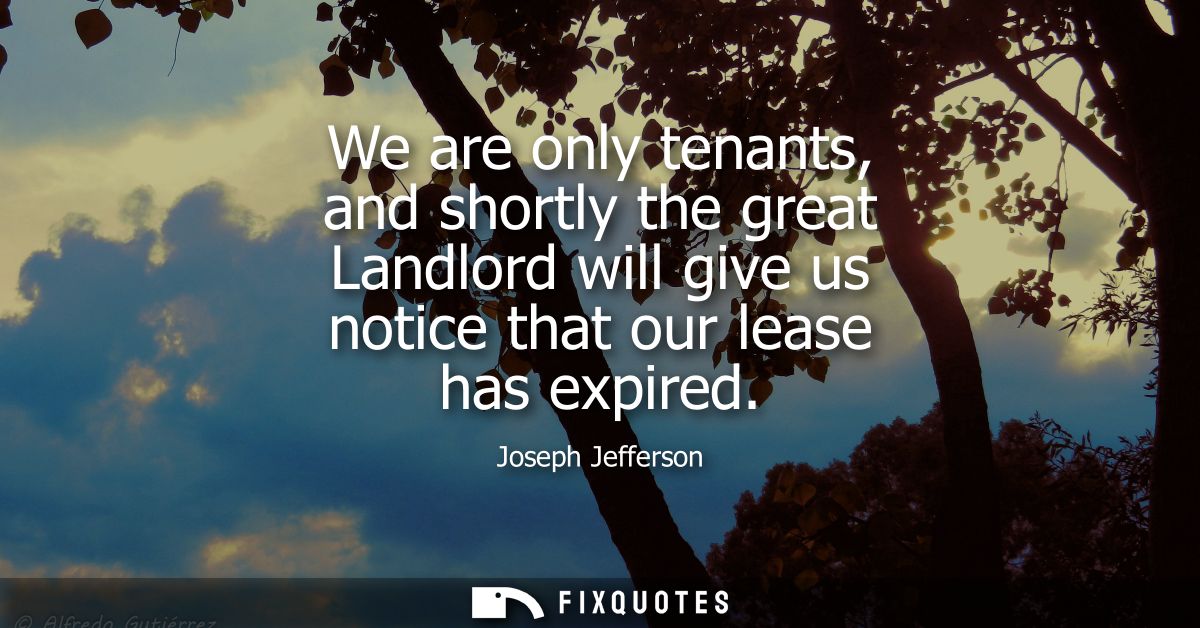
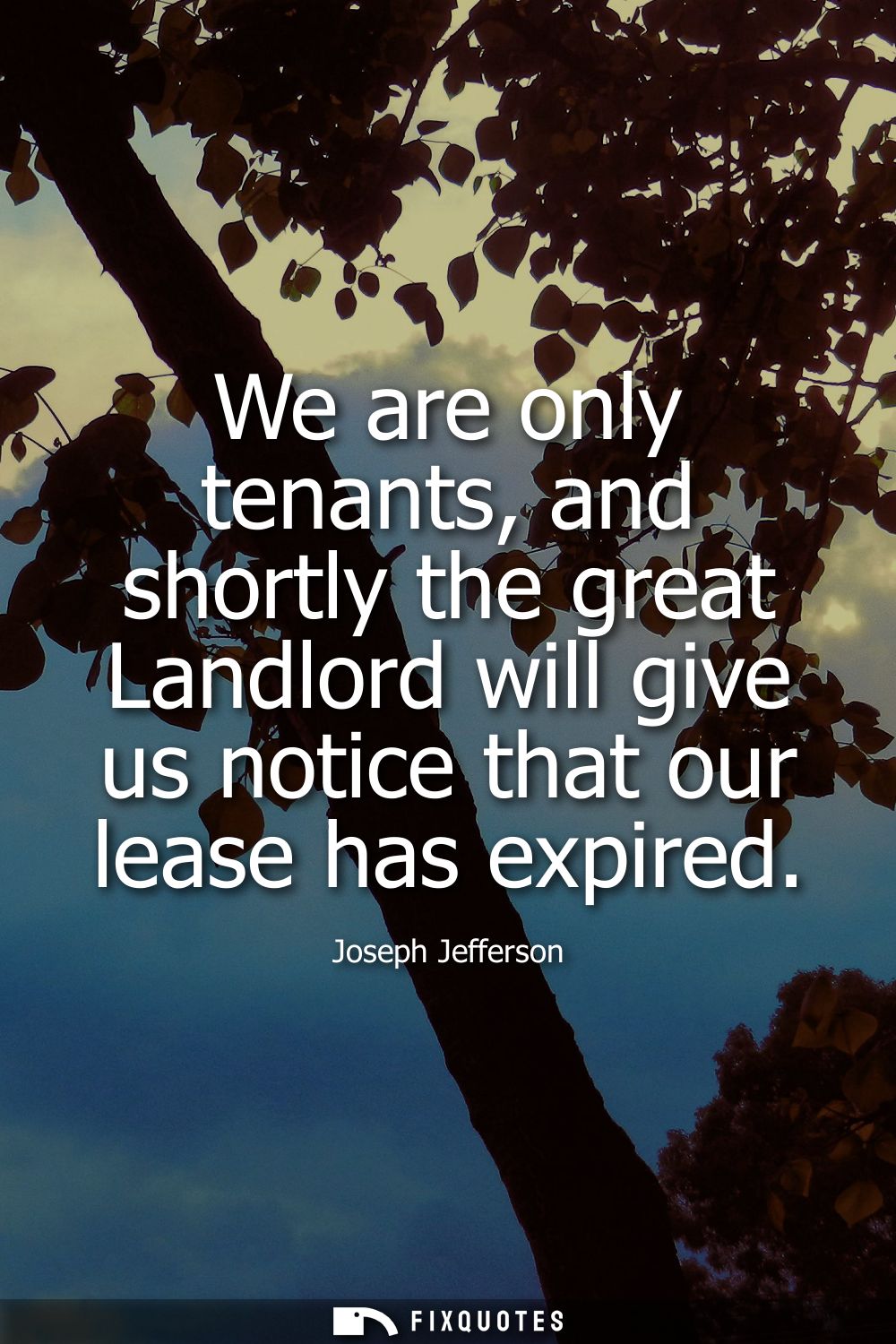
"We are only tenants, and shortly the great Landlord will give us notice that our lease has expired"
About this Quote
The “great Landlord” is capital-G divinity, but Jefferson avoids sermonizing. God isn’t a wrathful judge; He’s an administrator. That’s the subtextual trick: the cosmos is not out to “get” you. It’s simply structured so your stay ends. The line offers consolation without promising escape. You aren’t being singled out; your contract was always finite.
There’s also a quiet moral argument hiding in the real-estate imagery. If you’re only a tenant, stewardship matters. You don’t trash a place you’ll be held accountable for, and you don’t confuse occupancy with entitlement. In a 19th-century America reshaped by property, expansion, and the sudden enrichment of some and dispossession of others, the metaphor carries a gentle corrective: possession is provisional. Even the powerful are renters in the long run.
Jefferson, a beloved stage figure, likely understood audiences crave levity around the inevitable. The line works because it grants dignity to impermanence while offering a crisp, almost comic frame: death as notice served, not chaos unleashed.
Quote Details
| Topic | Mortality |
|---|---|
| Source | Help us find the source |
| Cite |
Citation Formats
APA Style (7th ed.)
Jefferson, Joseph. (2026, January 16). We are only tenants, and shortly the great Landlord will give us notice that our lease has expired. FixQuotes. https://fixquotes.com/quotes/we-are-only-tenants-and-shortly-the-great-137007/
Chicago Style
Jefferson, Joseph. "We are only tenants, and shortly the great Landlord will give us notice that our lease has expired." FixQuotes. January 16, 2026. https://fixquotes.com/quotes/we-are-only-tenants-and-shortly-the-great-137007/.
MLA Style (9th ed.)
"We are only tenants, and shortly the great Landlord will give us notice that our lease has expired." FixQuotes, 16 Jan. 2026, https://fixquotes.com/quotes/we-are-only-tenants-and-shortly-the-great-137007/. Accessed 20 Mar. 2026.