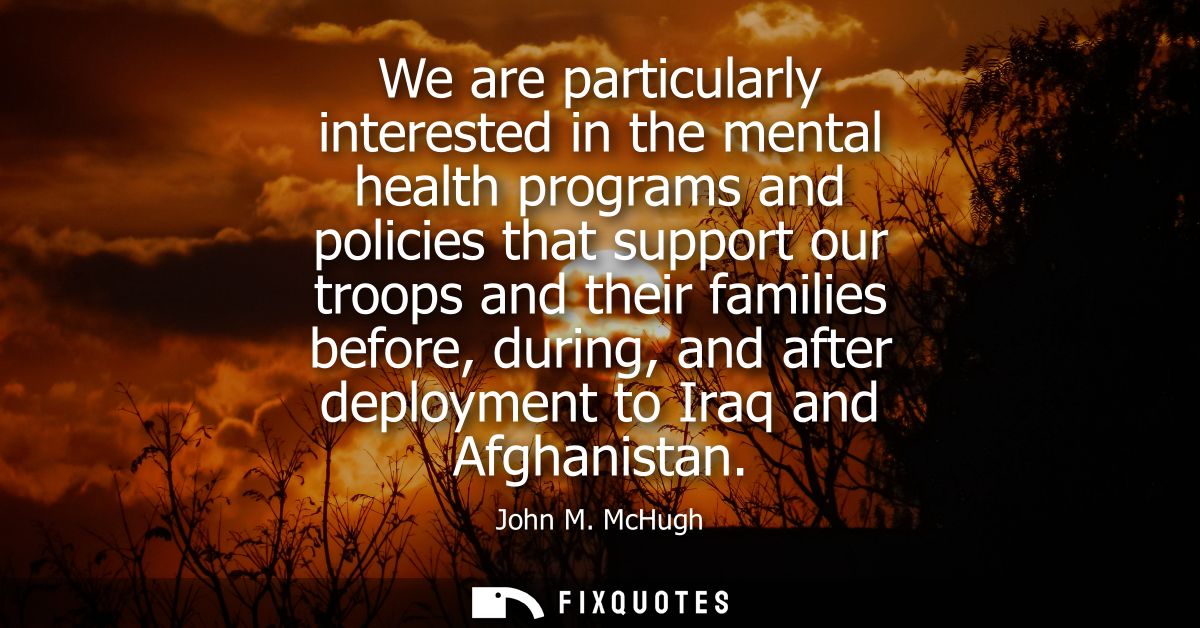
"We are particularly interested in the mental health programs and policies that support our troops and their families before, during, and after deployment to Iraq and Afghanistan"
About this Quote
The time-stamped specificity of “Iraq and Afghanistan” anchors the quote in the post-9/11 wars, when the public narrative leaned on heroism and sacrifice while the private costs piled up: repeat deployments, traumatic brain injury, PTSD, depression, suicide risk, family breakdown, bureaucratic delays inside the VA and DoD. McHugh’s inclusion of “their families” widens the blast radius. It quietly rejects the older myth that war damage stops at the uniform, acknowledging spouses raising kids alone, reintegration strain, caregiver burden, and the secondary trauma that policy often treats as an afterthought.
The phrase “before, during, and after deployment” is doing policy work. It’s a critique of reactive care models that wait for a crisis, insisting on continuity: screening and resilience prep, in-theater support, and long-tail services when the news cycle has moved on. Subtext: the wounds of these wars are not episodic; they’re administrative, cumulative, and expensive. By casting mental health as a programmatic lifecycle, McHugh is making a political case that caring for troops isn’t only patriotism in speeches - it’s sustained infrastructure when the cameras leave.
Quote Details
| Topic | Mental Health |
|---|---|
| Source | Help us find the source |
| Cite |
Citation Formats
APA Style (7th ed.)
McHugh, John M. (2026, January 16). We are particularly interested in the mental health programs and policies that support our troops and their families before, during, and after deployment to Iraq and Afghanistan. FixQuotes. https://fixquotes.com/quotes/we-are-particularly-interested-in-the-mental-93920/
Chicago Style
McHugh, John M. "We are particularly interested in the mental health programs and policies that support our troops and their families before, during, and after deployment to Iraq and Afghanistan." FixQuotes. January 16, 2026. https://fixquotes.com/quotes/we-are-particularly-interested-in-the-mental-93920/.
MLA Style (9th ed.)
"We are particularly interested in the mental health programs and policies that support our troops and their families before, during, and after deployment to Iraq and Afghanistan." FixQuotes, 16 Jan. 2026, https://fixquotes.com/quotes/we-are-particularly-interested-in-the-mental-93920/. Accessed 5 Apr. 2026.