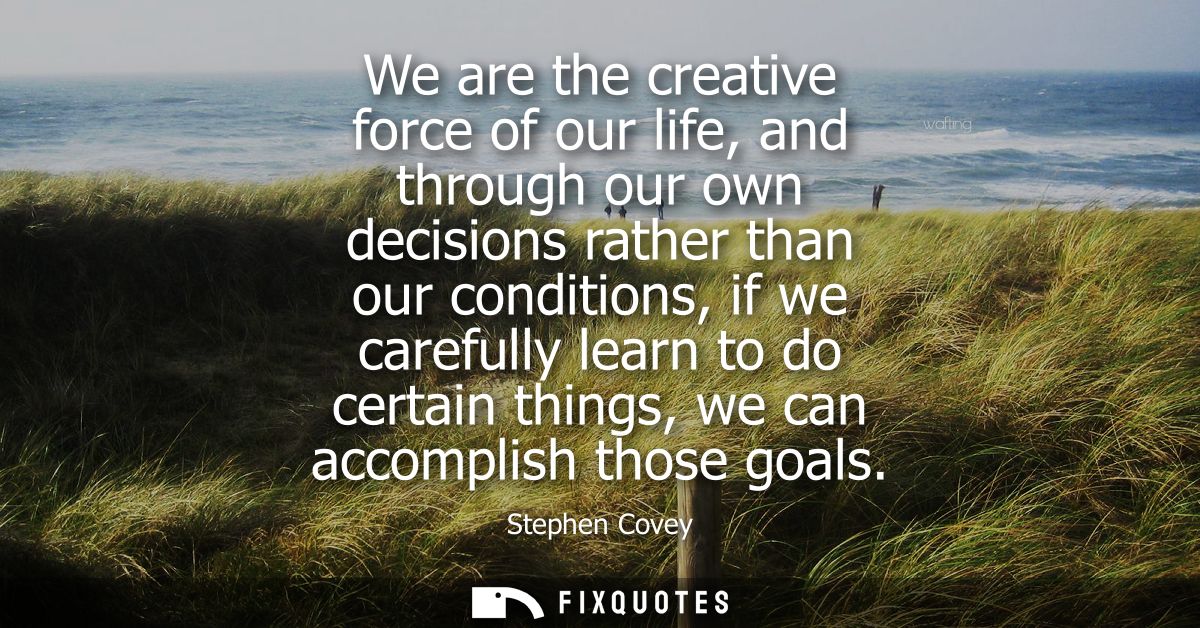
"We are the creative force of our life, and through our own decisions rather than our conditions, if we carefully learn to do certain things, we can accomplish those goals"
About this Quote
The subtext is a quiet rebuke to victimhood narratives and, more broadly, to structural explanations. By contrasting “decisions” with “conditions,” Covey loads the moral weight onto the individual. If your life isn’t where you want it, the implication goes, you’ve mismanaged your choices or failed to acquire the right habits. That’s bracing, even liberating, and it’s also a convenient ideology for institutions: it shifts attention away from pay scales, discrimination, unstable housing, or burnout-inducing workloads and toward personal optimization.
Context matters. Covey rose with late-20th-century corporate culture’s hunger for portable character: leadership as a toolkit, ethics as productivity, inner life as performance. This line works because it flatters the modern professional’s favorite fantasy: that the self is a start-up. You can pivot, iterate, “accomplish those goals.” It’s hope with an action plan, sharpened into a sentence that makes responsibility feel like power.
Quote Details
| Topic | Goal Setting |
|---|---|
| Source | Help us find the source |
| Cite |
Citation Formats
APA Style (7th ed.)
Covey, Stephen. (2026, January 17). We are the creative force of our life, and through our own decisions rather than our conditions, if we carefully learn to do certain things, we can accomplish those goals. FixQuotes. https://fixquotes.com/quotes/we-are-the-creative-force-of-our-life-and-through-27338/
Chicago Style
Covey, Stephen. "We are the creative force of our life, and through our own decisions rather than our conditions, if we carefully learn to do certain things, we can accomplish those goals." FixQuotes. January 17, 2026. https://fixquotes.com/quotes/we-are-the-creative-force-of-our-life-and-through-27338/.
MLA Style (9th ed.)
"We are the creative force of our life, and through our own decisions rather than our conditions, if we carefully learn to do certain things, we can accomplish those goals." FixQuotes, 17 Jan. 2026, https://fixquotes.com/quotes/we-are-the-creative-force-of-our-life-and-through-27338/. Accessed 2 Apr. 2026.