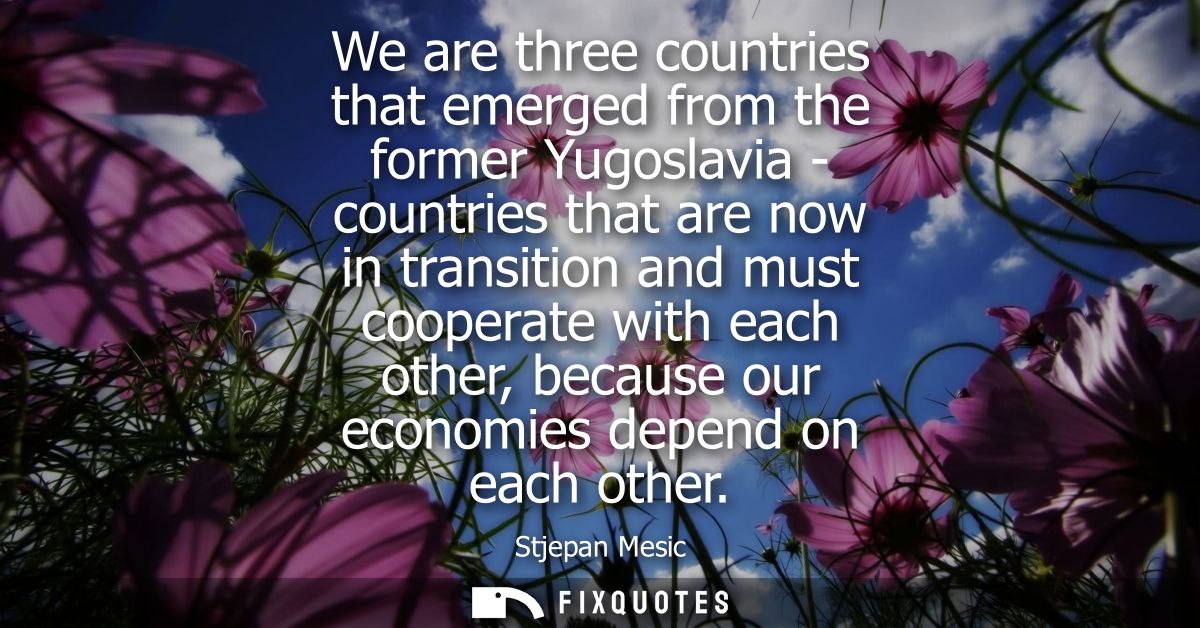
"We are three countries that emerged from the former Yugoslavia - countries that are now in transition and must cooperate with each other, because our economies depend on each other"
About this Quote
The phrase "must cooperate" is the tell. It pretends to be economic common sense, but it is also a moral demand smuggled in as pragmatism. Mesic is sidestepping the emotional minefield of nationalism by arguing from necessity: you can hate your neighbor, but you still need their port, their rail line, their consumers, their energy routes. Interdependence becomes the quiet antidote to the region's favorite political drug: grievance.
"Three countries" is strategic narrowing. The former Yugoslavia produced more than three successor states, but Mesic is likely invoking the most tightly knotted economic triangle in the northwestern Balkans (Croatia, Bosnia and Herzegovina, and Serbia, depending on the moment). It's a way of keeping the argument concrete while avoiding a grand, doomed call to reconstitute Yugoslavia. Cooperation, not reunion.
In the early 2000s, with EU accession as the horizon and war-crimes tribunals as the shadow, Mesic's intent reads as statecraft by reframing: shift the conversation from who suffered more to who can build more. Economic dependence isn't just a fact; it's leverage against the politics of permanent revenge.
Quote Details
| Topic | Peace |
|---|---|
| Source | Help us find the source |
| Cite |
Citation Formats
APA Style (7th ed.)
Mesic, Stjepan. (2026, January 16). We are three countries that emerged from the former Yugoslavia - countries that are now in transition and must cooperate with each other, because our economies depend on each other. FixQuotes. https://fixquotes.com/quotes/we-are-three-countries-that-emerged-from-the-133741/
Chicago Style
Mesic, Stjepan. "We are three countries that emerged from the former Yugoslavia - countries that are now in transition and must cooperate with each other, because our economies depend on each other." FixQuotes. January 16, 2026. https://fixquotes.com/quotes/we-are-three-countries-that-emerged-from-the-133741/.
MLA Style (9th ed.)
"We are three countries that emerged from the former Yugoslavia - countries that are now in transition and must cooperate with each other, because our economies depend on each other." FixQuotes, 16 Jan. 2026, https://fixquotes.com/quotes/we-are-three-countries-that-emerged-from-the-133741/. Accessed 5 Mar. 2026.