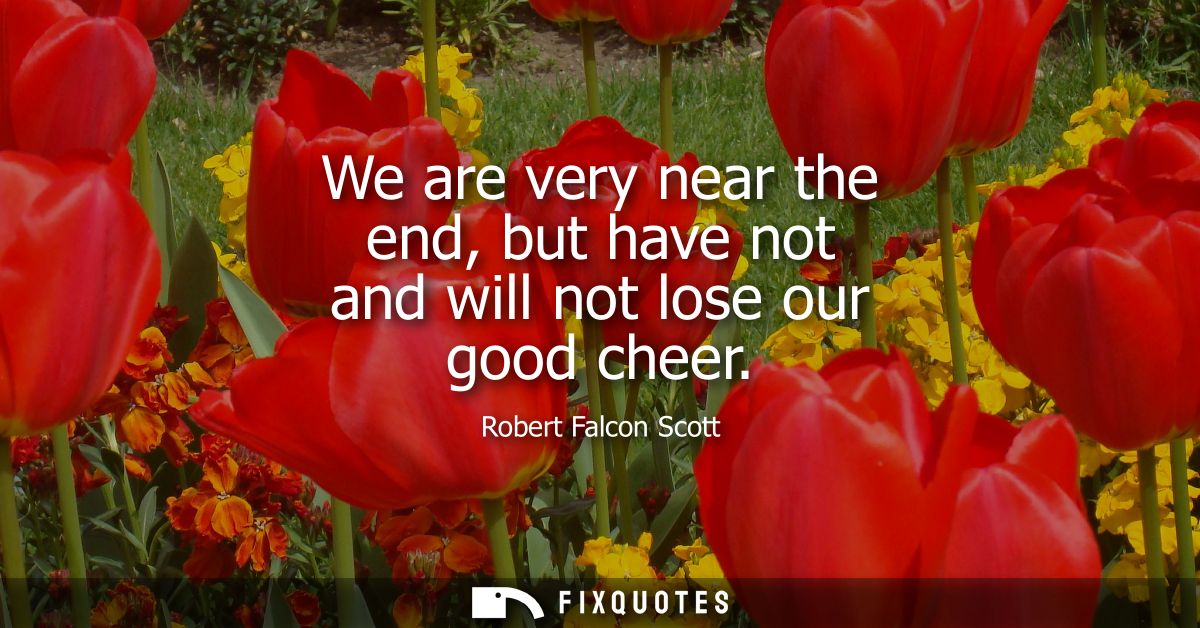
"We are very near the end, but have not and will not lose our good cheer"
About this Quote
The intent is partly private - a man steadying himself and his companions - and partly public, aimed at the imagined reader who will eventually recover the words. Scott knows he’s writing for posterity, and that awareness shapes the subtext: if the body fails, the narrative must not. “Good cheer” sounds quaint, even underpowered against starvation and frostbite, which is exactly why it works. It’s the language of Edwardian stoicism, the cultural code that prized restraint over confession. By choosing understatement, Scott turns catastrophe into proof of discipline.
Context matters: this is not just personal tragedy but the collapse of a national romance about heroic conquest, arriving after the crushing discovery that Amundsen had already beaten them to the Pole. The line functions as reputational triage. It asks the world to remember not the miscalculations, but the demeanor - as if morale itself could be a last, clean victory.
Quote Details
| Topic | Resilience |
|---|---|
| Source | Help us find the source |
| Cite |
Citation Formats
APA Style (7th ed.)
Scott, Robert Falcon. (2026, January 18). We are very near the end, but have not and will not lose our good cheer. FixQuotes. https://fixquotes.com/quotes/we-are-very-near-the-end-but-have-not-and-will-18857/
Chicago Style
Scott, Robert Falcon. "We are very near the end, but have not and will not lose our good cheer." FixQuotes. January 18, 2026. https://fixquotes.com/quotes/we-are-very-near-the-end-but-have-not-and-will-18857/.
MLA Style (9th ed.)
"We are very near the end, but have not and will not lose our good cheer." FixQuotes, 18 Jan. 2026, https://fixquotes.com/quotes/we-are-very-near-the-end-but-have-not-and-will-18857/. Accessed 12 Feb. 2026.