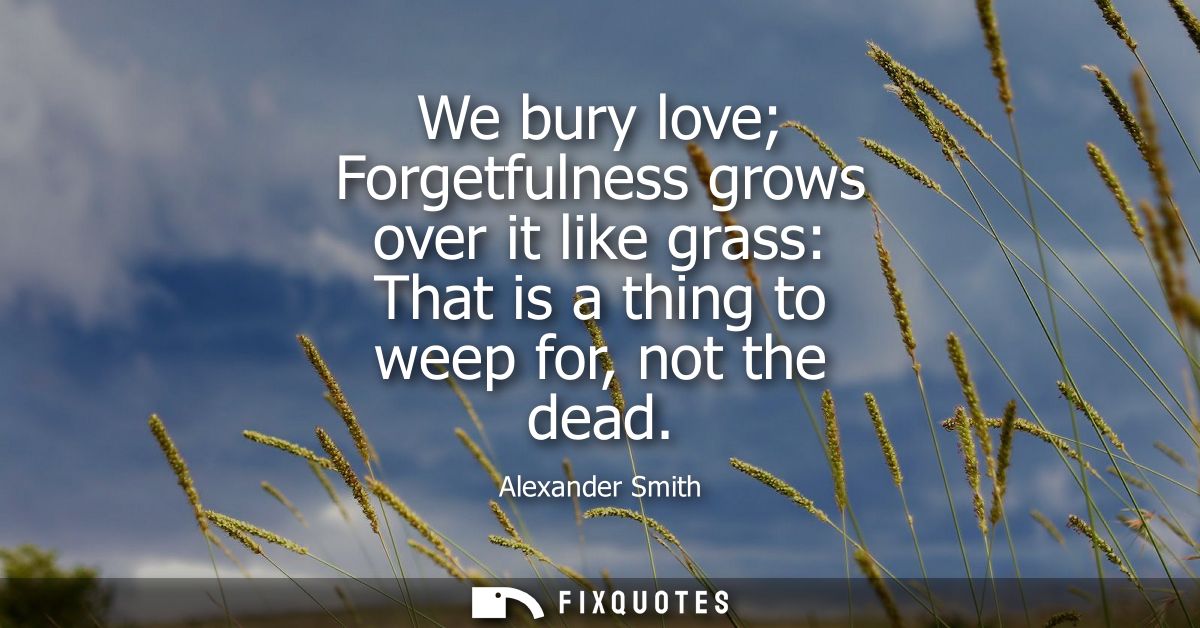
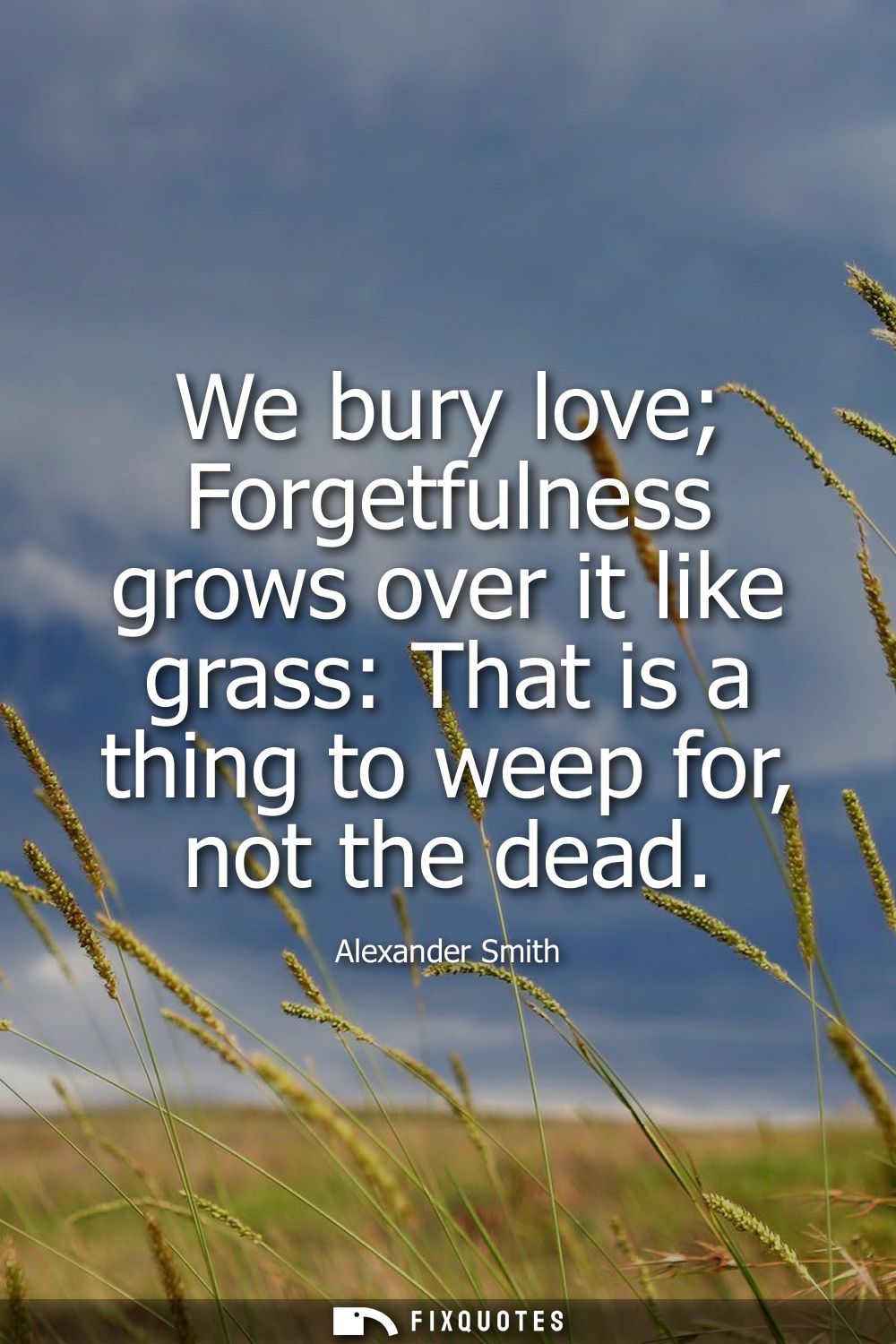
"We bury love; Forgetfulness grows over it like grass: That is a thing to weep for, not the dead"
About this Quote
The image that follows is quietly savage. Forgetfulness doesn’t arrive like a villain; it “grows over it like grass,” natural, ordinary, even pretty. Grass is what makes a grave look tidy. In that small domestic detail, Smith sketches a Victorian moral psychology: the culture prized composure, forward motion, respectable silence. Time, in this poem, isn’t a healer so much as a groundskeeper, smoothing the mess until you can pretend it was never there.
Smith writes in an era saturated with elegy and public mourning rituals, but he’s less interested in cemetery sentiment than in the private betrayals that happen after the funeral. The dead can’t be harmed by our amnesia; the damage is to the self who once loved fiercely, and to the relationships that might have demanded ongoing loyalty.
The last turn, “That is a thing to weep for, not the dead,” works as a moral correction. It redirects tears from fate to failure: the tragedy isn’t that people die, it’s that we survive by letting our deepest attachments become unmarked ground.
Quote Details
| Topic | Heartbreak |
|---|---|
| Source | Help us find the source |
| Cite |
Citation Formats
APA Style (7th ed.)
Smith, Alexander. (2026, January 15). We bury love; Forgetfulness grows over it like grass: That is a thing to weep for, not the dead. FixQuotes. https://fixquotes.com/quotes/we-bury-love-forgetfulness-grows-over-it-like-13063/
Chicago Style
Smith, Alexander. "We bury love; Forgetfulness grows over it like grass: That is a thing to weep for, not the dead." FixQuotes. January 15, 2026. https://fixquotes.com/quotes/we-bury-love-forgetfulness-grows-over-it-like-13063/.
MLA Style (9th ed.)
"We bury love; Forgetfulness grows over it like grass: That is a thing to weep for, not the dead." FixQuotes, 15 Jan. 2026, https://fixquotes.com/quotes/we-bury-love-forgetfulness-grows-over-it-like-13063/. Accessed 27 Mar. 2026.