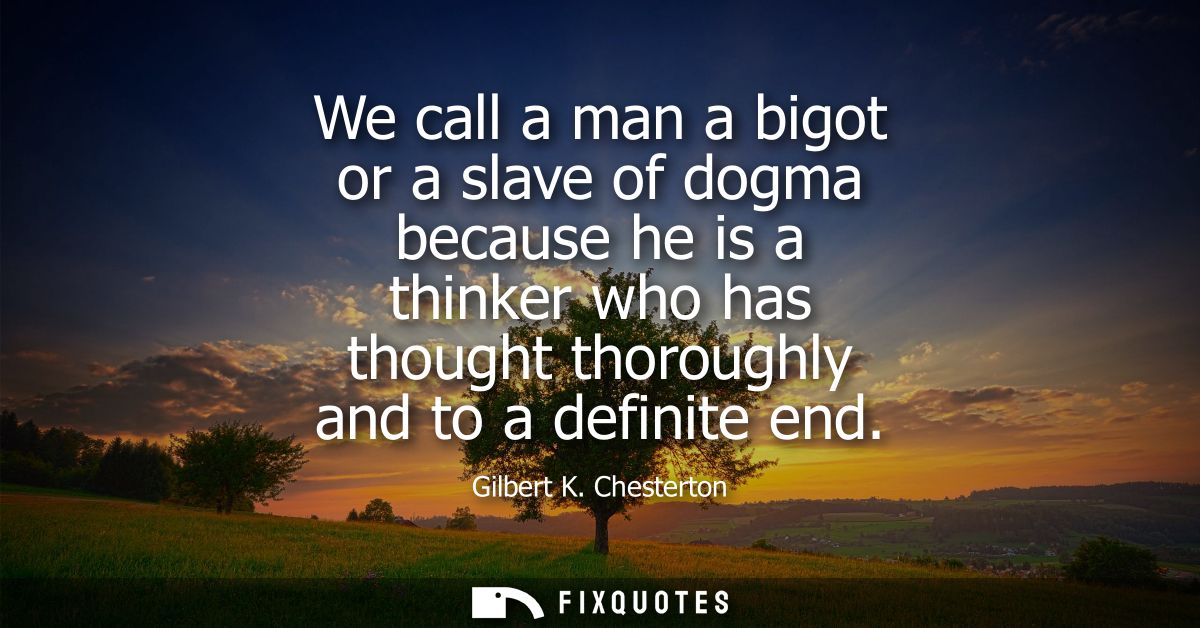
"We call a man a bigot or a slave of dogma because he is a thinker who has thought thoroughly and to a definite end"
About this Quote
The subtext is a critique of a certain liberal temperament (then as now) that confuses uncertainty with sophistication. To arrive at “a definite end” is to violate the social contract of perpetual provisionality. In a culture that treats beliefs as accessories, commitment reads as aggression. Chesterton’s Catholic apologetics hover behind the line: he’s defending orthodoxy not as a dead weight but as an endpoint reached by argument, imagination, and moral reasoning.
Context matters: early 20th-century Britain was soaking in secular modernity, scientific prestige, and a growing suspicion of creeds. Chesterton’s wit is to concede the charge while redirecting it. If dogma is slavery, he implies, then the freest minds are those who never decide anything at all. The irony lands because it exposes a status game: “tolerance” can become a way to delegitimize rivals without engaging their conclusions.
Quote Details
| Topic | Reason & Logic |
|---|---|
| Source | Help us find the source |
| Cite |
Citation Formats
APA Style (7th ed.)
Chesterton, Gilbert K. (2026, January 15). We call a man a bigot or a slave of dogma because he is a thinker who has thought thoroughly and to a definite end. FixQuotes. https://fixquotes.com/quotes/we-call-a-man-a-bigot-or-a-slave-of-dogma-because-7420/
Chicago Style
Chesterton, Gilbert K. "We call a man a bigot or a slave of dogma because he is a thinker who has thought thoroughly and to a definite end." FixQuotes. January 15, 2026. https://fixquotes.com/quotes/we-call-a-man-a-bigot-or-a-slave-of-dogma-because-7420/.
MLA Style (9th ed.)
"We call a man a bigot or a slave of dogma because he is a thinker who has thought thoroughly and to a definite end." FixQuotes, 15 Jan. 2026, https://fixquotes.com/quotes/we-call-a-man-a-bigot-or-a-slave-of-dogma-because-7420/. Accessed 30 Mar. 2026.