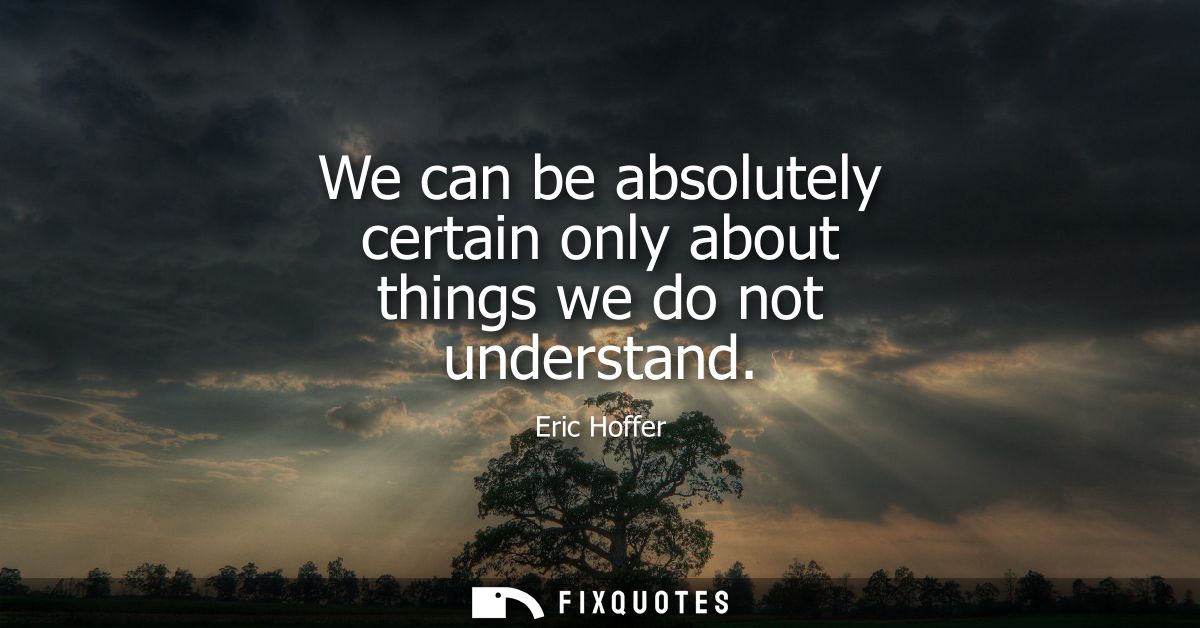
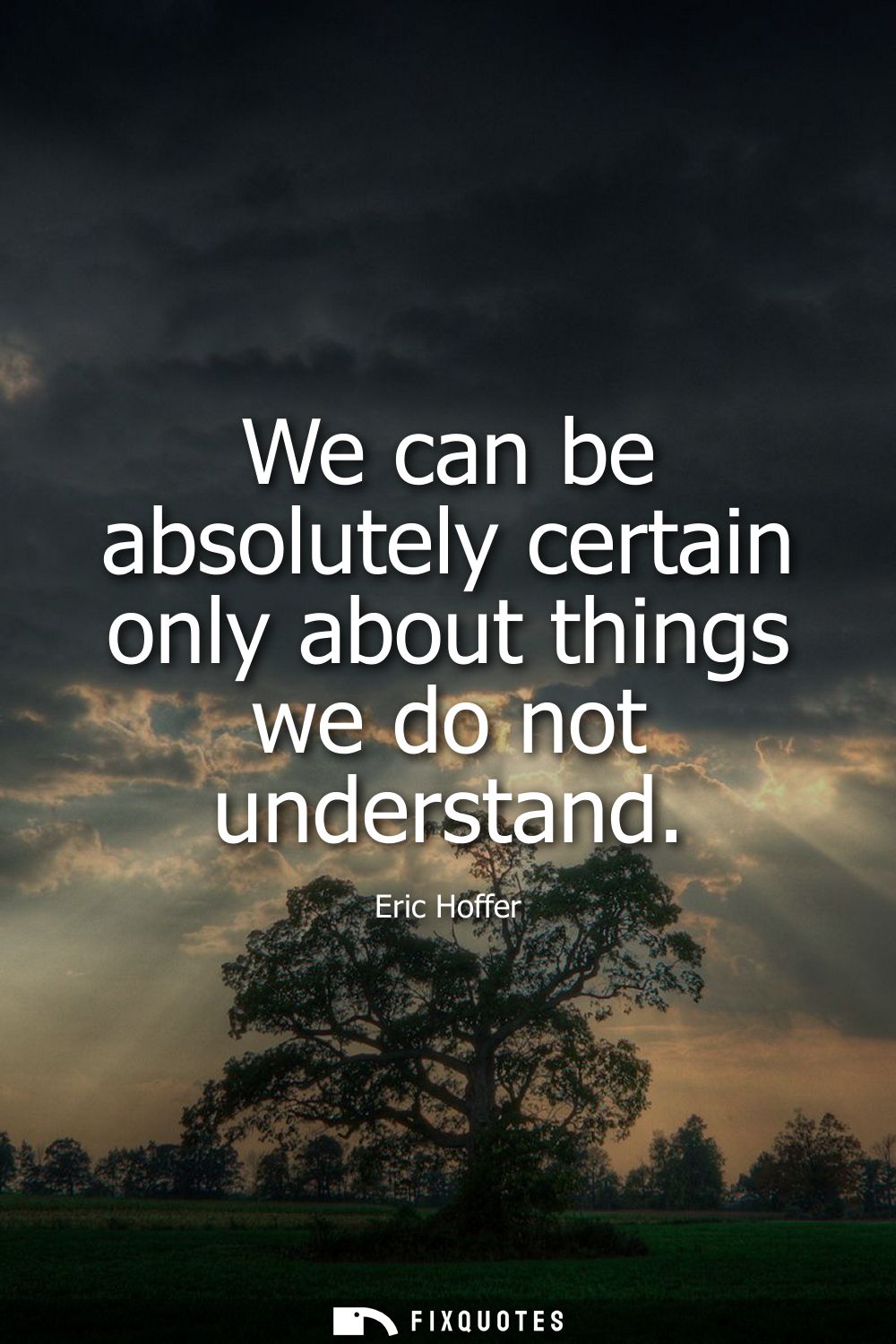
"We can be absolutely certain only about things we do not understand"
About this Quote
Certainty, in Hoffer's hands, is less a badge of rigor than a tell: the loud confidence of someone insulated from complexity. The line flips a cultural instinct - that certainty signals mastery - into a diagnosis of intellectual laziness. It works because it feels like an accusation aimed at everyone else and, if you let it land, at you.
Hoffer is circling a psychological trick: the more you actually understand a thing, the more you see its moving parts, its tradeoffs, its edge cases, its room for surprise. Understanding expands the perimeter of what you know you don't know. Certainty, by contrast, thrives on distance. When the subject is abstracted into slogans, when other people's motives are flattened into caricature, when history becomes a morality play, it's easy to be "absolutely certain". The absolutism isn't proof; it's the cover story.
The subtext is political as much as personal. Hoffer wrote in the midcentury shadow of mass movements and ideological crusades, when certainty wasn't just an annoying personality trait; it was a recruitment tool. Totalizing beliefs promise clarity, identity, and purpose, especially to people who feel dislocated. Hoffer is warning that the emotional comfort of a closed worldview can masquerade as knowledge, and that the most dangerous convictions often come with the least understanding of the human beings they bulldoze.
There's also a sly self-protective move here: he isn't praising doubt as a performance of sophistication. He's arguing for humility as a civic virtue. In a culture that rewards hot takes, Hoffer's line is a reminder that certainty is cheap - comprehension is the hard purchase.
Hoffer is circling a psychological trick: the more you actually understand a thing, the more you see its moving parts, its tradeoffs, its edge cases, its room for surprise. Understanding expands the perimeter of what you know you don't know. Certainty, by contrast, thrives on distance. When the subject is abstracted into slogans, when other people's motives are flattened into caricature, when history becomes a morality play, it's easy to be "absolutely certain". The absolutism isn't proof; it's the cover story.
The subtext is political as much as personal. Hoffer wrote in the midcentury shadow of mass movements and ideological crusades, when certainty wasn't just an annoying personality trait; it was a recruitment tool. Totalizing beliefs promise clarity, identity, and purpose, especially to people who feel dislocated. Hoffer is warning that the emotional comfort of a closed worldview can masquerade as knowledge, and that the most dangerous convictions often come with the least understanding of the human beings they bulldoze.
There's also a sly self-protective move here: he isn't praising doubt as a performance of sophistication. He's arguing for humility as a civic virtue. In a culture that rewards hot takes, Hoffer's line is a reminder that certainty is cheap - comprehension is the hard purchase.
Quote Details
| Topic | Truth |
|---|
More Quotes by Eric
Add to List