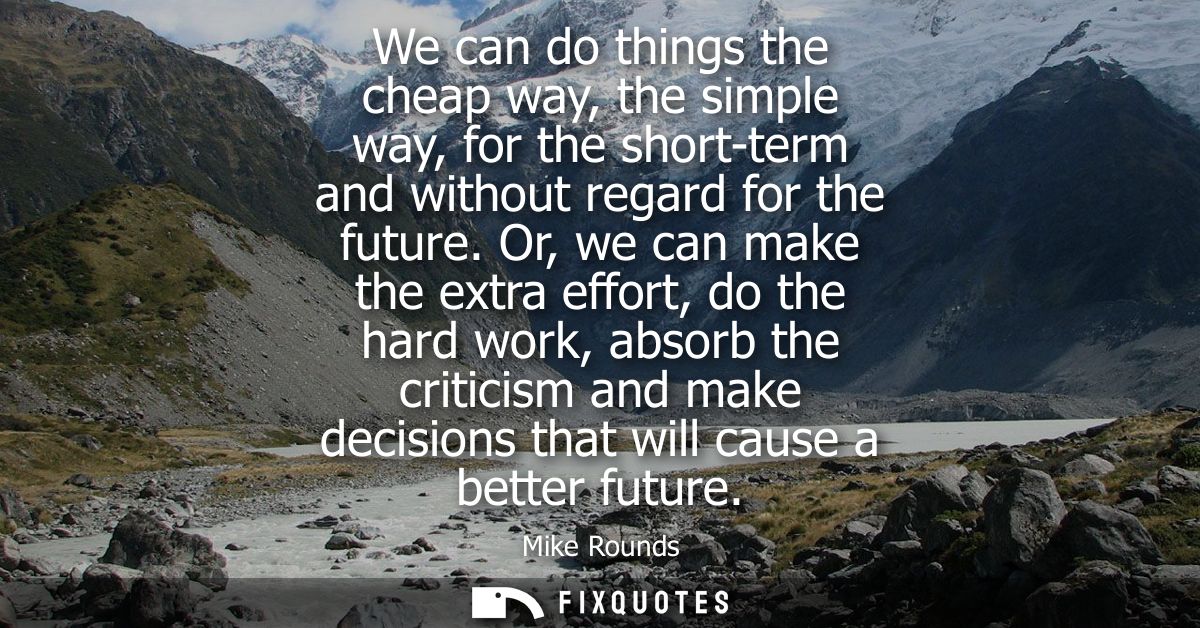
"We can do things the cheap way, the simple way, for the short-term and without regard for the future. Or, we can make the extra effort, do the hard work, absorb the criticism and make decisions that will cause a better future"
About this Quote
The line sells responsibility the way politicians often have to: not as a warm virtue, but as a kind of civic toughness. Rounds sets up a clean fork in the road - cheap/simple/short-term versus extra effort/hard work/future - and the simplicity is the point. It compresses policy complexity into a moral choice, turning budget fights and regulatory tradeoffs into a test of character.
Notice the rhetorical stacking: "cheap", "simple", "short-term", and "without regard" are all terms that imply not just bad outcomes but bad faith. The alternative path is framed as adult discipline: "absorb the criticism" is doing a lot of work, preemptively naming the political cost of long-range decisions while flattering the audience as people mature enough to take heat. It also launders controversy. If a proposal draws backlash, the quote invites you to interpret that backlash as proof the decision was serious, not that it was misguided.
The intent is coalition-building around austerity or reform: pay now, benefit later. In a U.S. political context - where election cycles reward immediacy and punish pain - "better future" becomes a bipartisan talisman that can justify everything from infrastructure spending to entitlement cuts, depending on who’s speaking and what they’re trying to move. The subtext: trust me with unpopular choices, because popularity is the wrong metric. It’s a classic inoculation strategy, positioning opponents as peddlers of the "cheap way" before they even respond.
Notice the rhetorical stacking: "cheap", "simple", "short-term", and "without regard" are all terms that imply not just bad outcomes but bad faith. The alternative path is framed as adult discipline: "absorb the criticism" is doing a lot of work, preemptively naming the political cost of long-range decisions while flattering the audience as people mature enough to take heat. It also launders controversy. If a proposal draws backlash, the quote invites you to interpret that backlash as proof the decision was serious, not that it was misguided.
The intent is coalition-building around austerity or reform: pay now, benefit later. In a U.S. political context - where election cycles reward immediacy and punish pain - "better future" becomes a bipartisan talisman that can justify everything from infrastructure spending to entitlement cuts, depending on who’s speaking and what they’re trying to move. The subtext: trust me with unpopular choices, because popularity is the wrong metric. It’s a classic inoculation strategy, positioning opponents as peddlers of the "cheap way" before they even respond.
Quote Details
| Topic | Work Ethic |
|---|
More Quotes by Mike
Add to List