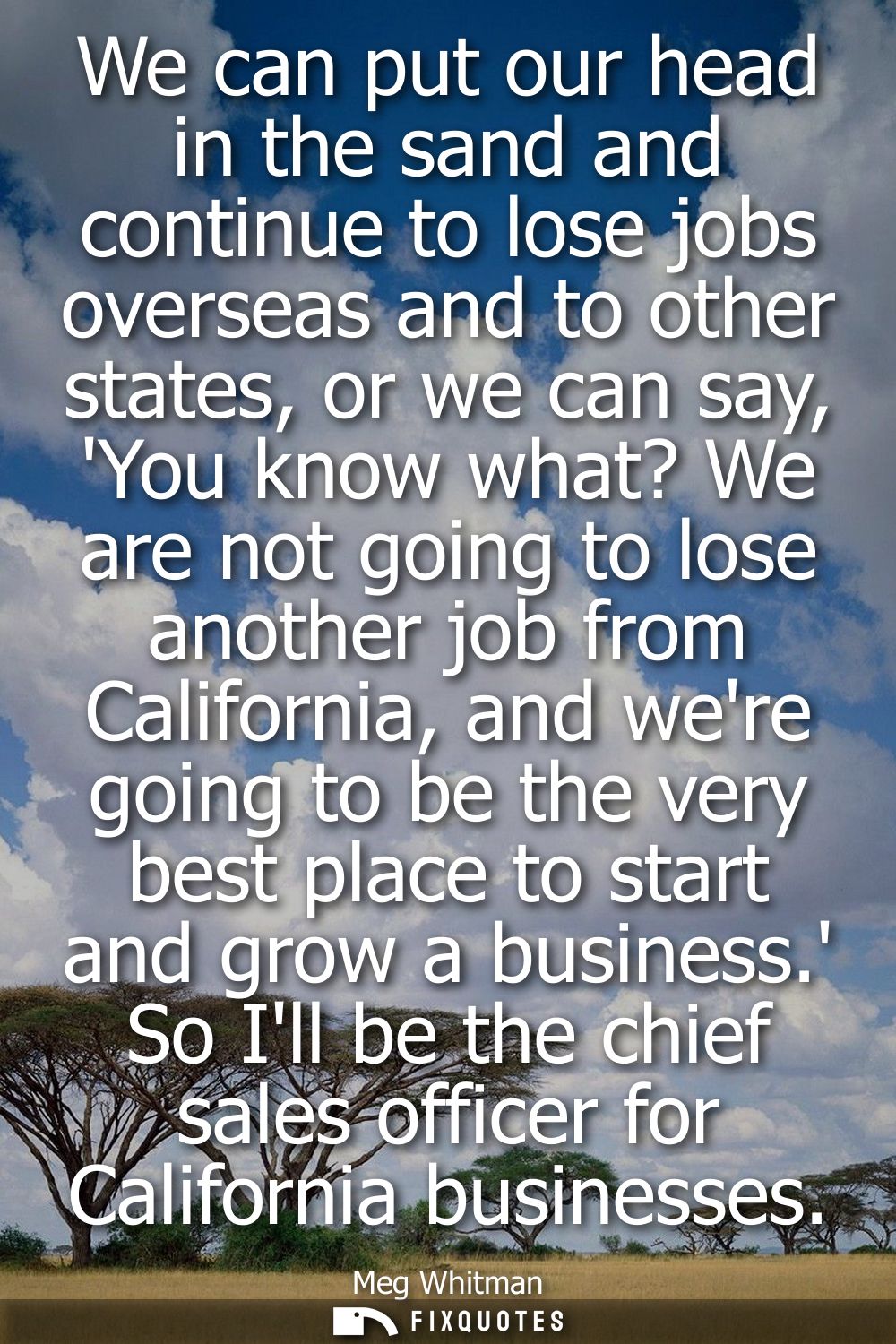
"We can put our head in the sand and continue to lose jobs overseas and to other states, or we can say, 'You know what? We are not going to lose another job from California, and we're going to be the very best place to start and grow a business.' So I'll be the chief sales officer for California businesses"
About this Quote
The subtext is corporate: California is a brand problem. By offering to be “chief sales officer,” Whitman imports executive logic into public governance, positioning the state as a product to be pitched and its businesses as clients to be retained. That metaphor quietly reshapes citizenship into customer relationship management: the job of government becomes competitiveness, the metric becomes capital’s satisfaction, and dissent risks being recoded as bad for “growth.”
Context matters. Whitman rose as a high-profile business leader (eBay) and entered politics in an era when “jobs going overseas” and “businesses fleeing the state” were dominant anxieties, amplified by post-recession insecurity and interstate tax-and-regulation rivalry. The line is built to reassure employers and spook voters: keep losing, or hire the executive. It works because it offers a simple villain (drift, bureaucracy, denial) and a simple protagonist (the salesperson-in-chief), compressing complex economic forces into a story of willpower and management.
Quote Details
| Topic | Business |
|---|---|
| Source | Help us find the source |
| Cite |
Citation Formats
APA Style (7th ed.)
Whitman, Meg. (2026, January 16). We can put our head in the sand and continue to lose jobs overseas and to other states, or we can say, 'You know what? We are not going to lose another job from California, and we're going to be the very best place to start and grow a business.' So I'll be the chief sales officer for California businesses. FixQuotes. https://fixquotes.com/quotes/we-can-put-our-head-in-the-sand-and-continue-to-105241/
Chicago Style
Whitman, Meg. "We can put our head in the sand and continue to lose jobs overseas and to other states, or we can say, 'You know what? We are not going to lose another job from California, and we're going to be the very best place to start and grow a business.' So I'll be the chief sales officer for California businesses." FixQuotes. January 16, 2026. https://fixquotes.com/quotes/we-can-put-our-head-in-the-sand-and-continue-to-105241/.
MLA Style (9th ed.)
"We can put our head in the sand and continue to lose jobs overseas and to other states, or we can say, 'You know what? We are not going to lose another job from California, and we're going to be the very best place to start and grow a business.' So I'll be the chief sales officer for California businesses." FixQuotes, 16 Jan. 2026, https://fixquotes.com/quotes/we-can-put-our-head-in-the-sand-and-continue-to-105241/. Accessed 4 Apr. 2026.