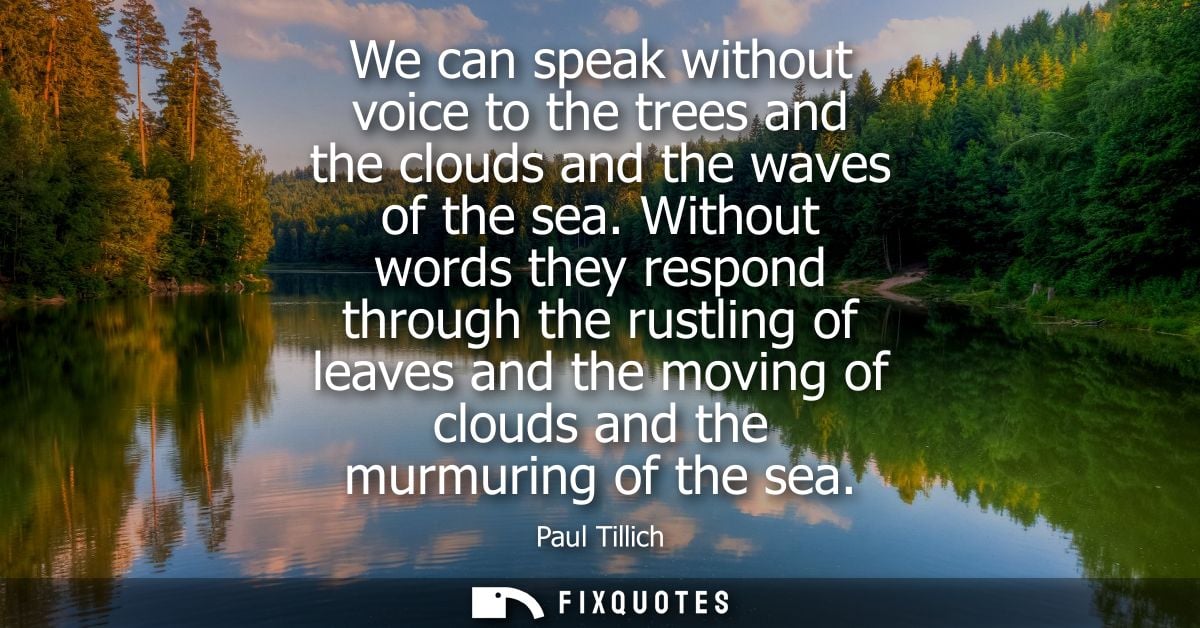
"We can speak without voice to the trees and the clouds and the waves of the sea. Without words they respond through the rustling of leaves and the moving of clouds and the murmuring of the sea"
About this Quote
The intent is quietly polemical. A 20th-century theologian living through the mechanization of life and the collapse of old certainties, Tillich keeps insisting that reality is thicker than our explanations of it. Here, language is treated as both tool and obstacle: words can clarify, but they can also trap experience in concepts, turning the living world into an object. By removing "voice" and "words", he performs his point. He pushes the reader toward a different mode of knowing: receptive, analogical, almost prayer-like.
The subtext is that modern people have become spiritually illiterate, not because they lack beliefs, but because they’ve lost the capacity to perceive resonance. The trees and sea "respond" through their own textures - rustle, drift, murmur - which suggests a cosmos that is not mute but not obliged to be legible on human terms. Tillich’s signature move is to treat these encounters as "signs" without reducing them to slogans: nature isn’t God, but it can disclose the depth of being.
It works because it flatters neither sentimentality nor certainty. The world answers, but only if you stop demanding that it speak your language.
Quote Details
| Topic | Nature |
|---|---|
| Source | Help us find the source |
| Cite |
Citation Formats
APA Style (7th ed.)
Tillich, Paul. (2026, January 18). We can speak without voice to the trees and the clouds and the waves of the sea. Without words they respond through the rustling of leaves and the moving of clouds and the murmuring of the sea. FixQuotes. https://fixquotes.com/quotes/we-can-speak-without-voice-to-the-trees-and-the-11371/
Chicago Style
Tillich, Paul. "We can speak without voice to the trees and the clouds and the waves of the sea. Without words they respond through the rustling of leaves and the moving of clouds and the murmuring of the sea." FixQuotes. January 18, 2026. https://fixquotes.com/quotes/we-can-speak-without-voice-to-the-trees-and-the-11371/.
MLA Style (9th ed.)
"We can speak without voice to the trees and the clouds and the waves of the sea. Without words they respond through the rustling of leaves and the moving of clouds and the murmuring of the sea." FixQuotes, 18 Jan. 2026, https://fixquotes.com/quotes/we-can-speak-without-voice-to-the-trees-and-the-11371/. Accessed 19 Feb. 2026.