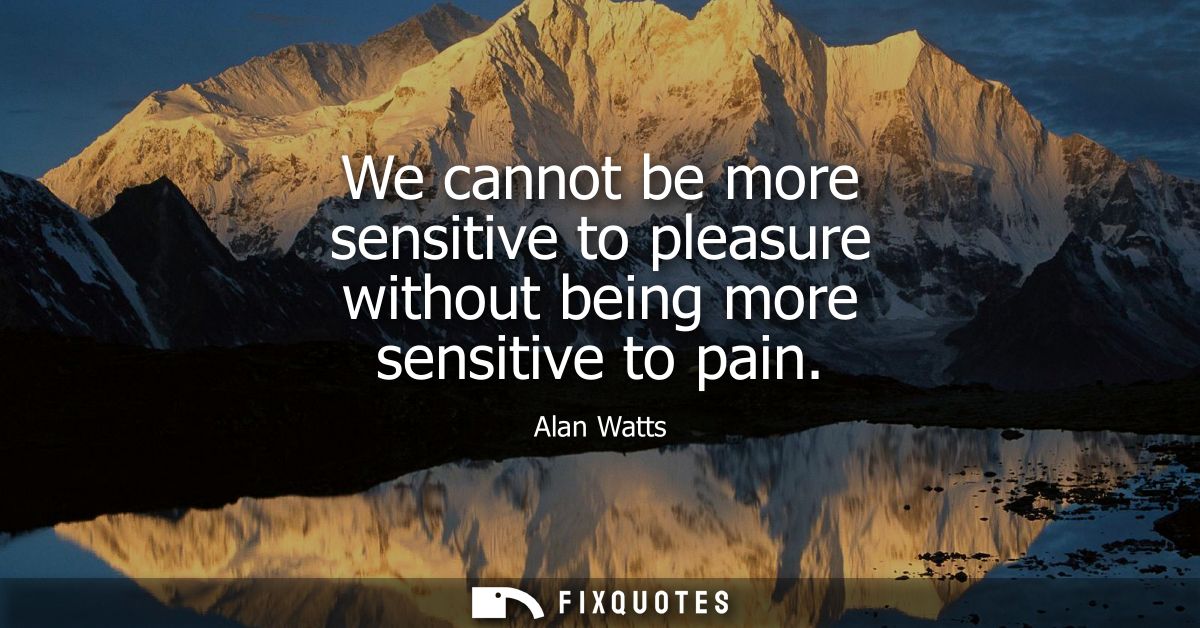
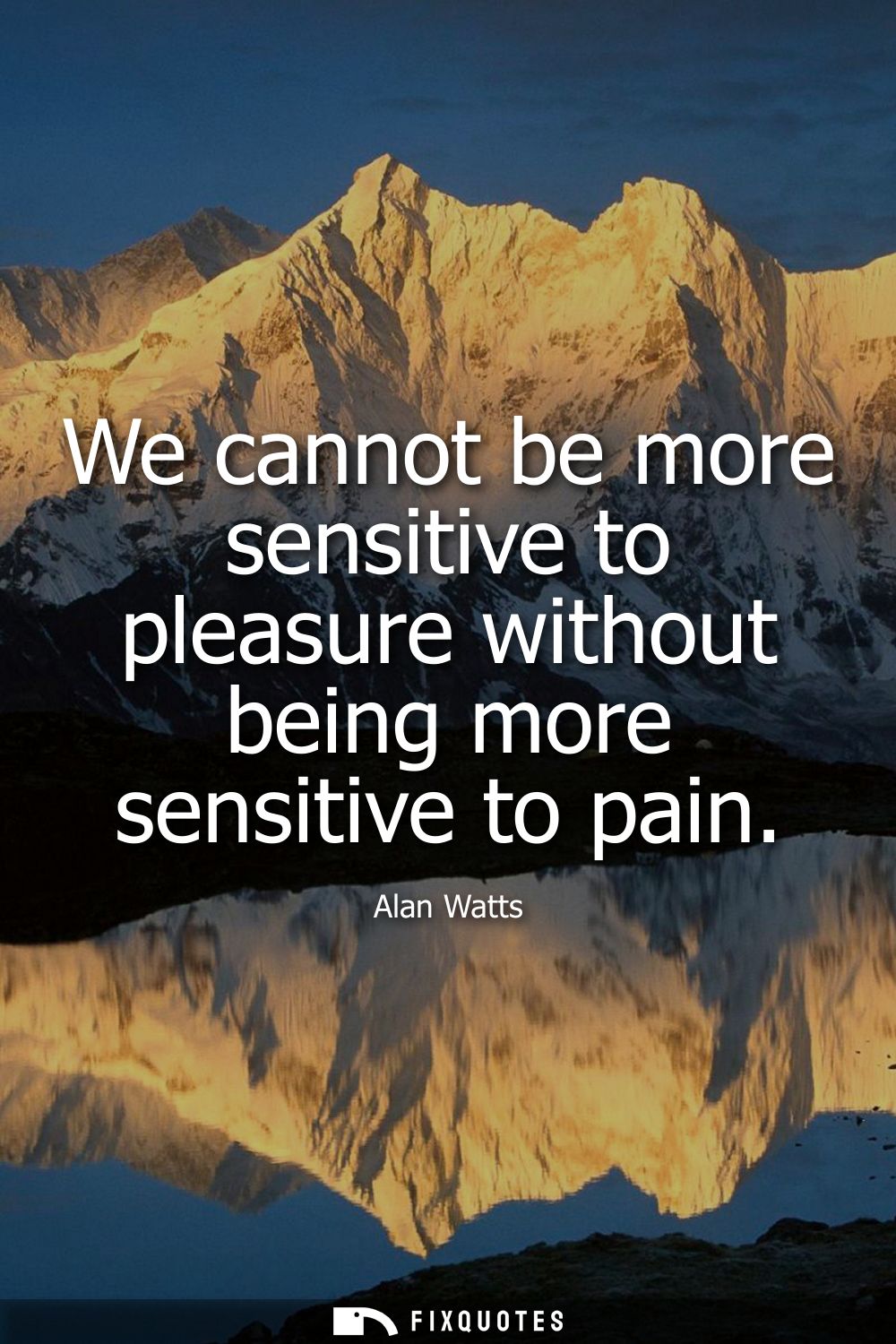
"We cannot be more sensitive to pleasure without being more sensitive to pain"
About this Quote
The subtext is both Buddhist and quietly contrarian. Watts spent his career translating Eastern ideas for Western seekers who often approached spirituality as a self-improvement hack. Here he’s warning against the consumer mindset applied to inner life: pick the premium package (bliss) and decline the unpleasant add-ons. You can’t. The self that clings to pleasure is the same self that recoils from pain; the refusal of one amplifies the fear of the other.
Context matters: mid-century America, prosperity rising, tranquilizers in the medicine cabinet, “positive thinking” as a civic religion. Watts is pushing back on the idea that comfort equals enlightenment. He’s also diagnosing why chasing happiness can feel brittle: when you make pleasure the measure of a life, pain becomes not just inevitable but insulting, a sign of personal failure.
The intent isn’t masochism. It’s a recalibration: maturity means trading numbness for range. The price of a more awake life is that it hurts more sometimes. The payoff is that it’s real.
Quote Details
| Topic | Wisdom |
|---|---|
| Source | Help us find the source |
| Cite |
Citation Formats
APA Style (7th ed.)
Watts, Alan. (2026, January 18). We cannot be more sensitive to pleasure without being more sensitive to pain. FixQuotes. https://fixquotes.com/quotes/we-cannot-be-more-sensitive-to-pleasure-without-22817/
Chicago Style
Watts, Alan. "We cannot be more sensitive to pleasure without being more sensitive to pain." FixQuotes. January 18, 2026. https://fixquotes.com/quotes/we-cannot-be-more-sensitive-to-pleasure-without-22817/.
MLA Style (9th ed.)
"We cannot be more sensitive to pleasure without being more sensitive to pain." FixQuotes, 18 Jan. 2026, https://fixquotes.com/quotes/we-cannot-be-more-sensitive-to-pleasure-without-22817/. Accessed 26 Mar. 2026.