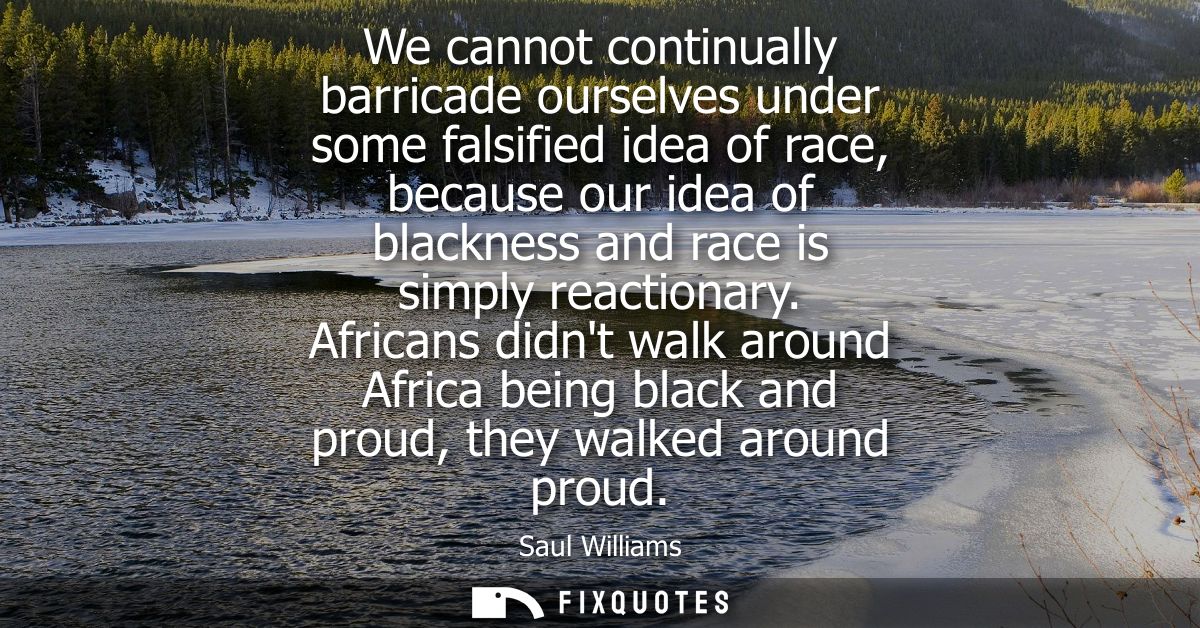
"We cannot continually barricade ourselves under some falsified idea of race, because our idea of blackness and race is simply reactionary. Africans didn't walk around Africa being black and proud, they walked around proud"
About this Quote
The line about Africans not “walking around Africa being black” isn’t a romantic reset to some pure precolonial innocence; it’s a jab at how modern racial consciousness is historically produced. “Black” is a label that gains force in a world where whiteness has already appointed itself the default. Williams points to a deeper, pre-racial grammar of belonging: ethnicity, language, lineage, place, faith, class. Pride existed, but it wasn’t routed through a single flattening color category.
Context matters: Williams comes out of spoken word and hip-hop, traditions that often turn identity into armor and anthem. He respects that necessity while questioning its limits. The subtext is a dare to imagine liberation beyond branding: not “blackness” as a posture performed for recognition (or for survival), but dignity that doesn’t need an oppressor’s vocabulary to name itself. It’s an argument for moving from reactive identity to generative self-definition, without pretending the current battlefield disappears.
Quote Details
| Topic | Equality |
|---|---|
| Source | Help us find the source |
| Cite |
Citation Formats
APA Style (7th ed.)
Williams, Saul. (2026, January 17). We cannot continually barricade ourselves under some falsified idea of race, because our idea of blackness and race is simply reactionary. Africans didn't walk around Africa being black and proud, they walked around proud. FixQuotes. https://fixquotes.com/quotes/we-cannot-continually-barricade-ourselves-under-76778/
Chicago Style
Williams, Saul. "We cannot continually barricade ourselves under some falsified idea of race, because our idea of blackness and race is simply reactionary. Africans didn't walk around Africa being black and proud, they walked around proud." FixQuotes. January 17, 2026. https://fixquotes.com/quotes/we-cannot-continually-barricade-ourselves-under-76778/.
MLA Style (9th ed.)
"We cannot continually barricade ourselves under some falsified idea of race, because our idea of blackness and race is simply reactionary. Africans didn't walk around Africa being black and proud, they walked around proud." FixQuotes, 17 Jan. 2026, https://fixquotes.com/quotes/we-cannot-continually-barricade-ourselves-under-76778/. Accessed 27 Mar. 2026.