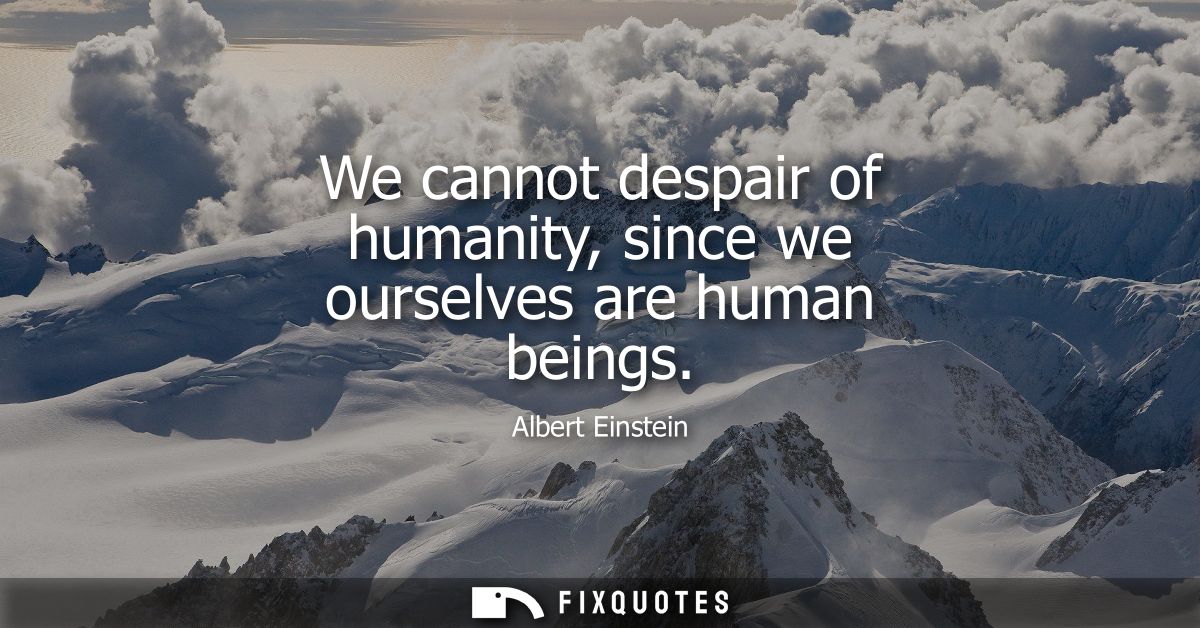
"We cannot despair of humanity, since we ourselves are human beings"
About this Quote
Einstein’s line is optimism with a physicist’s stubborn respect for evidence: the data point he refuses to ignore is us. It’s not a sentimental appeal to “believe in people,” but a logical booby trap for cynicism. If you claim humanity is beyond redemption while you remain part of humanity, you’re either exempting yourself (a quiet form of arrogance) or condemning yourself too (a kind of nihilistic self-harm). The sentence corners despair and makes it confess what it usually hides: a desire to stand outside the mess and judge it from a clean balcony.
The subtext is ethical accountability disguised as reassurance. “We cannot” isn’t just a prediction; it’s a constraint, almost a moral law. Despair becomes a luxury of the detached, and Einstein is denying detachment itself. To be human is to be implicated, which means the future can’t be written off without also writing off your own capacity to act. Hope, here, isn’t a mood; it’s a duty that follows from belonging.
Context matters. Einstein lived through mechanized slaughter, the rise of fascism, exile, and the nuclear age his own work helped make possible. He knew exactly how low “humanity” could sink, and he also watched how quickly the language of inevitability can excuse brutality. This is a compact rebuttal to fatalism: if humans made the catastrophe, humans can make the repair. Despair flatters itself as realism. Einstein frames it as a logical contradiction - and a moral escape hatch we don’t get to use.
The subtext is ethical accountability disguised as reassurance. “We cannot” isn’t just a prediction; it’s a constraint, almost a moral law. Despair becomes a luxury of the detached, and Einstein is denying detachment itself. To be human is to be implicated, which means the future can’t be written off without also writing off your own capacity to act. Hope, here, isn’t a mood; it’s a duty that follows from belonging.
Context matters. Einstein lived through mechanized slaughter, the rise of fascism, exile, and the nuclear age his own work helped make possible. He knew exactly how low “humanity” could sink, and he also watched how quickly the language of inevitability can excuse brutality. This is a compact rebuttal to fatalism: if humans made the catastrophe, humans can make the repair. Despair flatters itself as realism. Einstein frames it as a logical contradiction - and a moral escape hatch we don’t get to use.
Quote Details
| Topic | Optimism |
|---|---|
| Source | Later attribution: Christ Is Our God (Yinka Bamgbelu, 2015) modern compilationISBN: 9781631354625 · ID: rTQQCgAAQBAJ
Evidence:
... Albert Einstein " We cannot despair of humanity , since we ourselves are human beings . " -Albert Einstein " Morality is of the highest importance - but for us , not for God . " -Albert Einstein " All religions , arts and sciences are ... |
| Cite |
Citation Formats
APA Style (7th ed.)
Einstein, Albert. (2026, March 25). We cannot despair of humanity, since we ourselves are human beings. FixQuotes. https://fixquotes.com/quotes/we-cannot-despair-of-humanity-since-we-ourselves-25346/
Chicago Style
Einstein, Albert. "We cannot despair of humanity, since we ourselves are human beings." FixQuotes. March 25, 2026. https://fixquotes.com/quotes/we-cannot-despair-of-humanity-since-we-ourselves-25346/.
MLA Style (9th ed.)
"We cannot despair of humanity, since we ourselves are human beings." FixQuotes, 25 Mar. 2026, https://fixquotes.com/quotes/we-cannot-despair-of-humanity-since-we-ourselves-25346/. Accessed 27 Mar. 2026.
More Quotes by Albert
Add to List