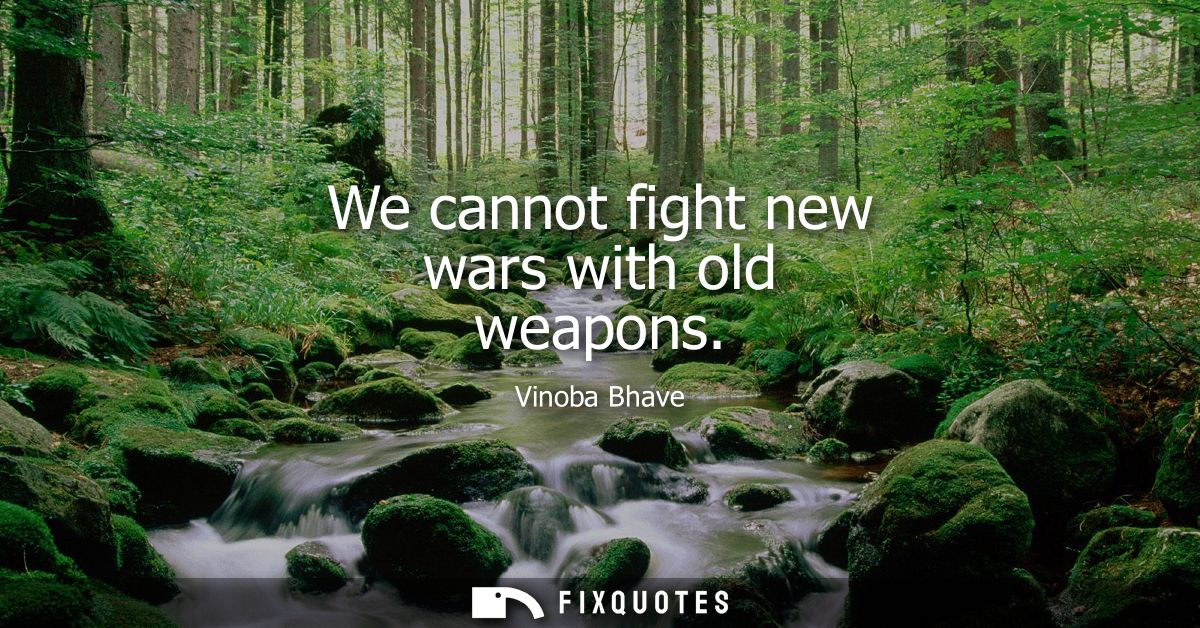
"We cannot fight new wars with old weapons"
About this Quote
Vinoba Bhave’s line lands with the calm force of a teacher who’s watched people mistake habit for strategy. “We cannot fight new wars with old weapons” isn’t just a call for upgraded tools; it’s a warning about the reflex to recycle inherited methods when the world has already changed shape. Bhave frames conflict as evolutionary: new conditions create new forms of struggle, and clinging to yesterday’s arsenal becomes a kind of self-sabotage.
The subtext is less militaristic than it sounds. For Bhave, “weapons” are also moral frameworks, political tactics, and social institutions. Coming from a Gandhian reformer associated with the Bhoodan (land-gift) movement, he’s implicitly arguing that coercion, rigid ideology, and colonial-era power structures can’t solve post-independence India’s emerging crises: inequality, land concentration, communal tension, and the modernization pressures reshaping village life. The “new wars” are structural and psychological as much as physical.
Why it works rhetorically is its strategic vagueness. By refusing to name the war or the weapons, Bhave makes the sentence portable. It can apply to nonviolent organizing just as easily as it applies to nation-states rearming. It also smuggles in an ethical challenge: if your methods are “old,” they may be not only ineffective but morally exhausted. The line is an educator’s provocation dressed as common sense, pushing listeners to update their imaginations before they update their arsenals.
The subtext is less militaristic than it sounds. For Bhave, “weapons” are also moral frameworks, political tactics, and social institutions. Coming from a Gandhian reformer associated with the Bhoodan (land-gift) movement, he’s implicitly arguing that coercion, rigid ideology, and colonial-era power structures can’t solve post-independence India’s emerging crises: inequality, land concentration, communal tension, and the modernization pressures reshaping village life. The “new wars” are structural and psychological as much as physical.
Why it works rhetorically is its strategic vagueness. By refusing to name the war or the weapons, Bhave makes the sentence portable. It can apply to nonviolent organizing just as easily as it applies to nation-states rearming. It also smuggles in an ethical challenge: if your methods are “old,” they may be not only ineffective but morally exhausted. The line is an educator’s provocation dressed as common sense, pushing listeners to update their imaginations before they update their arsenals.
Quote Details
| Topic | Embrace Change |
|---|---|
| Source | Later attribution: Why Service Matters (Raul Pupo, 2019) modern compilationISBN: 9780359741755 · ID: FsuhDwAAQBAJ
Evidence:
... have access to information systems that mine key customer interactions and transactions. 9. Sound: The voice of the ... Vinoba Bhave that, “we cannot fight new wars with old weapons.” THE NFL MELTDOWN: A CASE STUDY IN CUSTOMER ... |
| Cite |
Citation Formats
APA Style (7th ed.)
Bhave, Vinoba. (2026, March 14). We cannot fight new wars with old weapons. FixQuotes. https://fixquotes.com/quotes/we-cannot-fight-new-wars-with-old-weapons-129672/
Chicago Style
Bhave, Vinoba. "We cannot fight new wars with old weapons." FixQuotes. March 14, 2026. https://fixquotes.com/quotes/we-cannot-fight-new-wars-with-old-weapons-129672/.
MLA Style (9th ed.)
"We cannot fight new wars with old weapons." FixQuotes, 14 Mar. 2026, https://fixquotes.com/quotes/we-cannot-fight-new-wars-with-old-weapons-129672/. Accessed 24 Mar. 2026.
More Quotes by Vinoba
Add to List