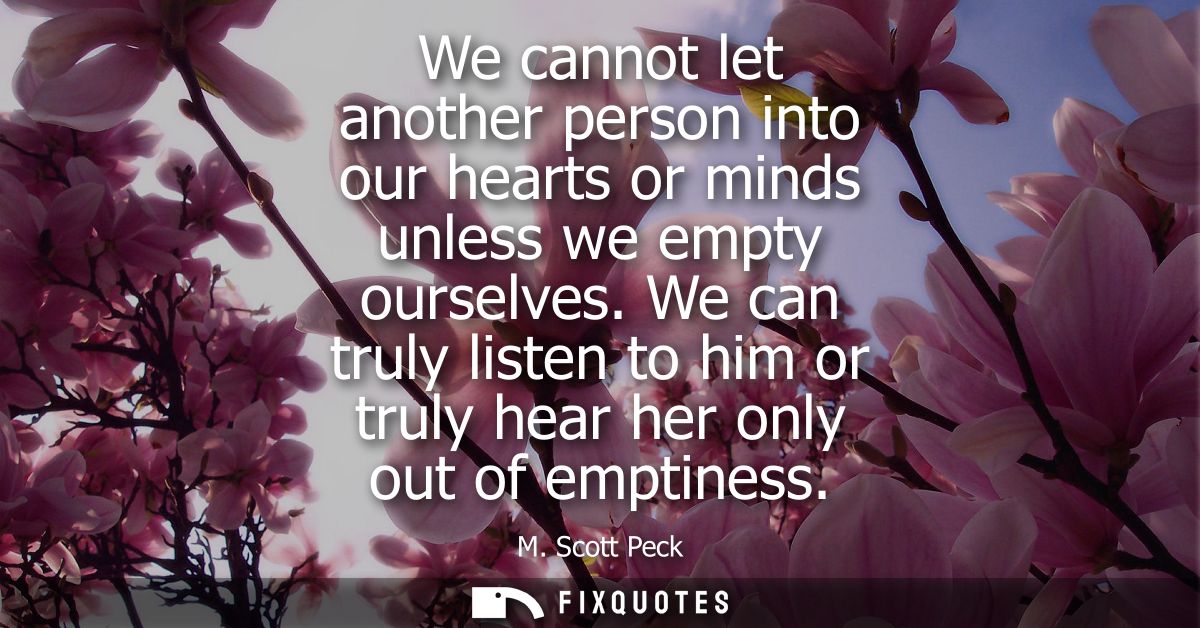
"We cannot let another person into our hearts or minds unless we empty ourselves. We can truly listen to him or truly hear her only out of emptiness"
About this Quote
The phrasing does double work. “Let another person into our hearts or minds” frames intimacy as permission, not entitlement; it’s something offered, not extracted. Then Peck tightens the moral screw: you don’t get to claim you’re “open” if you’re still stuffed with your own agenda. The subtext is confrontational because it exposes a common counterfeit of care: listening that’s actually self-expression in disguise, where the other person becomes raw material for your advice, your diagnosis, your story about being the kind of person who listens.
Context matters. Peck wrote as a clinician-pop philosopher in an era when self-actualization language was booming. Against a culture increasingly organized around the sovereign self, he argues that genuine connection is a kind of self-emptying that feels risky precisely because it interrupts control. “Only out of emptiness” is his way of naming the cost: to truly hear someone, you have to relinquish the small comforts of being right, being interesting, being safe. The point isn’t erasure; it’s a deliberate clearing, long enough for someone else to arrive.
Quote Details
| Topic | Love |
|---|---|
| Source | Help us find the source |
| Cite |
Citation Formats
APA Style (7th ed.)
Peck, M. Scott. (2026, January 16). We cannot let another person into our hearts or minds unless we empty ourselves. We can truly listen to him or truly hear her only out of emptiness. FixQuotes. https://fixquotes.com/quotes/we-cannot-let-another-person-into-our-hearts-or-114263/
Chicago Style
Peck, M. Scott. "We cannot let another person into our hearts or minds unless we empty ourselves. We can truly listen to him or truly hear her only out of emptiness." FixQuotes. January 16, 2026. https://fixquotes.com/quotes/we-cannot-let-another-person-into-our-hearts-or-114263/.
MLA Style (9th ed.)
"We cannot let another person into our hearts or minds unless we empty ourselves. We can truly listen to him or truly hear her only out of emptiness." FixQuotes, 16 Jan. 2026, https://fixquotes.com/quotes/we-cannot-let-another-person-into-our-hearts-or-114263/. Accessed 3 Apr. 2026.