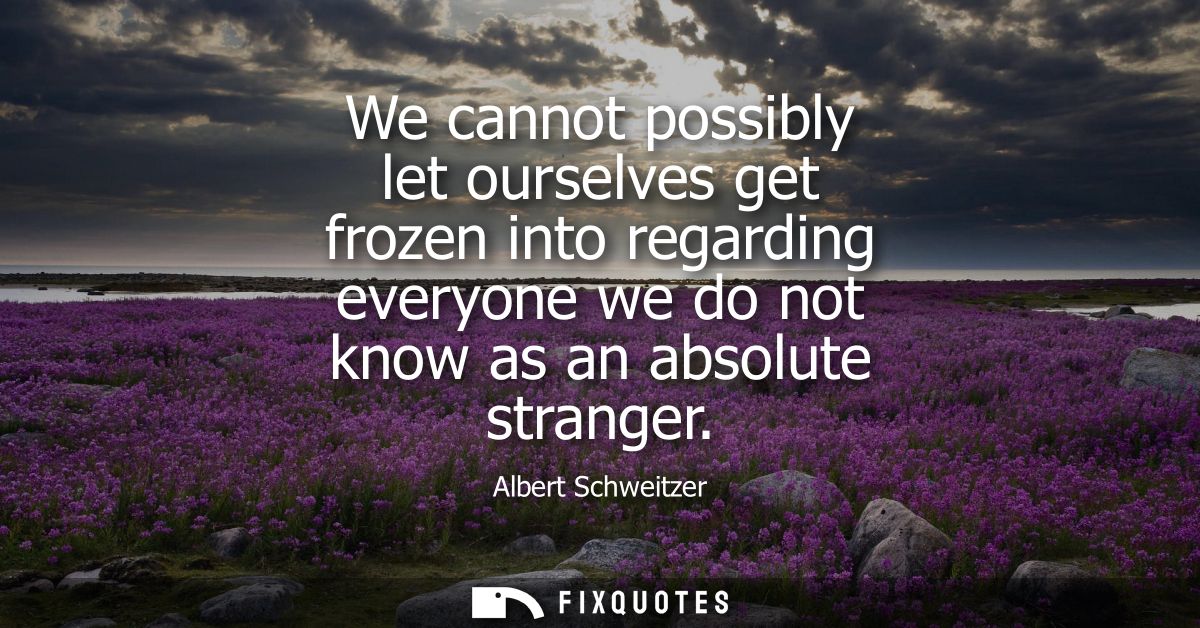
"We cannot possibly let ourselves get frozen into regarding everyone we do not know as an absolute stranger"
About this Quote
As a theologian, Schweitzer is speaking from within a tradition that insists ethics begins before intimacy. You don’t earn someone’s consideration by becoming legible or familiar; their human presence already makes a claim on you. That logic anticipates his famous ethic of "reverence for life", where moral seriousness means expanding the radius of concern beyond the comfortable circle of kin, tribe, or congregation.
The subtext is also cultural. Early 20th-century Europe was industrializing social distance: cities full of people trained to look past each other, bureaucracies that made suffering someone else’s file, colonial systems that depended on converting whole populations into abstractions. Schweitzer treats "absolute stranger" as a dangerous fiction that allows polite withdrawal. He’s not asking for instant intimacy with everyone; he’s warning that when we normalize non-recognition, we end up spiritually and politically numb - competent at ignoring need because we’ve practiced it daily.
Quote Details
| Topic | Kindness |
|---|---|
| Source | Help us find the source |
| Cite |
Citation Formats
APA Style (7th ed.)
Schweitzer, Albert. (2026, January 18). We cannot possibly let ourselves get frozen into regarding everyone we do not know as an absolute stranger. FixQuotes. https://fixquotes.com/quotes/we-cannot-possibly-let-ourselves-get-frozen-into-22956/
Chicago Style
Schweitzer, Albert. "We cannot possibly let ourselves get frozen into regarding everyone we do not know as an absolute stranger." FixQuotes. January 18, 2026. https://fixquotes.com/quotes/we-cannot-possibly-let-ourselves-get-frozen-into-22956/.
MLA Style (9th ed.)
"We cannot possibly let ourselves get frozen into regarding everyone we do not know as an absolute stranger." FixQuotes, 18 Jan. 2026, https://fixquotes.com/quotes/we-cannot-possibly-let-ourselves-get-frozen-into-22956/. Accessed 28 Mar. 2026.