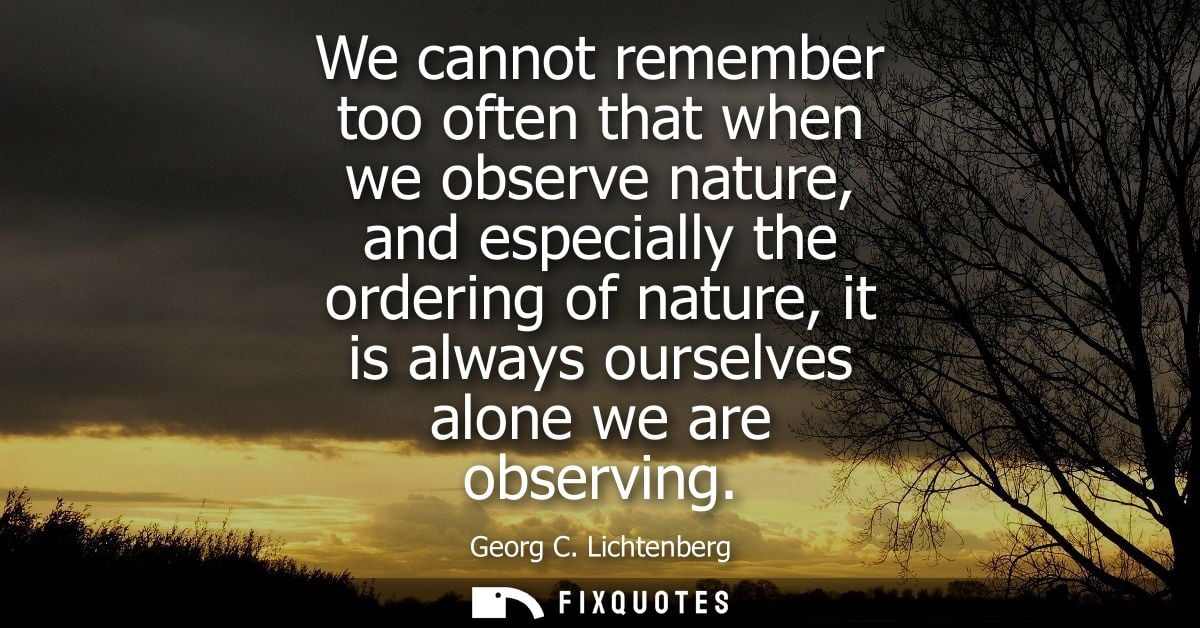
"We cannot remember too often that when we observe nature, and especially the ordering of nature, it is always ourselves alone we are observing"
About this Quote
The line works because it weaponizes modesty. It doesn’t deny that nature has structure; it questions our confidence that the structure we celebrate is nature’s rather than our own mental furniture. The subtext is epistemological, but it lands like social critique: you don’t just see what’s out there, you see what your instruments, categories, language, and expectations allow you to see. That “ourselves alone” is deliberately isolating, almost bleak. Observation becomes self-portraiture, and scientific certainty starts to look like autobiography with equations.
Context matters: late-18th-century Europe was drunk on classification, measurement, and the promise that reason could tidy the world. Lichtenberg, working amid experiments and empirical pride, offers an internal check against the era’s triumphalism. It anticipates modern anxieties about bias in data, model-dependent “truth,” and the way theories can harden into worldview. His intent isn’t to sink science into relativism; it’s to keep it honest - by admitting that the observer is never outside the frame.
Quote Details
| Topic | Truth |
|---|---|
| Source | Help us find the source |
| Cite |
Citation Formats
APA Style (7th ed.)
Lichtenberg, Georg C. (2026, January 15). We cannot remember too often that when we observe nature, and especially the ordering of nature, it is always ourselves alone we are observing. FixQuotes. https://fixquotes.com/quotes/we-cannot-remember-too-often-that-when-we-observe-13336/
Chicago Style
Lichtenberg, Georg C. "We cannot remember too often that when we observe nature, and especially the ordering of nature, it is always ourselves alone we are observing." FixQuotes. January 15, 2026. https://fixquotes.com/quotes/we-cannot-remember-too-often-that-when-we-observe-13336/.
MLA Style (9th ed.)
"We cannot remember too often that when we observe nature, and especially the ordering of nature, it is always ourselves alone we are observing." FixQuotes, 15 Jan. 2026, https://fixquotes.com/quotes/we-cannot-remember-too-often-that-when-we-observe-13336/. Accessed 5 Mar. 2026.