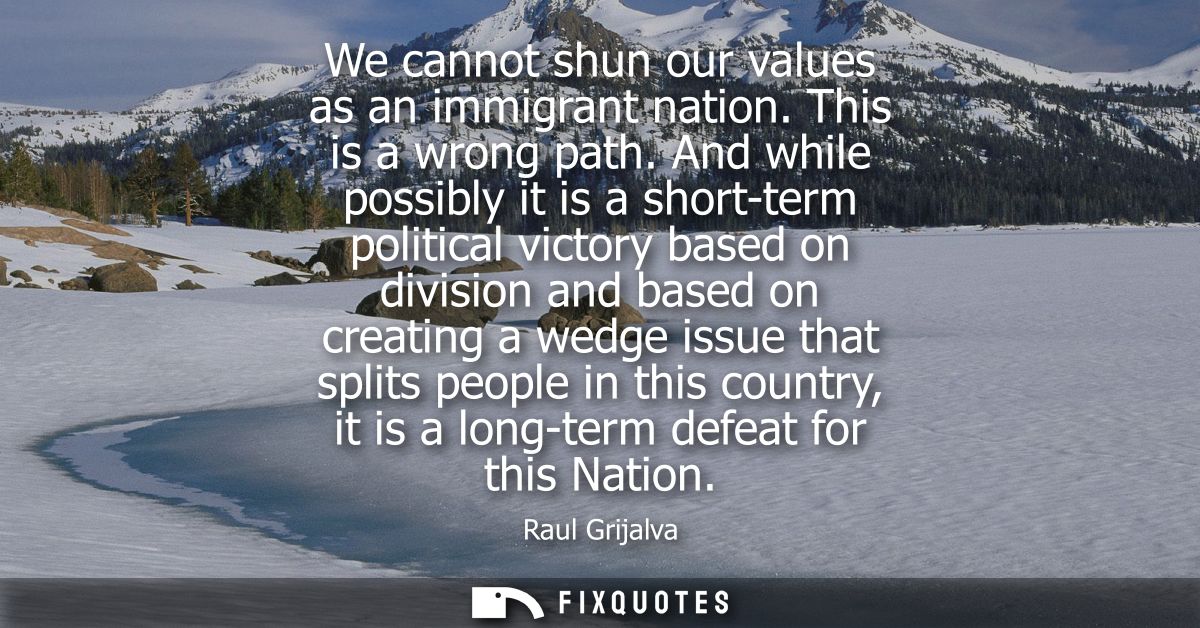
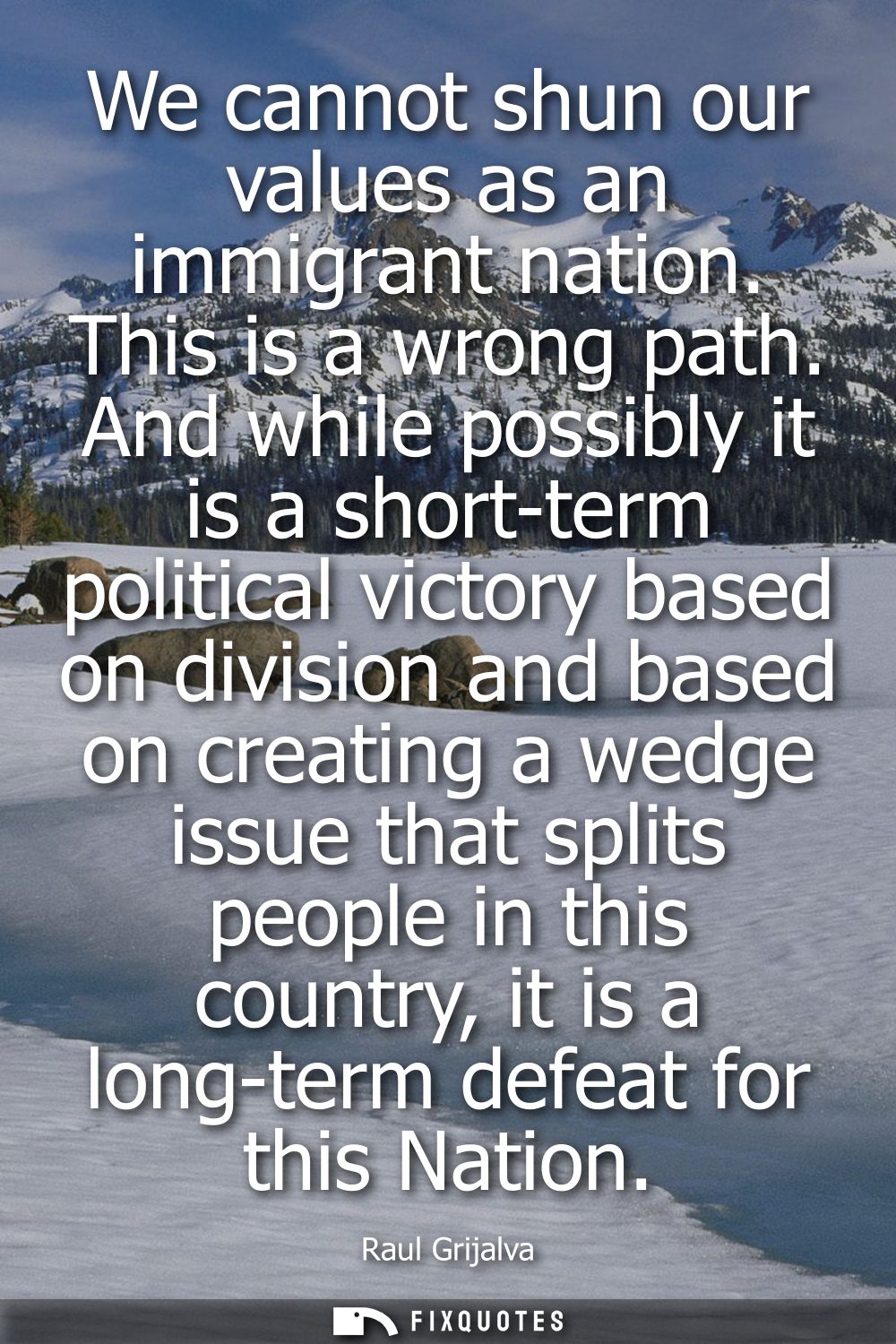
"We cannot shun our values as an immigrant nation. This is a wrong path. And while possibly it is a short-term political victory based on division and based on creating a wedge issue that splits people in this country, it is a long-term defeat for this Nation"
About this Quote
The line “This is a wrong path” is deliberately plain, almost blunt to the point of impatience. That simplicity is strategic: it suggests the issue shouldn’t require technocratic parsing. He’s signaling that what’s happening is not a complicated tradeoff but a clear moral deviation, a move that will look indefensible with hindsight.
Then comes the political diagnosis: “short-term political victory” built on “division” and a “wedge issue.” That’s insider language, aimed as much at journalists and moderates as at opponents. The subtext is accusatory but measured: the other side isn’t sincerely solving a problem; it’s manufacturing one to harvest fear and loyalty. By labeling it a wedge, he also normalizes disagreement while condemning the tactic of turning human mobility into an identity weapon.
“Long-term defeat” shifts the stakes from elections to legacy. He’s warning that even if hardline policies win headlines and votes, they corrode social cohesion and undercut America’s claim to be a pluralist democracy. It’s an argument designed for the middle: you don’t have to be idealistic to see that governing by scapegoat eventually breaks the governed.
Quote Details
| Topic | Human Rights |
|---|---|
| Source | Help us find the source |
| Cite |
Citation Formats
APA Style (7th ed.)
Grijalva, Raul. (2026, January 15). We cannot shun our values as an immigrant nation. This is a wrong path. And while possibly it is a short-term political victory based on division and based on creating a wedge issue that splits people in this country, it is a long-term defeat for this Nation. FixQuotes. https://fixquotes.com/quotes/we-cannot-shun-our-values-as-an-immigrant-nation-163739/
Chicago Style
Grijalva, Raul. "We cannot shun our values as an immigrant nation. This is a wrong path. And while possibly it is a short-term political victory based on division and based on creating a wedge issue that splits people in this country, it is a long-term defeat for this Nation." FixQuotes. January 15, 2026. https://fixquotes.com/quotes/we-cannot-shun-our-values-as-an-immigrant-nation-163739/.
MLA Style (9th ed.)
"We cannot shun our values as an immigrant nation. This is a wrong path. And while possibly it is a short-term political victory based on division and based on creating a wedge issue that splits people in this country, it is a long-term defeat for this Nation." FixQuotes, 15 Jan. 2026, https://fixquotes.com/quotes/we-cannot-shun-our-values-as-an-immigrant-nation-163739/. Accessed 11 Feb. 2026.